Synchronizing Power
Steinmetz Usage
Section titled “Steinmetz Usage”In the Commonwealth Edison report, synchronizing power is the restoring exchange that tends to hold alternators or station sections in step, or pull them back into step after a disturbance.
The report’s practical warning is severe: a short circuit may clear, but if station sections have drifted out of synchronism, voltage may remain depressed and the system may not return to normal operation. Synchronizing power is therefore not a decorative concept. It is what makes an interconnected AC system cohere after shock.
Modern Equivalent
Section titled “Modern Equivalent”Modern electrical engineering would relate this to synchronizing torque, power-angle stability, transient stability, and out-of-step protection. The same idea appears in generator stability studies: a synchronous machine must exchange electrical power with the system in a way that restores rotor angle and speed toward stable operation.
Mathematical Explanation
Section titled “Mathematical Explanation”The appendix treats two equal-voltage alternators or station sections connected with phase or frequency displacement. In modernized candidate form:
The out-of-step voltage difference produces interchange current. That current produces power exchange. Depending on phase angle, impedance, voltage, and machine characteristics, the exchange may restore synchronism or allow continued slipping.
Source Caution
Section titled “Source Caution”The appendix formulas in the PDF text are OCR/PDF-layer damaged. The current equation records are source-located candidates, not reviewed transcriptions. The next step is to render pages 28-45, compare the formulas against the scan, and promote only corrected expressions.
Modern Electrical Engineering Interpretation
The report is an early practical route into transient stability. It links low voltage after a fault, loss of synchronous load, turbine-governor delay, station-section acceleration, and the reduction of synchronizing power through interconnection conditions.
Ether-Field Interpretive Reading
Interpretive only: one can read synchronizing power as field-mediated energy exchange between coupled rotating electrical systems. That is conceptually suggestive, but the historical source is a power-system stability argument, not an explicit ether-field ontology.
Related Pages
Section titled “Related Pages”Reader Synthesis
Section titled “Reader Synthesis”What Steinmetz Is Doing Here
The processed corpus gives this concept a source trail across Steinmetz’s books and lectures. Read the source distribution first, because the meaning often changes between radiation, AC calculation, apparatus, and transients.
The current strongest source route is Theory and Calculation of Electric Apparatus, with 737 candidate hits across 22 sections.
Modern Translation
Translate the older wording into modern electrical-engineering language only after the source location is visible.
This page currently tracks 2339 candidate occurrences across 12 sources and 163 sections.
Mathematical And Visual Route
Use the linked equation atlas and source formula maps to decide whether this concept has a mathematical layer, a diagrammatic layer, or mainly a terminology layer.
Use the math/visual bridge lower on this page to jump into formula families, source visual maps, and candidate figure leads.
Interpretive Boundary
Interpretive readings are welcome in this archive only when they are labeled and separated from Steinmetz’s explicit wording.
Layer labels stay active: source claim, modern equivalent, mathematical reconstruction, historical note, and interpretive reading are not interchangeable.
Best Steinmetz Passages To Read First
Section titled “Best Steinmetz Passages To Read First”| Passage | Hits | Location | Open |
|---|---|---|---|
| Chapter 4: Induction Motor With Secondary Excitation Theory and Calculation of Electric Apparatus | 156 | lines 5555-8554 | read - research review |
| Mathematical Appendix 5: Appendix: Synchronous Operation Investigation of Some Trouble in the Generating System of the Commonwealth Edison Co. | 151 | PDF pages 27-68, lines 2165-5013 | read - research review |
| Chapter 12: Frequency Converter Or General Alternating Current Transformer Theory and Calculation of Electric Apparatus | 101 | lines 14897-17124 | read - research review |
| Chapter 24: Synchronous Motor Theory and Calculation of Alternating Current Phenomena | 95 | lines 25682-29374 | read - research review |
Research Position
Section titled “Research Position”- Tracked vocabulary: Synchronizing power, Synchronism.
- Concordance: Synchronizing power - Synchronism.
- Source discipline: the table above is for reading and navigation; exact quotation still requires scan verification.
- Reader route: read the passage first, then return here for modern translation, mathematical reconstruction, visual routes, and interpretation boundaries.
- Editorial rule: expand this page by promoting scan-checked passages, equations, and diagrams from the linked workbench pages, not by adding unsourced generalizations.
Source-Grounded Dossier
Section titled “Source-Grounded Dossier”Generated evidence layer: this dossier is built from the processed concept concordance. Counts and snippets are OCR/PDF-text aids, not final quotations. Verify against scans before making exact claims.
Candidate occurrences tracked for this page.
Sources with at least one hit.
Sections, lectures, chapters, or report divisions to review.
What The Current Corpus Shows
Section titled “What The Current Corpus Shows”Read this concept through the Commonwealth Edison report and related AC-machine language. It belongs to stability, phase relation, station sections, and real apparatus, not only abstract phasors.
The strongest current source concentration is Theory and Calculation of Electric Apparatus with 737 candidate hits across 22 sections.
The dossier is meant to turn a concept page into a reading path: begin with Steinmetz’s source wording, then use the research links only when you need candidate counts, snippets, mathematical reconstruction, historical context, or interpretive layers.
Terms And Aliases Tracked
Section titled “Terms And Aliases Tracked”Synchronizing power, synchronizing-power, Synchronism, synchronising, synchronism, synchronizing, synchronous
Concordance Records
Section titled “Concordance Records”Synchronizing power - Synchronism
Source Distribution
Section titled “Source Distribution”Priority Passages To Read
Section titled “Priority Passages To Read”Chapter 4: Induction Motor With Secondary Excitation - 156 candidate hits
Source: Theory and Calculation of Electric Apparatus (1917)
Location: lines 5555-8554 - Tracked concepts: Synchronism
CHAPTER IV INDUCTION MOTOR WITH SECONDARY EXCITATION 38. While in the typical synchronous machine and eommu- tating machine the magnetic field is excited by a direct current, characteristic of the induction machine is, that the magnetic field is excited by an alternating current derived from the alter- nating supply voltage, just as in the alt ...... -.SJ Z,-.l+.3j -'I-. 1 - i- m v. / :> -350 J- > PS j / 1 i 1 1 i 1 I 0 1 0 1 0 1 Fio. 20. - Low-epecd induction motor, load c : the Elements of Electrical Engineering," 4th edition, difference. 39. In the synchronous machine usually the stator, in com- mutating machines the rotor is the armature, that is, the element to -which electrical power is supp...Mathematical Appendix 5: Appendix: Synchronous Operation - 151 candidate hits
Source: Investigation of Some Trouble in the Generating System of the Commonwealth Edison Co. (1919)
Location: PDF pages 27-68, lines 2165-5013 - Tracked concepts: Synchronism, Synchronizing power
... n a sin 2a> =- cos a cos w. 2z 2z The second term: E 2 p'Y'= - cos a. cos a> has the same sign for negative w, that is, when the machine is lagging, as for positive w when the machine is leading, thus it represents no energy transfer between the machines. The synchronizing power, or energy transfer during the synchro- nizing oscillations of two altern...... ts no energy transfer between the machines. The synchronizing power, or energy transfer during the synchro- nizing oscillations of two alternators, which are out of phase but in synchronism, thus is given by the expression: E 2 P=- sin a sin 2co (6) Thus, the synchronizing power p, is a maximum, and is : _E 2 . for a = 90 degrees, that is, if the resi...Chapter 12: Frequency Converter Or General Alternating Current Transformer - 101 candidate hits
Source: Theory and Calculation of Electric Apparatus (1917)
Location: lines 14897-17124 - Tracked concepts: Synchronism
... primary n r thus, if: / = primary frequency, or frequency of impressed e.m.f., sf = secondary frequency; and the e.m.f. generated per secondary turn by the mutual flux has to the e.m.f. generated per primary turn the ratio, «, s = 0 represents synchronous motion of the secondary; s < 0 represents motion above synchronism - driven by external mechanica...... impressed e.m.f., sf = secondary frequency; and the e.m.f. generated per secondary turn by the mutual flux has to the e.m.f. generated per primary turn the ratio, «, s = 0 represents synchronous motion of the secondary; s < 0 represents motion above synchronism - driven by external mechanical power, as will be seen; 8 = 1 represents standstill; s > 1...Chapter 24: Synchronous Motor - 95 candidate hits
Source: Theory and Calculation of Alternating Current Phenomena (1916)
Location: lines 25682-29374 - Tracked concepts: Synchronism
CHAPTER XXIV SYNCHRONOUS MOTOR 212. In the chapter on synchronizing alternators we have seen that when an alternator running in synchronism is connected with a system of given voltage, the work done by the alternator can be either positive or negative. In the latter case the alt ...CHAPTER XXIV SYNCHRONOUS MOTOR 212. In the chapter on synchronizing alternators we have seen that when an alternator running in synchronism is connected with a system of given voltage, the work done by the alternator can be either positive or negative. In the latter case the alternator consumes electrical, and consequentl ...Chapter 16: Induction Motor - 94 candidate hits
Source: Theory and Calculation of Alternating Current Phenomena (1900)
Location: lines 13649-16361 - Tracked concepts: Synchronism
... e frequency as the E.M.Fs. impressed upon the primary, but of a frequency which is the difference between the impressed frequency 238 ALTERNATING-CURRENT PHENOMENA. and the frequency of rotation, or equal to the "slip," that is, the difference between synchronism and speed (in cycles). Hence, if N = frequency of main or primary E.M.F., and s = percent...... the motor," or " Counter E.M.F." Since the secondary frequency is s N, the secondary in- duced E.M.F. (reduced to primary system) is El = - se. Let I0 = exciting current, or current passing through the motor, per primary circuit, when doing no work (at synchronism), and K= g -j- j 'b = orimary admittance per circuit = - . We thus have, ge = magnetic e...Report Record 4: Record of Four Troubles - 79 candidate hits
Source: Investigation of Some Trouble in the Generating System of the Commonwealth Edison Co. (1919)
Location: PDF pages 16-27, lines 1139-2164 - Tracked concepts: Synchronism, Synchronizing power
... rge a part of the entire system. It is dangerous, as Fisk B and Northwest combined give too large a power for safe handling under all emergencies. Furthermore, due to the connection between these stations being practically all resistance and no reactance, the synchronizing power between Fisk B and Northwest must be small, and when synchronism is once...... come back and the station section drop into step again with the rest of the system. This did not occur, but station sections remained out of step with each other at practically zero voltage for a considerable time, about a quarter of an hour. Apparently, the synchronizing power between the station sections is lower than desirable, and the speed con- t...Reading Layers To Build Out
Section titled “Reading Layers To Build Out”| Layer | What to add next |
|---|---|
| Steinmetz wording | Pull exact source passages only after scan verification; keep OCR text labeled until then. |
| Modern engineering reading | Translate the source usage into present electrical-engineering or physics language without erasing the older vocabulary. |
| Mathematical layer | Link equations, variables, diagrams, and worked examples when the concept has formula candidates. |
| Historical layer | Identify whether the term is still used, renamed, absorbed into modern theory, or historically obsolete. |
| Ether-field interpretation | Keep interpretive readings separate from Steinmetz’s explicit claim and from modern physics. |
| Open questions | Record places where the concordance suggests a lead but the scan or edition has not yet been checked. |
Next Editorial Actions
Section titled “Next Editorial Actions”- Open the highest-priority source-text passages above and verify the wording against scans.
- Promote exact definitions, equations, diagrams, and hidden-gem passages into this page with source references.
- Add related concept links, equation pages, and diagram pages once the evidence is scan checked.
- Keep speculative or Wheeler-style readings in explicitly labeled interpretation blocks.
Math And Visual Evidence Map
Section titled “Math And Visual Evidence Map”Generated bridge: this section crosslinks the concept page with the formula atlas, figure atlas, source visual maps, and source formula maps. It is a routing layer, not final interpretation.
Formula candidates routed to this concept.
Figure candidates routed to this concept.
Modern guide diagrams related to this concept.
Formula Families To Review
Section titled “Formula Families To Review”Apparatus, Machines, And Power Systems - Impedance, Reactance, And Admittance - Power, Energy, Work, And Efficiency
Source Maps For This Concept
Section titled “Source Maps For This Concept”theory-calculation-electric-apparatus visuals - theory-calculation-electric-apparatus formulas - theoretical-elements-electrical-engineering visuals - theoretical-elements-electrical-engineering formulas - theory-calculation-alternating-current-phenomena visuals - theory-calculation-alternating-current-phenomena formulas - commonwealth-edison-generating-system-trouble visuals - commonwealth-edison-generating-system-trouble formulas - theory-calculation-alternating-current-phenomena-1900 visuals - theory-calculation-alternating-current-phenomena-1900 formulas - theory-calculation-alternating-current-phenomena-1897 visuals - theory-calculation-alternating-current-phenomena-1897 formulas
Related Modern Guide Diagrams
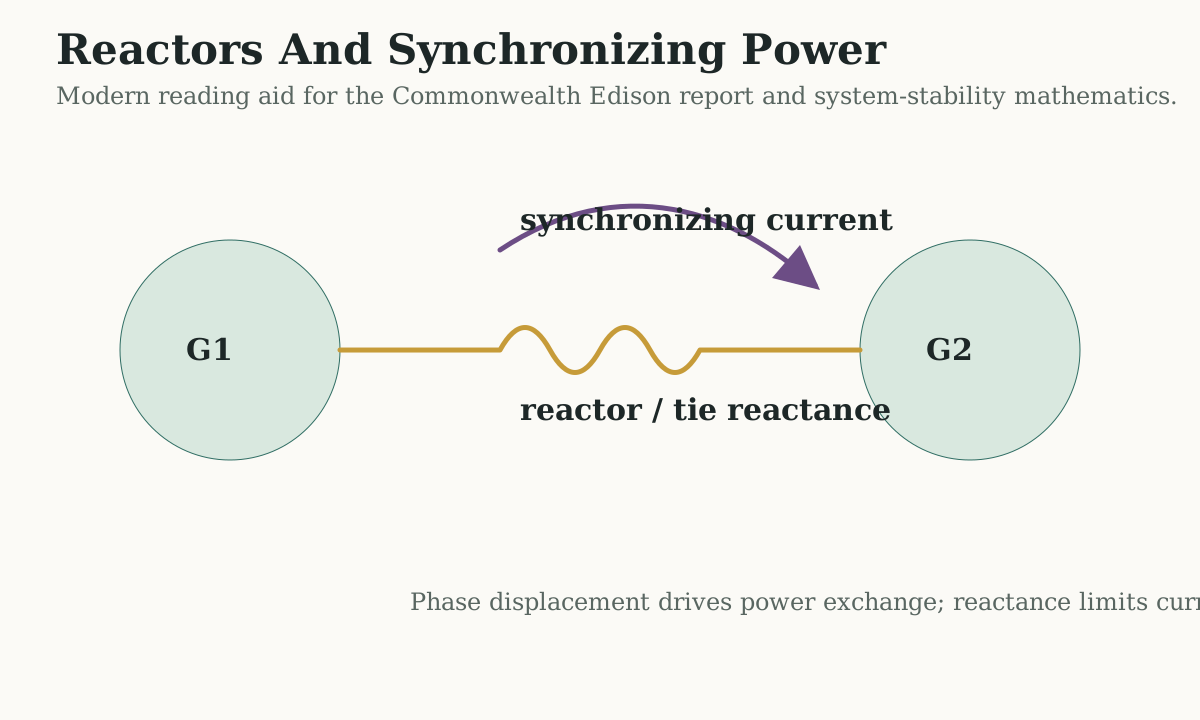
Section titled “Related Modern Guide Diagrams”Modern reading aid for the Commonwealth Edison report and system-stability mathematics.
synchronizing-power, power-limiting-reactors, reactance
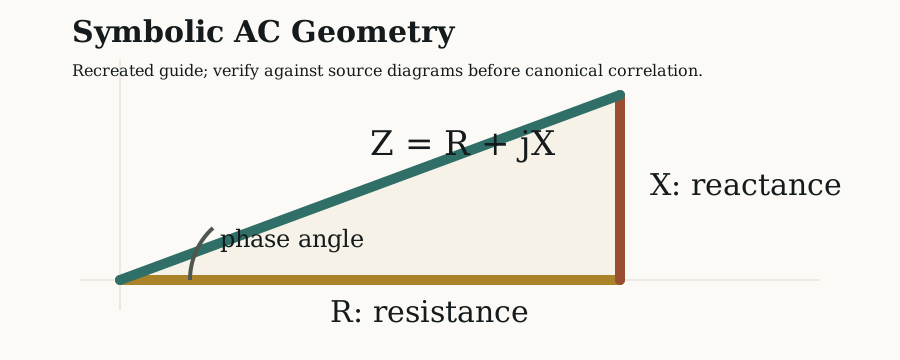
Modern guide for resistance, reactance, impedance, phase angle, and symbolic quantities.
impedance, reactance, power-factor, symbolic-method
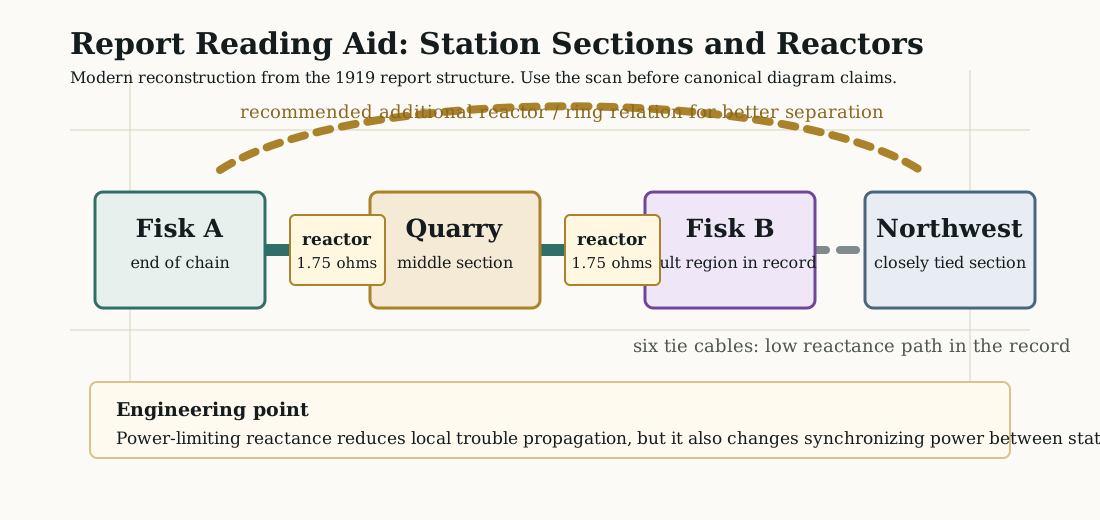
Modern reading aid for station sections, power-limiting reactors, tie cables, and synchronism.
power-limiting-reactors, synchronizing-power, reactance, power-systems
Highest-Priority Formula Leads
Section titled “Highest-Priority Formula Leads”| Candidate | Family | OCR/PDF text | Routes |
|---|---|---|---|
theoretical-elements-electrical-engineering-eq-candidate-0132strong-formula-candidate | symbolic-ac | If an alternating current i = I0 sin 6 passes through a resist- | source research review |
theory-calculation-alternating-current-phenomena-1900-eq-candidate-0156strong-formula-candidate | apparatus-systems | E.M.F. of the generator OE°, where Z0 = r0 - jx0 = inter- | source research review |
theoretical-elements-electrical-engineering-eq-candidate-0138strong-formula-candidate | symbolic-ac | e.m.f., e = EQ sin 6. | source research review |
theoretical-elements-electrical-engineering-eq-candidate-0133strong-formula-candidate | symbolic-ac | i*r = 702r sin2 0 = ^r C1 ~ cos 2 0), | source research review |
theoretical-elements-electrical-engineering-eq-candidate-0168strong-formula-candidate | symbolic-ac | e = E0 sin (0 - 0i) = 273 sin (0 - 0i) ; | source research review |
theoretical-elements-electrical-engineering-eq-candidate-0170strong-formula-candidate | symbolic-ac | e = 273 sin 210 (t - h). | source research review |
theory-calculation-electric-apparatus-eq-candidate-0267strong-formula-candidate | apparatus-systems | ” -Pi = U (e0 - ri\ - xi2) + it (xit - n2), (16) | source research review |
theory-calculation-electric-apparatus-eq-candidate-0268strong-formula-candidate | apparatus-systems | Pi = cot’i - r (tV + it2) | source research review |
Highest-Priority Figure Leads
Section titled “Highest-Priority Figure Leads”| Candidate | Caption lead | Section | Routes |
|---|---|---|---|
theory-calculation-alternating-current-phenomena-1900-fig-052Fig. 52 | tance,— that is, of the power consumed in the receiver Fig. 52. circuit, which in this case approaches the conditions of a | Chapter 8: Circuits Containing Resistance, Inductance, And Capacity | source research review |
theory-calculation-alternating-current-phenomena-fig-065Fig. 65 | loss of power. Fig. 65. Then, if Eo = impressed e.m.f., the current in receiver circuit is | Chapter 9: Circuits Containing Resistance, Inductive Reactance, And Condensive Reactance | source research review |
theory-calculation-alternating-current-phenomena-fig-068Fig. 68 | supply, and inversely. Fig. 68 The generation of alternating-current electric power almost always takes place at constant potential. For some purposes, | Chapter 9: Circuits Containing Resistance, Inductive Reactance, And Condensive Reactance | source research review |
theory-calculation-alternating-current-phenomena-fig-125Fig. 125 | KX) Fig. 125. voltage will rise until by magnetic saturation in the induction generator its power-factor has fallen to equality with that of | Chapter 19: Induction Generators | source research review |
theory-calculation-alternating-current-phenomena-fig-143Fig. 143 | mnrmnmnwv Fig. 143. allel; as, for instance, by the arrangement shown in Fig. 143, | Chapter 23: Synchronizing Alternators | source research review |
theory-calculation-alternating-current-phenomena-fig-144Fig. 144 | nal admittance of the second machine. Fig. 144. Then, er + e’r = al^• | Chapter 23: Synchronizing Alternators | source research review |
theory-calculation-alternating-current-phenomena-fig-164Fig. 164 | X = reactance of the circuit between counter e.m.f., e, and im- FiG. 164. pressed e.m.f., eo, OEr = iiv = e.m.f. consumed by resistance, OEj: = iix = e.m.f. consumed by reactance of the power com- | Chapter 24: Synchronous Motor | source research review |
theory-calculation-alternating-current-phenomena-fig-170Fig. 170 | 600 600 KILOWATTS Fig. 170. It is interesting that at e = 2180, the power-factor is practi- | Chapter 24: Synchronous Motor | source research review |