Dielectric Loss
Steinmetz Usage
Section titled “Steinmetz Usage”In the dielectric-loss chapter, Steinmetz treats the dielectric path with an admittance language. The dielectric may carry a capacity current, but it can also consume real power through leakage, dielectric hysteresis, corona, and related loss effects.
Modern Equivalent
Section titled “Modern Equivalent”Modern engineering may describe these effects as:
- dielectric loss,
- leakage conductance,
- loss tangent,
- equivalent parallel conductance,
- equivalent series resistance,
- insulation loss.
Mathematical Structure
Section titled “Mathematical Structure”The dielectric has an electrostatic capacity:
and a capacity susceptance:
The real loss path is represented by conductance:
Together they form a dielectric admittance model.
Why It Matters
Section titled “Why It Matters”This is one of the archive’s key field-language bridges. Steinmetz does not treat a dielectric as a perfect empty insulator. It has storage, leakage, loss, and frequency behavior.
Modern Electrical Engineering Interpretation
Modern capacitor models often hide dielectric behavior behind ideal capacitance plus ESR or loss tangent. Steinmetz’s treatment keeps the dielectric material and its field behavior closer to the surface.
Ether-Field Interpretive Reading
Interpretive only: a Wheeler-style reading may treat dielectric loss as field compression/storage with lag, leakage, or internal dissipation. The source-grounded layer is that Steinmetz explicitly models dielectric capacity current and real-power loss in dielectric media.
Related Pages
Section titled “Related Pages”Reader Synthesis
Section titled “Reader Synthesis”What Steinmetz Is Doing Here
Dielectric terms lead from capacity and insulation into field stress, loss, and stored electric energy.
The current strongest source route is Theory and Calculation of Alternating Current Phenomena, with 365 candidate hits across 33 sections.
Modern Translation
Modern readers can connect this to capacitance, dielectric field, permittivity, loss angle, insulation stress, and displacement current.
This page currently tracks 1569 candidate occurrences across 14 sources and 140 sections.
Mathematical And Visual Route
Follow capacity, condensive reactance, susceptance, charging current, energy storage, and frequency dependence.
Use the math/visual bridge lower on this page to jump into formula families, source visual maps, and candidate figure leads.
Interpretive Boundary
This is a legitimate place to compare dielectric-field language with ether-field vocabulary, provided the comparison is labeled.
Layer labels stay active: source claim, modern equivalent, mathematical reconstruction, historical note, and interpretive reading are not interchangeable.
Best Steinmetz Passages To Read First
Section titled “Best Steinmetz Passages To Read First”| Passage | Hits | Location | Open |
|---|---|---|---|
| Chapter 14: Dielectric Losses Theory and Calculation of Alternating Current Phenomena | 217 | lines 14334-15409 | read - research review |
| Lecture 2: The Electric Field Elementary Lectures on Electric Discharges, Waves and Impulses, and Other Transients | 114 | lines 1003-1658 | read - research review |
| Lecture 2: The Electric Field Elementary Lectures on Electric Discharges, Waves and Impulses, and Other Transients | 114 | lines 883-1530 | read - research review |
| Theory Section 19: Fields of Force Theoretical Elements of Electrical Engineering | 81 | lines 7737-7990 | read - research review |
Research Position
Section titled “Research Position”- Tracked vocabulary: Dielectricity, Dielectric Field, Dielectric constant.
- Concordance: Dielectricity - Dielectric Field - Dielectric constant.
- Source discipline: the table above is for reading and navigation; exact quotation still requires scan verification.
- Reader route: read the passage first, then return here for modern translation, mathematical reconstruction, visual routes, and interpretation boundaries.
- Editorial rule: expand this page by promoting scan-checked passages, equations, and diagrams from the linked workbench pages, not by adding unsourced generalizations.
Source Expansion Impact
Section titled “Source Expansion Impact”Dielectric and insulation language gets a stronger high-voltage path.
Treat breakdown and gas discharge as source-specific phenomena rather than generic dielectric mystique.
| Source Target | Year | Status | Why It Matters Here |
|---|---|---|---|
| Disruptive Strength with Transient Voltages | 1910 | Planned Acquisition | This source should strengthen insulation stress, breakdown, and surge-dielectric language. |
| Condenser Discharges Through a General Gas Circuit | 1922 | Planned Acquisition | This should enrich discharge, damping, oscillation, and nonlinear gas-circuit behavior. |
| Cable Charge and Discharge | 1923 | Registered Authority Target | This is the direct source for cable transients and should strengthen the line/capacity side of the archive. |
Source-Grounded Dossier
Section titled “Source-Grounded Dossier”Generated evidence layer: this dossier is built from the processed concept concordance. Counts and snippets are OCR/PDF-text aids, not final quotations. Verify against scans before making exact claims.
Candidate occurrences tracked for this page.
Sources with at least one hit.
Sections, lectures, chapters, or report divisions to review.
What The Current Corpus Shows
Section titled “What The Current Corpus Shows”Read this concept page through the linked source passages first. Use the dossier to locate Steinmetz’s wording, then add modern, mathematical, historical, and interpretive layers only with labels.
The strongest current source concentration is Theory and Calculation of Alternating Current Phenomena with 365 candidate hits across 33 sections.
The dossier is meant to turn a concept page into a reading path: begin with Steinmetz’s source wording, then use the research links only when you need candidate counts, snippets, mathematical reconstruction, historical context, or interpretive layers.
Terms And Aliases Tracked
Section titled “Terms And Aliases Tracked”dielectric, dielectricity, displacement, displacement current, electrostatic, dielectric field, dielectrics, Dielectric constant, dielectric-constant
Concordance Records
Section titled “Concordance Records”Dielectricity - Dielectric Field - Dielectric constant
Source Distribution
Section titled “Source Distribution”Priority Passages To Read
Section titled “Priority Passages To Read”Chapter 14: Dielectric Losses - 217 candidate hits
Source: Theory and Calculation of Alternating Current Phenomena (1916)
Location: lines 14334-15409 - Tracked concepts: Dielectric Field, Dielectricity
CHAPTER XIV DIELECTRIC LOSSES Dielectric Hysteresis 116. Just as magnetic hysteresis and eddy currents give a power component in the inductive reactance, as "effective resistance," so the energy losses in the dielectric lead to a power component in the condensive reactance, ...CHAPTER XIV DIELECTRIC LOSSES Dielectric Hysteresis 116. Just as magnetic hysteresis and eddy currents give a power component in the inductive reactance, as "effective resistance," so the energy losses in the dielectric lead to a power component in the condensive reactance, which may be repre- ...Lecture 2: The Electric Field - 114 candidate hits
Source: Elementary Lectures on Electric Discharges, Waves and Impulses, and Other Transients (1914)
Location: lines 1003-1658 - Tracked concepts: Dielectric Field, Dielectricity
... hile power flows through the conductors A, power is con- sumed in these conductors by JV[ conversion into heat, repre- sented by ^2r. This, however, Fig. 7. is not all, but in the space surrounding the conductor cer- tain phenomena occur: magnetic and electrostatic forces appear. Fig. 8. - Electric Field of Conductor. The conductor is surrounded by a...... wn in Fig. 8. By the return conductor, the circles 10 THE ELECTRIC FIELD. 11 are crowded together between the conductors, and the magnetic field consists of eccentric circles surrounding the conductors, as shown by the drawn lines in Fig. 9. An electrostatic, or, as more properly called, dielectric field, issues from the conductors, that is, a dielect...Lecture 2: The Electric Field - 114 candidate hits
Source: Elementary Lectures on Electric Discharges, Waves and Impulses, and Other Transients (1911)
Location: lines 883-1530 - Tracked concepts: Dielectric Field, Dielectricity
... While power flows through the conductors A, power is con- sumed in these conductors by conversion into heat, repre- sented by i?r. This, however, Fig. 7. is not all, but in the space surrounding the conductor cer- tain phenomena occur: magnetic and electrostatic forces appear. Fig. 8. - Electric Field of Conductor. The conductor is surrounded by a mag...... wn in Fig. 8. By the return conductor, the circles 10 THE ELECTRIC FIELD. 11 are crowded together between the conductors, and the magnetic field consists of eccentric circles surrounding the conductors, as shown by the drawn lines in Fig. 9. An electrostatic, or, as more properly called, dielectric field, issues from the conductors, that is, a dielect...Theory Section 19: Fields of Force - 81 candidate hits
Source: Theoretical Elements of Electrical Engineering (1915)
Location: lines 7737-7990 - Tracked concepts: Dielectric Field, Dielectricity
... e earth, and water to run down hill - and this space thus is a field of gravitational force, the earth the gram- motive force. In the space surrounding conductors having a high potential difference, we observe a field of dielectric force, that is, electro- static or dielectric forces are exerted, and the potential difference between the conductors is...... is space thus is a field of gravitational force, the earth the gram- motive force. In the space surrounding conductors having a high potential difference, we observe a field of dielectric force, that is, electro- static or dielectric forces are exerted, and the potential difference between the conductors is the electromotive force of the dielectric fi...Lecture 10: Continual And Cumulative Oscillations - 60 candidate hits
Source: Elementary Lectures on Electric Discharges, Waves and Impulses, and Other Transients (1914)
Location: lines 6804-8485 - Tracked concepts: Dielectric Field, Dielectricity
... enon by which the stored energy readjusts itself to a change of circuit conditions. In an oscilla- tory transient, the difference of stored energy of the previous and the after condition of the circuit, at a circuit change, oscillates between magnetic and dielectric energy. As there always must be some energy dissipation in the circuit, the oscillatin...... hen, with an overlap of successive oscillations, no dead period occurs, during which the energy, which oscillates during the next wave train, is supplied to the line, this energy must be supplied during the oscillation, that is, there must be such a phase displacement or lag within the oscil- lation, which gives a negative energy cycle, or reversed hy...Chapter 1: The Constants Of The Electric Circuit - 59 candidate hits
Source: Theory and Calculation of Transient Electric Phenomena and Oscillations (1909)
Location: lines 1317-1992 - Tracked concepts: Dielectric Field, Dielectric constant, Dielectricity
... rostatic actions. The magnetic action is a maximum in the direction concen- tric, or approximately so, to the conductor. That is, a needle- shaped magnetizable body, as an iron needle, tends to set itself in a direction concentric to the conductor. The electrostatic action has a maximum in a direction radial, or approximately so, to the conductor. Tha...... etizable body, as an iron needle, tends to set itself in a direction concentric to the conductor. The electrostatic action has a maximum in a direction radial, or approximately so, to the conductor. That is, a light needle- shaped conducting body, if the electrostatic component of the field is powerful enough, tends to set itself in a direction radial...Reading Layers To Build Out
Section titled “Reading Layers To Build Out”| Layer | What to add next |
|---|---|
| Steinmetz wording | Pull exact source passages only after scan verification; keep OCR text labeled until then. |
| Modern engineering reading | Translate the source usage into present electrical-engineering or physics language without erasing the older vocabulary. |
| Mathematical layer | Link equations, variables, diagrams, and worked examples when the concept has formula candidates. |
| Historical layer | Identify whether the term is still used, renamed, absorbed into modern theory, or historically obsolete. |
| Ether-field interpretation | Keep interpretive readings separate from Steinmetz’s explicit claim and from modern physics. |
| Open questions | Record places where the concordance suggests a lead but the scan or edition has not yet been checked. |
Next Editorial Actions
Section titled “Next Editorial Actions”- Open the highest-priority source-text passages above and verify the wording against scans.
- Promote exact definitions, equations, diagrams, and hidden-gem passages into this page with source references.
- Add related concept links, equation pages, and diagram pages once the evidence is scan checked.
- Keep speculative or Wheeler-style readings in explicitly labeled interpretation blocks.
Math And Visual Evidence Map
Section titled “Math And Visual Evidence Map”Generated bridge: this section crosslinks the concept page with the formula atlas, figure atlas, source visual maps, and source formula maps. It is a routing layer, not final interpretation.
Formula candidates routed to this concept.
Figure candidates routed to this concept.
Modern guide diagrams related to this concept.
Formula Families To Review
Section titled “Formula Families To Review”Inductance, Capacity, And Stored Energy - Magnetism, Hysteresis, And Core Loss - Power, Energy, Work, And Efficiency
Source Maps For This Concept
Section titled “Source Maps For This Concept”theory-calculation-alternating-current-phenomena visuals - theory-calculation-alternating-current-phenomena formulas - electric-discharges-waves-impulses-1914 visuals - electric-discharges-waves-impulses-1914 formulas - elementary-lectures-electric-discharges-waves-impulses visuals - elementary-lectures-electric-discharges-waves-impulses formulas - theory-calculation-alternating-current-phenomena-1900 visuals - theory-calculation-alternating-current-phenomena-1900 formulas - theoretical-elements-electrical-engineering visuals - theoretical-elements-electrical-engineering formulas - theory-calculation-transient-electric-phenomena-oscillations visuals - theory-calculation-transient-electric-phenomena-oscillations formulas
Related Modern Guide Diagrams
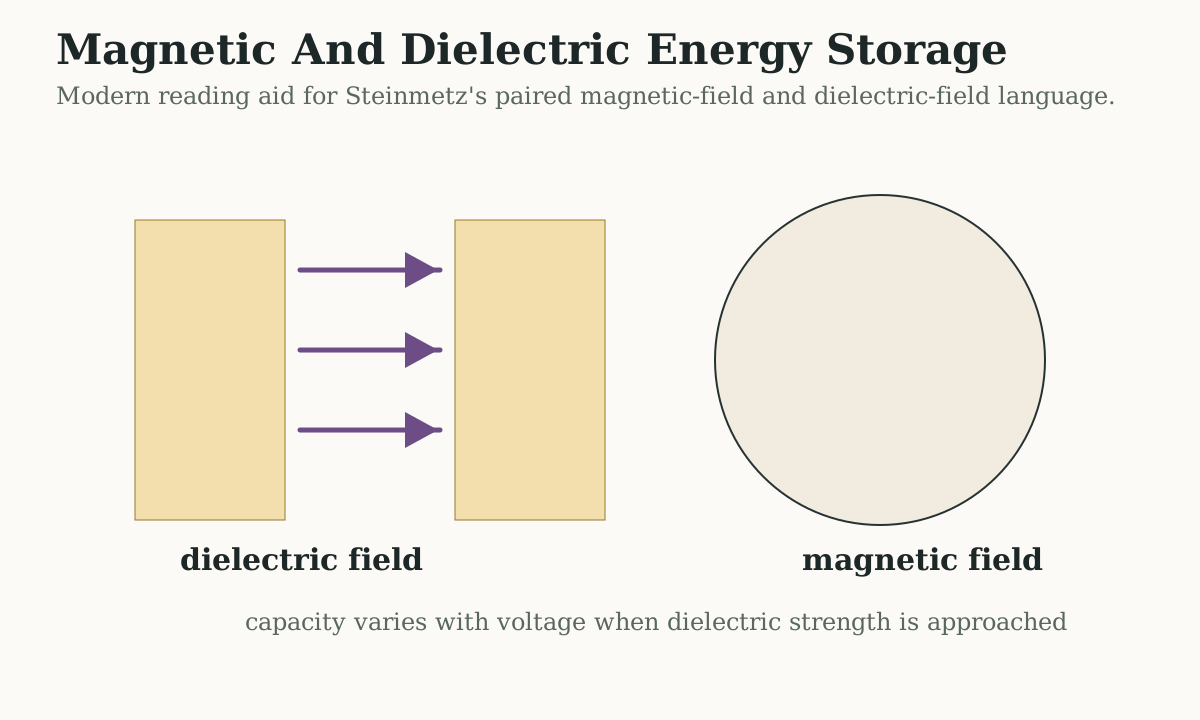
Section titled “Related Modern Guide Diagrams”Modern reading aid for Steinmetz’s paired magnetic-field and dielectric-field language.
dielectric-field, magnetic-field, energy-storage
Highest-Priority Formula Leads
Section titled “Highest-Priority Formula Leads”| Candidate | Family | OCR/PDF text | Routes |
|---|---|---|---|
elementary-lectures-electric-discharges-waves-impulses-eq-candidate-0195strong-formula-candidate | transients-oscillation | i = io cos (0 - 7) = io cos 7 cos <j> + i0 sin 7 sin | source research review |
theory-calculation-alternating-current-phenomena-1900-eq-candidate-0240strong-formula-candidate | symbolic-ac | is r - j (x -f x0} = r = .6, x + x0 = 0, and tan S>0 = 0 ; | source research review |
elementary-lectures-electric-discharges-waves-impulses-eq-candidate-0220strong-formula-candidate | transients-oscillation | if = 140 cos 0.2 1 - 80 sin 0.2 1, | source research review |
theory-calculation-alternating-current-phenomena-1897-eq-candidate-0161strong-formula-candidate | symbolic-ac | but E = E^y I^E^j z. If x^ > - 2,t-, it raises, if ;r < - 2 jr, | source research review |
theory-calculation-alternating-current-phenomena-1900-eq-candidate-0281strong-formula-candidate | inductance-capacity | Then, if E0 = impressed E.M.F.,- | source research review |
electric-discharges-waves-impulses-1914-eq-candidate-0135strong-formula-candidate | transients-oscillation | (S!,J = 20,000 lines per cm^. * | source research review |
electric-discharges-waves-impulses-1914-eq-candidate-0159strong-formula-candidate | transients-oscillation | T = 2.92 - { 9.21 log’^ , ,\ . + .921 log’^ i ’ ^ ^ | source research review |
electric-discharges-waves-impulses-1914-eq-candidate-0162strong-formula-candidate | transients-oscillation | division with log^^e = .4343. | source research review |
Highest-Priority Figure Leads
Section titled “Highest-Priority Figure Leads”| Candidate | Caption lead | Section | Routes |
|---|---|---|---|
electric-discharges-waves-impulses-1914-fig-003Fig. 3 | G O Fig. 3. the stored energy has to be supplied from the source of power; that is, for a short time power, in supplying the stored energy, flows not | Lecture 1: Nature And Origin Of Transients | source research review |
theory-calculation-alternating-current-phenomena-fig-065Fig. 65 | loss of power. Fig. 65. Then, if Eo = impressed e.m.f., the current in receiver circuit is | Chapter 9: Circuits Containing Resistance, Inductive Reactance, And Condensive Reactance | source research review |
theory-calculation-alternating-current-phenomena-fig-096Fig. 96 | ^ m Fig. 96. )J | Chapter 14: Dielectric Losses | source research review |
theory-calculation-alternating-current-phenomena-fig-097Fig. 97 | ’ m Fig. 97. throughout the field section, but the voltage gradient in the | Chapter 14: Dielectric Losses | source research review |
theory-calculation-alternating-current-phenomena-fig-098Fig. 98 | do so. Fig. 98. Fig. 99. | Chapter 14: Dielectric Losses | source research review |
theory-calculation-alternating-current-phenomena-fig-099Fig. 99 | Fig. 98. Fig. 99. h’5 | Chapter 14: Dielectric Losses | source research review |
theory-calculation-alternating-current-phenomena-fig-100Fig. 100 | JTTTTTTTTTTTTTTTTTTTTTTT- Fig. 100. In this case the intensity as well as phase of the current, and consequently of the counter e.m.f. of inductive reactance and | Chapter 15: Distributed Capacity, Inductance, Resistance, And Leakage | source research review |
theory-calculation-alternating-current-phenomena-fig-101Fig. 101 | iEo Fig. 101. Denoting in Fig. 101. | Chapter 15: Distributed Capacity, Inductance, Resistance, And Leakage | source research review |