Transient Phenomena
Steinmetz Usage
Section titled “Steinmetz Usage”Transient phenomena are the temporary electrical events that appear when a circuit changes state, when energy shifts between magnetic and electrostatic storage, when oscillations arise, or when a distributed line cannot be treated as a lumped circuit.
The archive’s OCR seed for Transient Electric Phenomena shows the book organized around transients in time, periodic transients, transients in space, and transients in time and space. That structure is important: Steinmetz is not only treating switching curves, but the broader transition from local circuit behavior to wave behavior.
The important reading habit is to ask what energy is doing during the temporary interval. A steady-state answer may tell the final current or voltage, but the transient answer asks how the system gets there, what intermediate stresses appear, and whether the path creates oscillation, excessive voltage, insulation danger, or wave reflection.
Modern Equivalent
Section titled “Modern Equivalent”Modern electrical engineering would connect this to RLC transient response, switching surges, eigenmodes, impulse response, damping, transmission-line theory, standing waves, traveling waves, and insulation stress.
Mathematical Explanation
Section titled “Mathematical Explanation”Most transient analysis separates a response into a permanent or forced term and a transient or natural term. A common modern symbolic form is:
The natural term may decay exponentially, oscillate while decaying, or propagate along a distributed structure.
Diagrammatic Explanation
Section titled “Diagrammatic Explanation”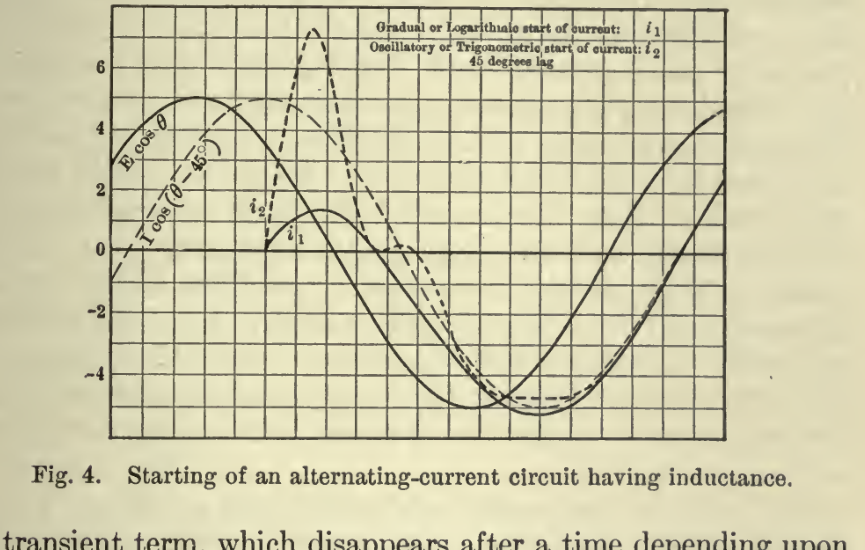
Steinmetz’s visual distinction between gradual and oscillatory start.
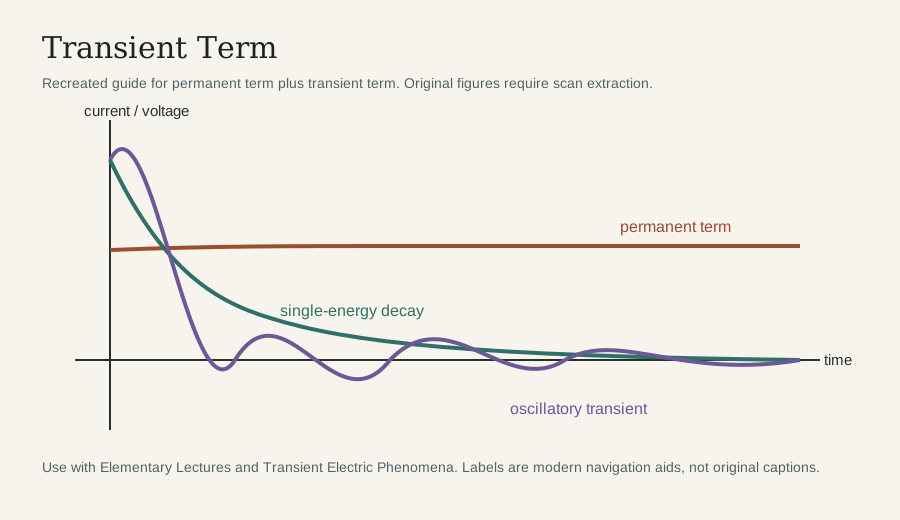
Temporary terms decaying toward or oscillating around a permanent state.
Why It Matters
Section titled “Why It Matters”Transient phenomena reveal electrical behavior that steady-state formulas conceal. They are crucial for lightning, line switching, transformer inrush, insulation stress, high-frequency oscillation, and the practical survival of power systems.
Cross-Source Research Map
Section titled “Cross-Source Research Map”Elementary Lectures
Use this as the readable entrance. Its lecture structure is ideal for concept pages on electric field, line oscillation, traveling waves, and impulse strength.
Transient Electric Phenomena
Use this as the mathematical deep source. It should supply the canonical equations for natural terms, oscillatory discharge, distributed constants, standing waves, traveling waves, and inductive discharge.
Alternating Current Phenomena
Use this as the bridge back to steady-state AC language: reactance, impedance, symbolic representation, hysteresis, and distributed capacity.
Ether-Field Interpretive Reading
Interpretive only: transients are a natural place for field-centered readings because they expose energy storage, release, propagation, damping, and lag. The archive should map those readings to exact Steinmetz passages rather than importing later vocabulary without source anchors.
Reader Synthesis
Section titled “Reader Synthesis”What Steinmetz Is Doing Here
Transient phenomena are Steinmetz’s correction to steady-state habits: electrical systems have temporary terms before permanent behavior is reached.
The current strongest source route is Theory and Calculation of Transient Electric Phenomena and Oscillations, with 514 candidate hits across 42 sections.
Modern Translation
Modern readers can map this to time-domain circuit response, natural response, forced response, damping, and distributed-line transients.
This page currently tracks 1332 candidate occurrences across 11 sources and 84 sections.
Mathematical And Visual Route
Follow exponential terms, oscillatory terms, damping, RLC response, condenser charge/discharge, line reflections, and surge propagation.
Use the math/visual bridge lower on this page to jump into formula families, source visual maps, and candidate figure leads.
Interpretive Boundary
Interpretive readings should preserve the engineering fact first: stored electric and magnetic energy must readjust through time.
Layer labels stay active: source claim, modern equivalent, mathematical reconstruction, historical note, and interpretive reading are not interchangeable.
Best Steinmetz Passages To Read First
Section titled “Best Steinmetz Passages To Read First”| Passage | Hits | Location | Open |
|---|---|---|---|
| Lecture 4: Single-Energy Transients In Alternating Current Circuits Elementary Lectures on Electric Discharges, Waves and Impulses, and Other Transients | 130 | lines 2485-3386 | read - research review |
| Lecture 4: Single-Energy Transients In Alternating Current Circuits Elementary Lectures on Electric Discharges, Waves and Impulses, and Other Transients | 126 | lines 2162-2971 | read - research review |
| Lecture 6: Double-Energy Transients Elementary Lectures on Electric Discharges, Waves and Impulses, and Other Transients | 62 | lines 3721-4369 | read - research review |
| Lecture 6: Double-Energy Transients Elementary Lectures on Electric Discharges, Waves and Impulses, and Other Transients | 62 | lines 3287-3955 | read - research review |
Research Position
Section titled “Research Position”- Tracked vocabulary: Transient Phenomena, Field Collapse.
- Concordance: Transient Phenomena - Field Collapse.
- Source discipline: the table above is for reading and navigation; exact quotation still requires scan verification.
- Reader route: read the passage first, then return here for modern translation, mathematical reconstruction, visual routes, and interpretation boundaries.
- Editorial rule: expand this page by promoting scan-checked passages, equations, and diagrams from the linked workbench pages, not by adding unsourced generalizations.
Source Expansion Impact
Section titled “Source Expansion Impact”The next wave is especially strong for transients.
Use processed transient books now; pending articles will sharpen impulse, instability, gas discharge, and cumulative-surge layers.
| Source Target | Year | Status | Why It Matters Here |
|---|---|---|---|
| Lightning Phenomena in Electric Circuits | 1907 | Registered Authority Target | This should become a cornerstone for surge theory, steep wave fronts, impulse behavior, and high-voltage protection. |
| Outline of Theory of Impulse Currents | 1916 | Registered Authority Target | This is a direct mathematical source for impulse-current reasoning and should feed the surge math route. |
| Instability of Electric Circuits | 1914 | Planned Acquisition | This source can connect cumulative circuit behavior, negative-resistance-like effects, oscillation, and protective design. |
| Condenser Discharges Through a General Gas Circuit | 1922 | Planned Acquisition | This should enrich discharge, damping, oscillation, and nonlinear gas-circuit behavior. |
| Frequency Conversion by Third Class Conductor and Mechanism of the Arcing Ground and Other Cumulative Surges | 1923 | Registered Authority Target | This is a flagship pending source for nonlinear discharge, arcing-ground behavior, frequency conversion, and cumulative surges. |
Source-Grounded Dossier
Section titled “Source-Grounded Dossier”Generated evidence layer: this dossier is built from the processed concept concordance. Counts and snippets are OCR/PDF-text aids, not final quotations. Verify against scans before making exact claims.
Candidate occurrences tracked for this page.
Sources with at least one hit.
Sections, lectures, chapters, or report divisions to review.
What The Current Corpus Shows
Section titled “What The Current Corpus Shows”Read this concept as a time-domain correction to steady-state circuit thinking. The strongest pages should show where Steinmetz separates permanent terms from transient terms and then follows the stored energy.
The strongest current source concentration is Theory and Calculation of Transient Electric Phenomena and Oscillations with 514 candidate hits across 42 sections.
The dossier is meant to turn a concept page into a reading path: begin with Steinmetz’s source wording, then use the research links only when you need candidate counts, snippets, mathematical reconstruction, historical context, or interpretive layers.
Terms And Aliases Tracked
Section titled “Terms And Aliases Tracked”temporary term, transient, transient phenomena, transient phenomenon, transients, collapse of the field, collapsing field, field collapse
Concordance Records
Section titled “Concordance Records”Transient Phenomena - Field Collapse
Source Distribution
Section titled “Source Distribution”Priority Passages To Read
Section titled “Priority Passages To Read”Lecture 4: Single-Energy Transients In Alternating Current Circuits - 130 candidate hits
Source: Elementary Lectures on Electric Discharges, Waves and Impulses, and Other Transients (1914)
Location: lines 2485-3386 - Tracked concepts: Transient Phenomena
LECTURE IV. SINGLE-ENERGY TRANSIENTS IN ALTERNATING- CURRENT CIRCUITS. 17. Whenever the conditions of an electric circuit are changed in such a manner as to require a change of stored energy, a transi- tion period appears, during which the stored energy adjusts itself from the condition ex ...... n existing before the change to the condition after the change. The currents in the circuit during the transition period can be considered as consisting of the superposition of the permanent current, corresponding to the conditions after the change, and a transient current, which connects the current value before the change with that brought about by...Lecture 4: Single-Energy Transients In Alternating Current Circuits - 126 candidate hits
Source: Elementary Lectures on Electric Discharges, Waves and Impulses, and Other Transients (1911)
Location: lines 2162-2971 - Tracked concepts: Transient Phenomena
LECTURE IV. SINGLE-ENERGY TRANSIENTS IN ALTERNATING- CURRENT CIRCUITS. 17. Whenever the conditions of an electric circuit are changed in such a manner as to require a change of stored energy, a transi- tion period appears, during which the stored energy adjusts itself from the condition ex ...... n existing before the change to the condition after the change. The currents in the circuit during the transition period can be considered as consisting of the superposition of the permanent current, corresponding to the conditions after the change, and a transient current, which connects the current value before the change with that brought about by...Lecture 6: Double-Energy Transients - 62 candidate hits
Source: Elementary Lectures on Electric Discharges, Waves and Impulses, and Other Transients (1914)
Location: lines 3721-4369 - Tracked concepts: Transient Phenomena
LECTURE VI. DOUBLE-ENERGY TRANSIENTS. 24. In a circuit in which energy can be stored in one form only, the change in the stored energy which can take place as the result of a change of the circuit conditions is an increase or decrease. The transient can be separated from the permanent condi ...LECTURE VI. DOUBLE-ENERGY TRANSIENTS. 24. In a circuit in which energy can be stored in one form only, the change in the stored energy which can take place as the result of a change of the circuit conditions is an increase or decrease. The transient can be separated from the permanent condition, and then always is the representation of a gradual decrease...Lecture 6: Double-Energy Transients - 62 candidate hits
Source: Elementary Lectures on Electric Discharges, Waves and Impulses, and Other Transients (1911)
Location: lines 3287-3955 - Tracked concepts: Transient Phenomena
LECTURE VI. DOUBLE-ENERGY TRANSIENTS. 24. In a circuit in which energy can be stored in one form only, the change in the stored energy which can take place as the result of a change of the circuit conditions is an increase or decrease. The transient can be separated from the permanent condi ...LECTURE VI. DOUBLE-ENERGY TRANSIENTS. 24. In a circuit in which energy can be stored in one form only, the change in the stored energy which can take place as the result of a change of the circuit conditions is an increase or decrease. The transient can be separated from the permanent condition, and then always is the representation of a gradual decrease...Lecture 1: Nature And Origin Of Transients - 53 candidate hits
Source: Elementary Lectures on Electric Discharges, Waves and Impulses, and Other Transients (1914)
Location: lines 557-1002 - Tracked concepts: Transient Phenomena
LECTURE I. NATURE AND ORIGIN OF TRANSIENTS. I. Electrical engineering deals with electric energy and its flow, that is, electric power. Two classes of phenomena are met: permanent and transient phenomena. To illustrate: Let G in Fig. 1 be a direct-current generator, which over a circuit A con- n ...LECTURE I. NATURE AND ORIGIN OF TRANSIENTS. I. Electrical engineering deals with electric energy and its flow, that is, electric power. Two classes of phenomena are met: permanent and transient phenomena. To illustrate: Let G in Fig. 1 be a direct-current generator, which over a circuit A con- nects to a load L, as a number of lamps, etc. In the generator...Lecture 1: Nature And Origin Of Transients - 53 candidate hits
Source: Elementary Lectures on Electric Discharges, Waves and Impulses, and Other Transients (1911)
Location: lines 460-882 - Tracked concepts: Transient Phenomena
LECTURE I. NATURE AND ORIGIN OF TRANSIENTS. i. Electrical engineering deals with electric energy and its flow, that is, electric power. Two classes of phenomena are met: permanent and transient, phenomena. To illustrate: Let G in Fig. 1 be a direct-current generator, which over a circuit A con- ...LECTURE I. NATURE AND ORIGIN OF TRANSIENTS. i. Electrical engineering deals with electric energy and its flow, that is, electric power. Two classes of phenomena are met: permanent and transient, phenomena. To illustrate: Let G in Fig. 1 be a direct-current generator, which over a circuit A con- nects to a load L, as a number of lamps, etc. In the generato...Reading Layers To Build Out
Section titled “Reading Layers To Build Out”| Layer | What to add next |
|---|---|
| Steinmetz wording | Pull exact source passages only after scan verification; keep OCR text labeled until then. |
| Modern engineering reading | Translate the source usage into present electrical-engineering or physics language without erasing the older vocabulary. |
| Mathematical layer | Link equations, variables, diagrams, and worked examples when the concept has formula candidates. |
| Historical layer | Identify whether the term is still used, renamed, absorbed into modern theory, or historically obsolete. |
| Ether-field interpretation | Keep interpretive readings separate from Steinmetz’s explicit claim and from modern physics. |
| Open questions | Record places where the concordance suggests a lead but the scan or edition has not yet been checked. |
Next Editorial Actions
Section titled “Next Editorial Actions”- Open the highest-priority source-text passages above and verify the wording against scans.
- Promote exact definitions, equations, diagrams, and hidden-gem passages into this page with source references.
- Add related concept links, equation pages, and diagram pages once the evidence is scan checked.
- Keep speculative or Wheeler-style readings in explicitly labeled interpretation blocks.
Math And Visual Evidence Map
Section titled “Math And Visual Evidence Map”Generated bridge: this section crosslinks the concept page with the formula atlas, figure atlas, source visual maps, and source formula maps. It is a routing layer, not final interpretation.
Formula candidates routed to this concept.
Figure candidates routed to this concept.
Modern guide diagrams related to this concept.
Formula Families To Review
Section titled “Formula Families To Review”Transients, Oscillation, And Damping - Waves, Lines, Radiation, And Frequency
Source Maps For This Concept
Section titled “Source Maps For This Concept”theory-calculation-transient-electric-phenomena-oscillations visuals - theory-calculation-transient-electric-phenomena-oscillations formulas - electric-discharges-waves-impulses-1914 visuals - electric-discharges-waves-impulses-1914 formulas - elementary-lectures-electric-discharges-waves-impulses visuals - elementary-lectures-electric-discharges-waves-impulses formulas - theory-calculation-electric-circuits visuals - theory-calculation-electric-circuits formulas - engineering-mathematics visuals - engineering-mathematics formulas - theory-calculation-electric-apparatus visuals - theory-calculation-electric-apparatus formulas
Related Modern Guide Diagrams
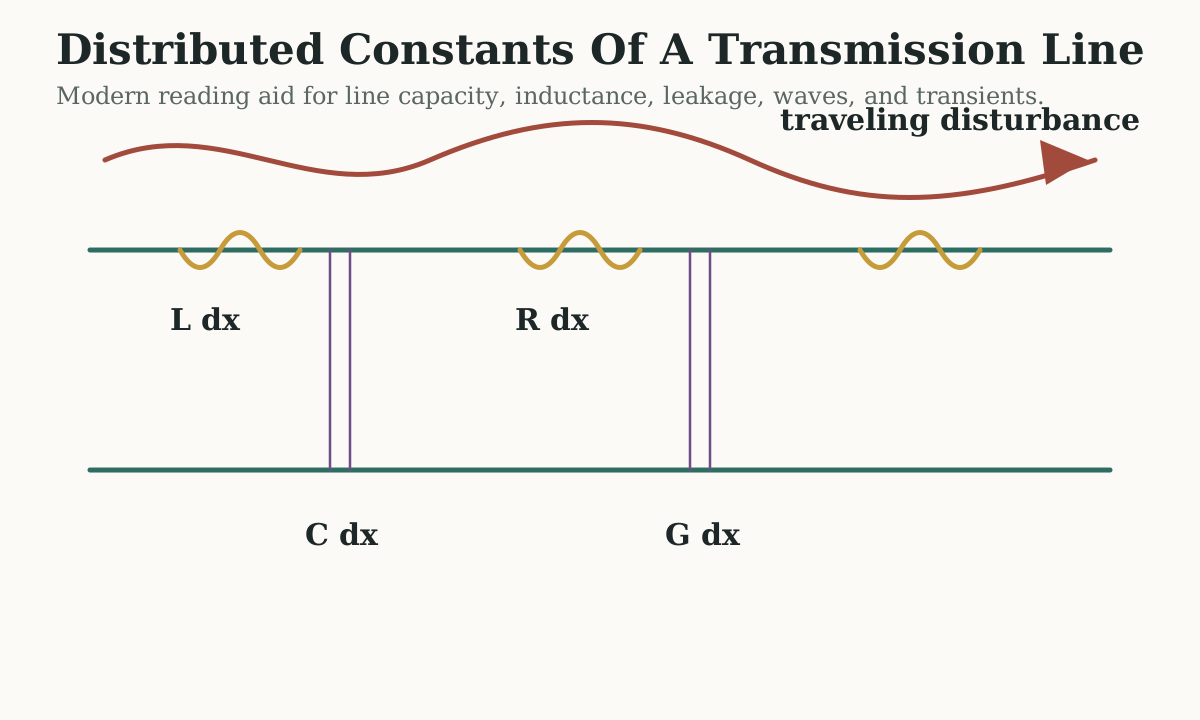
Section titled “Related Modern Guide Diagrams”Modern reading aid for line capacity, inductance, leakage, waves, and transients.
distributed-constants, capacity, inductance, waves
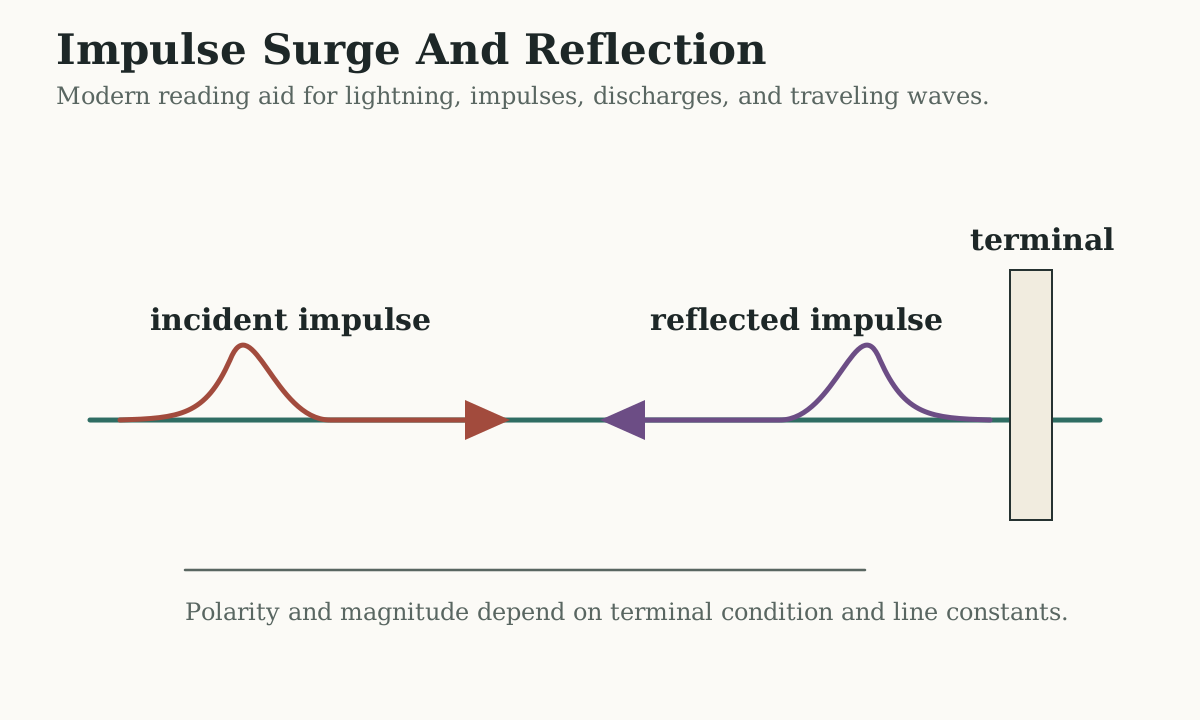
Modern reading aid for lightning, impulses, discharges, and traveling waves.
lightning-surges, impulse-current, traveling-wave
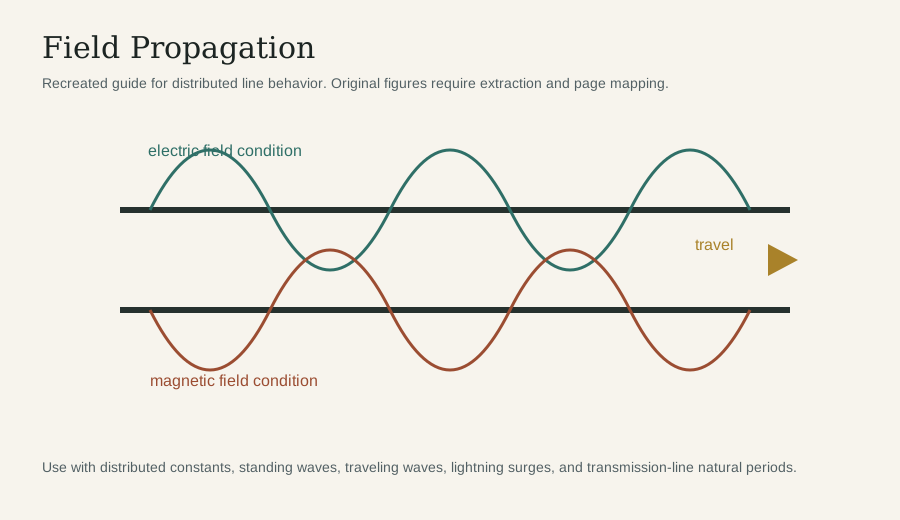
Modern reading aid for distributed constants, standing waves, traveling waves, and surge propagation.
electric-waves, distributed-constants, traveling-wave, lightning-surges
Highest-Priority Formula Leads
Section titled “Highest-Priority Formula Leads”| Candidate | Family | OCR/PDF text | Routes |
|---|---|---|---|
theory-calculation-transient-electric-phenomena-oscillations-eq-candidate-0272strong-formula-candidate | transients-oscillation | At the moment 0 = 0, let the e.m.f. e = E cos (0 - 00) be | source research review |
electric-discharges-waves-impulses-1914-eq-candidate-0240strong-formula-candidate | transients-oscillation | e = 2;oCe-”’ sin (0 =F co - 7) j | source research review |
electric-discharges-waves-impulses-1914-eq-candidate-0293strong-formula-candidate | transients-oscillation | i = e~ ”’ J ai cos </) cos co + 6i sin cf) cos co + Ci cos 0 sin co | source research review |
elementary-lectures-electric-discharges-waves-impulses-eq-candidate-0195strong-formula-candidate | transients-oscillation | i = io cos (0 - 7) = io cos 7 cos <j> + i0 sin 7 sin | source research review |
theory-calculation-transient-electric-phenomena-oscillations-eq-candidate-0276strong-formula-candidate | transients-oscillation | Since e = E cos (0 - 00) = impressed e.m.f., | source research review |
theory-calculation-transient-electric-phenomena-oscillations-eq-candidate-0296strong-formula-candidate | transients-oscillation | i = -z | cos (I? - 00- 0J- i~x° cos (00 + OJ j (9) | source research review |
elementary-lectures-electric-discharges-waves-impulses-eq-candidate-0220strong-formula-candidate | transients-oscillation | if = 140 cos 0.2 1 - 80 sin 0.2 1, | source research review |
theory-calculation-transient-electric-phenomena-oscillations-eq-candidate-0137strong-formula-candidate | transients-oscillation | i = I cos (d - 45°), | source research review |
Highest-Priority Figure Leads
Section titled “Highest-Priority Figure Leads”| Candidate | Caption lead | Section | Routes |
|---|---|---|---|
electric-discharges-waves-impulses-1914-fig-001Fig. 1 | oo,o o Fig. 1. exist, which are constant, or permanent, as long as the conditions | Lecture 1: Nature And Origin Of Transients | source research review |
electric-discharges-waves-impulses-1914-fig-002Fig. 2 | ]C Fig. 2. Commonly, transient and permanent phenomena are super- imposed upon each other. For instance, if in the circuit Fig. 1 | Lecture 1: Nature And Origin Of Transients | source research review |
electric-discharges-waves-impulses-1914-fig-003Fig. 3 | G O Fig. 3. the stored energy has to be supplied from the source of power; that is, for a short time power, in supplying the stored energy, flows not | Lecture 1: Nature And Origin Of Transients | source research review |
electric-discharges-waves-impulses-1914-fig-025Fig. 25 | frequency, and as the result an increase of voltage and a distor- tion of the quadrature phase occurs, as shown in the oscillogram Fig. 25. Various momentary short-circuit phenomena are illustrated by the oscillograms… | Lecture 4: Single-Energy Transients In Alternating Current Circuits | source research review |
electric-discharges-waves-impulses-1914-fig-029Fig. 29 | 4 5 Fig. 29. seconds | Lecture 5: Single-Energy Tra.Nsient Of Ironclad Circuit | source research review |
electric-discharges-waves-impulses-1914-fig-033Fig. 33 | = 0.000333 sec. = 0.33 millisecond; Fig. 33. hence, substituted in equation (28), | Lecture 6: Double-Energy Transients | source research review |
electric-discharges-waves-impulses-1914-fig-034Fig. 34 | B Fig. 34. However, if (8) are the equations of current and voltage at a point A of a line, shown diagrammatically in Fig. 34, at any other | Lecture 7: Line Oscillations | source research review |
theory-calculation-transient-electric-phenomena-oscillations-fig-099Fig. 99 | given for ^ = 0, where tt = t] for any other point of the line X the wave shape is the same, but all the ordinates reduced by the factor £~115* in the proportion as shown in the dotted curve in Fig. 99. Fig. 101 shows… | Chapter 4: Traveling Waves | source research review |