Impedance
Steinmetz Usage
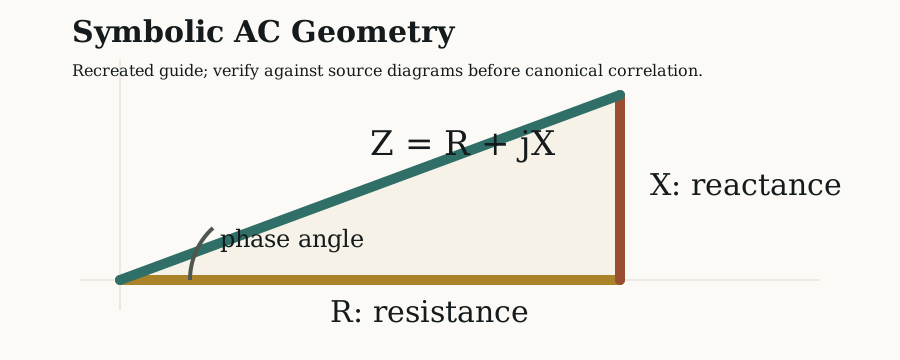
Section titled “Steinmetz Usage”Impedance is the alternating-current opposition that combines resistance and reactance. In the symbolic method, Steinmetz represents it as a complex quantity:
The OCR candidate in Chapter V places this directly after the discussion of current as a complex wave and the voltage required to overcome resistance and reactance.
Modern Equivalent
Section titled “Modern Equivalent”Modern notation usually writes:
where R is resistance, X is total reactance, and |Z| is impedance magnitude.
Physical Meaning
Section titled “Physical Meaning”Resistance is the power-consuming part. Reactance is the field-storage part. Impedance is the total relation between alternating voltage and alternating current when both effects are present.
Mathematical Layer
Section titled “Mathematical Layer”This is Ohm’s law restored for AC, but only after voltage, current, and opposition are treated as complex quantities with phase.
Ether-Field Interpretive Reading
Interpretive only: impedance can be read as the circuit-level expression of both dissipative opposition and field-storage opposition. Field-centered readers may emphasize the latter, but the source claim remains an engineering relation between voltage, current, resistance, and reactance.
Related Pages
Section titled “Related Pages”Reader Synthesis
Section titled “Reader Synthesis”What Steinmetz Is Doing Here
Impedance gathers resistance and reactance into one calculable AC opposition.
The current strongest source route is Theory and Calculation of Alternating Current Phenomena, with 313 candidate hits across 28 sections.
Modern Translation
Modern readers recognize it as complex impedance, but the source path shows why the geometric and physical split mattered.
This page currently tracks 1324 candidate occurrences across 13 sources and 154 sections.
Mathematical And Visual Route
Use R plus jX, magnitude, phase, voltage/current relation, and power-factor consequences.
Use the math/visual bridge lower on this page to jump into formula families, source visual maps, and candidate figure leads.
Interpretive Boundary
Field readings should connect reactance to storage and return, without confusing impedance with a literal material substance.
Layer labels stay active: source claim, modern equivalent, mathematical reconstruction, historical note, and interpretive reading are not interchangeable.
Best Steinmetz Passages To Read First
Section titled “Best Steinmetz Passages To Read First”| Passage | Hits | Location | Open |
|---|---|---|---|
| Chapter 17: The Alternating-Current Transformer Theory and Calculation of Alternating Current Phenomena | 45 | lines 16521-17716 | read - research review |
| Chapter 5: Single-Phase Induction Motor Theory and Calculation of Electric Apparatus | 44 | lines 8555-10582 | read - research review |
| Chapter 16: Induction Motor Theory and Calculation of Alternating Current Phenomena | 42 | lines 13649-16361 | read - research review |
| Chapter 19: Alternating- Current Motors In General Theory and Calculation of Electric Apparatus | 39 | lines 21713-23905 | read - research review |
Research Position
Section titled “Research Position”- Tracked vocabulary: Impedance.
- Concordance: Impedance.
- Source discipline: the table above is for reading and navigation; exact quotation still requires scan verification.
- Reader route: read the passage first, then return here for modern translation, mathematical reconstruction, visual routes, and interpretation boundaries.
- Editorial rule: expand this page by promoting scan-checked passages, equations, and diagrams from the linked workbench pages, not by adding unsourced generalizations.
Source Expansion Impact
Section titled “Source Expansion Impact”Impedance will be strengthened by the complex-quantity and general-equation sources.
The current reader route remains the AC book editions and Electric Circuits; papers should not be cited as decoded until acquired.
| Source Target | Year | Status | Why It Matters Here |
|---|---|---|---|
| Complex Quantities and Their Use in Electrical Engineering | 1894 | Registered Authority Target | This should become the flagship source for how Steinmetz made alternating-current calculation algebraic, geometric, and teachable. |
| The General Equations of the Electric Circuit | 1908 | Registered Authority Target | This paper bridges steady-state symbolic method, differential equations, and the general circuit theory behind later source books. |
| The General Equations of the Electric Circuit-III | 1919 | Registered Authority Target | The continuation lets the archive show development over time rather than treating general circuit equations as a one-off article. |
Source-Grounded Dossier
Section titled “Source-Grounded Dossier”Generated evidence layer: this dossier is built from the processed concept concordance. Counts and snippets are OCR/PDF-text aids, not final quotations. Verify against scans before making exact claims.
Candidate occurrences tracked for this page.
Sources with at least one hit.
Sections, lectures, chapters, or report divisions to review.
What The Current Corpus Shows
Section titled “What The Current Corpus Shows”Read this concept page through the linked source passages first. Use the dossier to locate Steinmetz’s wording, then add modern, mathematical, historical, and interpretive layers only with labels.
The strongest current source concentration is Theory and Calculation of Alternating Current Phenomena with 313 candidate hits across 28 sections.
The dossier is meant to turn a concept page into a reading path: begin with Steinmetz’s source wording, then use the research links only when you need candidate counts, snippets, mathematical reconstruction, historical context, or interpretive layers.
Terms And Aliases Tracked
Section titled “Terms And Aliases Tracked”impedance, impedances
Concordance Records
Section titled “Concordance Records”Source Distribution
Section titled “Source Distribution”Priority Passages To Read
Section titled “Priority Passages To Read”Chapter 17: The Alternating-Current Transformer - 45 candidate hits
Source: Theory and Calculation of Alternating Current Phenomena (1916)
Location: lines 16521-17716 - Tracked concepts: Impedance
... transformer depends upon the primary e.m.f., which dependence can be represented by an admittance, the "primary admittance," Fo = g^i - jbo, of the transformer. The resistance and reactance of the primary and the secondary circuit are represented in the impedance by Zo = To + jxo, and Zi = ri + jxi. Within the limited range of variation of the magneti...... The resistance and reactance of the primary and the secondary circuit are represented in the impedance by Zo = To + jxo, and Zi = ri + jxi. Within the limited range of variation of the magnetic density in a constant-potential transformer, admittance and impedance can usually, and with sufficient exactness, be considered as constant. Let no = number of...Chapter 5: Single-Phase Induction Motor - 44 candidate hits
Source: Theory and Calculation of Electric Apparatus (1917)
Location: lines 8555-10582 - Tracked concepts: Impedance
... hus is proportional to the quadrature flux. At synchronism, the quadrature magnetic flux produced by the armature currents becomes equal to the main magnetic flux produced by the impressed single-phase voltage (approximately, in reality it is less by the impedance drop of the exciting current in the armature conductors) and the magnetic disposition of...... olt-ampere excitation of the single- phase motor thus is the same as in the polyphase motor at the same induced voltage, and decreases to half this value at stand- still, where only one of the two quadrature components of magnetic flux exists. The primary impedance of the motor is that of the circuits used. The secondary impedance varies from the join...Chapter 16: Induction Motor - 42 candidate hits
Source: Theory and Calculation of Alternating Current Phenomena (1900)
Location: lines 13649-16361 - Tracked concepts: Impedance
... em ; if r^ = secondary resistance per circuit, rt = a2 r{ = secondary resistance per circuit reduced to primary system ; if x± = secondary reactance per circuit, xt = a2 x\ = secondary reactance per circuit reduced to primary system ; if £/ = secondary impedance per circuit, z1 = azz\ = secondary impedance per circuit reduced to primary system ; that...... rt = a2 r{ = secondary resistance per circuit reduced to primary system ; if x± = secondary reactance per circuit, xt = a2 x\ = secondary reactance per circuit reduced to primary system ; if £/ = secondary impedance per circuit, z1 = azz\ = secondary impedance per circuit reduced to primary system ; that is, the number of secondary circuits and of tur...Chapter 19: Alternating- Current Motors In General - 39 candidate hits
Source: Theory and Calculation of Electric Apparatus (1917)
Location: lines 21713-23905 - Tracked concepts: Impedance
... it, r', consumes an e.n r'(, in phase with the current, and the total or effective resistance of the circuit is, therefore, r = r' + r", and the total e.m.f. consumed by the circuit, or the impressed e.m.f.. is: E = (r+jx)I = Z{, .where : Z = r + jx = impedance, in vector denotation, z = Vr* + i* = impedance, in absolute terms. If an electric circuit...... urrent, and the total or effective resistance of the circuit is, therefore, r = r' + r", and the total e.m.f. consumed by the circuit, or the impressed e.m.f.. is: E = (r+jx)I = Z{, .where : Z = r + jx = impedance, in vector denotation, z = Vr* + i* = impedance, in absolute terms. If an electric circuit is in inductive relation to another electa circu...Chapter 4: Induction Motor With Secondary Excitation - 37 candidate hits
Source: Theory and Calculation of Electric Apparatus (1917)
Location: lines 5555-8554 - Tracked concepts: Impedance
... As illustration is shown in Fig. 20 the load curve of a typical 100-hp. 60-cycle 80-polar induction motor (90 revolutions per minute) of the constants: Impressed voltage: ea = 500. Primary exciting admittance: Ya = 0.02 - 0.6 j. Primary self-inductive impedance: Zu = 0.1 + 0.3j. Secondary self-inductive impedance: Zi = 0.1 + 0.3 j. INDUCTION MOTOR 53...... typical 100-hp. 60-cycle 80-polar induction motor (90 revolutions per minute) of the constants: Impressed voltage: ea = 500. Primary exciting admittance: Ya = 0.02 - 0.6 j. Primary self-inductive impedance: Zu = 0.1 + 0.3j. Secondary self-inductive impedance: Zi = 0.1 + 0.3 j. INDUCTION MOTOR 53 As seen, at full-load of 75 kw. output, the efficiency i...Chapter 12: Frequency Converter Or General Alternating Current Transformer - 33 candidate hits
Source: Theory and Calculation of Electric Apparatus (1917)
Location: lines 14897-17124 - Tracked concepts: Impedance
... air gap in the magnetic circuit, to permit movability between primary and secondary, and thus they require a higher magnetizing current than the closed magnetic circuit stationary transformer, and this again results in general in a higher self- inductive impedance. Thus, the frequency converter and in- duction motor magnetically represent transformers...... magnetic circuit stationary transformer, and this again results in general in a higher self- inductive impedance. Thus, the frequency converter and in- duction motor magnetically represent transformers of high ex- citing admittance and high self-inductive impedance. 104. The mutual magnetic flux of the transformer is pro- duced by the resultant m.m.f....Reading Layers To Build Out
Section titled “Reading Layers To Build Out”| Layer | What to add next |
|---|---|
| Steinmetz wording | Pull exact source passages only after scan verification; keep OCR text labeled until then. |
| Modern engineering reading | Translate the source usage into present electrical-engineering or physics language without erasing the older vocabulary. |
| Mathematical layer | Link equations, variables, diagrams, and worked examples when the concept has formula candidates. |
| Historical layer | Identify whether the term is still used, renamed, absorbed into modern theory, or historically obsolete. |
| Ether-field interpretation | Keep interpretive readings separate from Steinmetz’s explicit claim and from modern physics. |
| Open questions | Record places where the concordance suggests a lead but the scan or edition has not yet been checked. |
Next Editorial Actions
Section titled “Next Editorial Actions”- Open the highest-priority source-text passages above and verify the wording against scans.
- Promote exact definitions, equations, diagrams, and hidden-gem passages into this page with source references.
- Add related concept links, equation pages, and diagram pages once the evidence is scan checked.
- Keep speculative or Wheeler-style readings in explicitly labeled interpretation blocks.
Math And Visual Evidence Map
Section titled “Math And Visual Evidence Map”Generated bridge: this section crosslinks the concept page with the formula atlas, figure atlas, source visual maps, and source formula maps. It is a routing layer, not final interpretation.
Formula candidates routed to this concept.
Figure candidates routed to this concept.
Modern guide diagrams related to this concept.
Formula Families To Review
Section titled “Formula Families To Review”Impedance, Reactance, And Admittance - Symbolic AC And Complex Quantities
Source Maps For This Concept
Section titled “Source Maps For This Concept”theory-calculation-alternating-current-phenomena visuals - theory-calculation-alternating-current-phenomena formulas - theory-calculation-electric-apparatus visuals - theory-calculation-electric-apparatus formulas - theory-calculation-alternating-current-phenomena-1900 visuals - theory-calculation-alternating-current-phenomena-1900 formulas - theory-calculation-alternating-current-phenomena-1897 visuals - theory-calculation-alternating-current-phenomena-1897 formulas - theoretical-elements-electrical-engineering visuals - theoretical-elements-electrical-engineering formulas - theory-calculation-transient-electric-phenomena-oscillations visuals - theory-calculation-transient-electric-phenomena-oscillations formulas
Related Modern Guide Diagrams
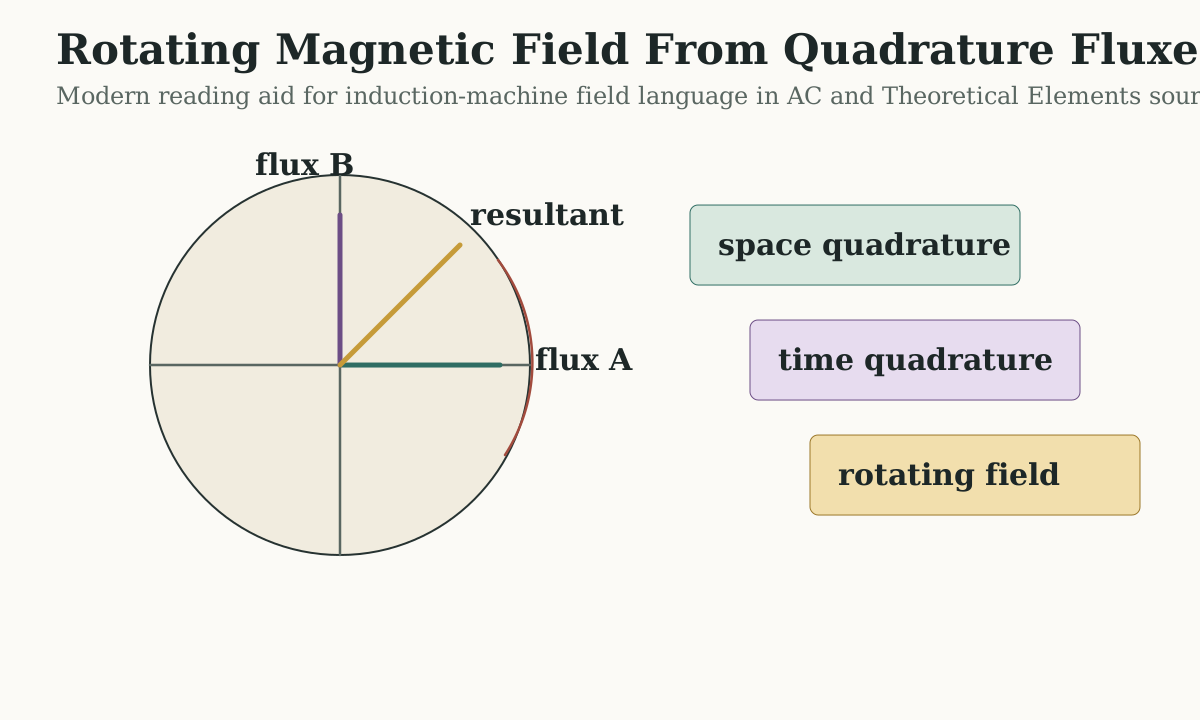
Section titled “Related Modern Guide Diagrams”Modern reading aid for induction-machine field language in AC and Theoretical Elements sources.
symbolic-method, magnetism, phase, induction-motor
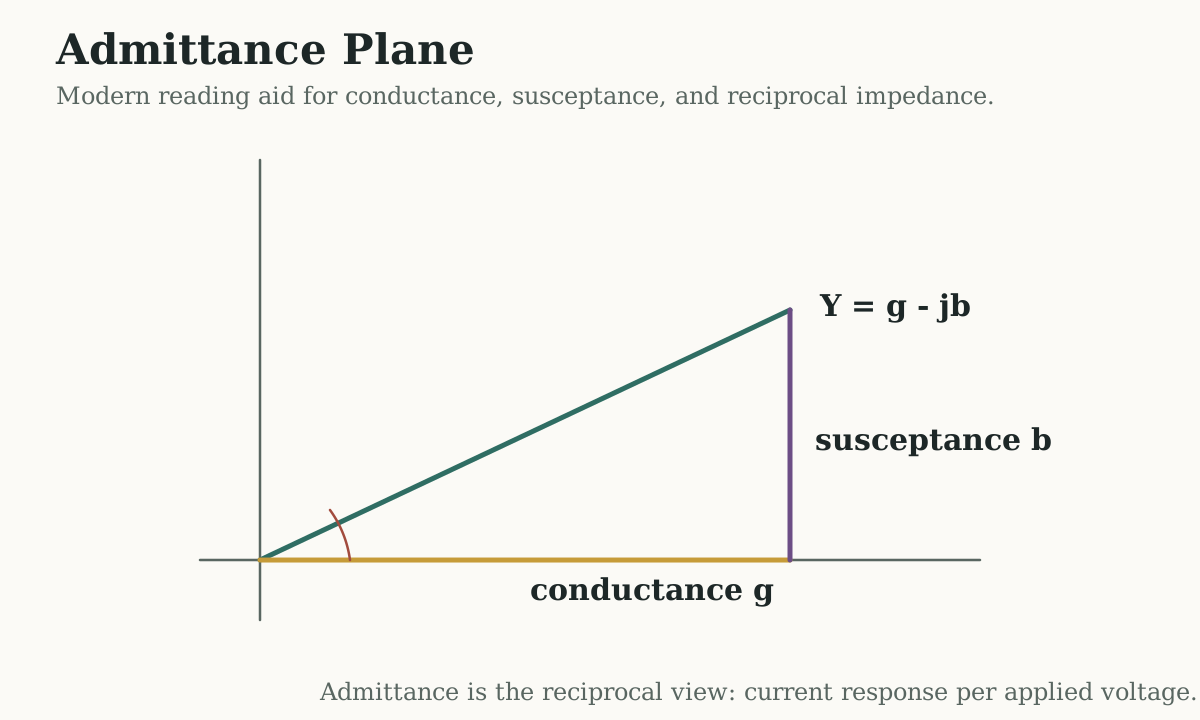
Modern reading aid for conductance, susceptance, and reciprocal impedance.
admittance, conductance, susceptance, symbolic-method
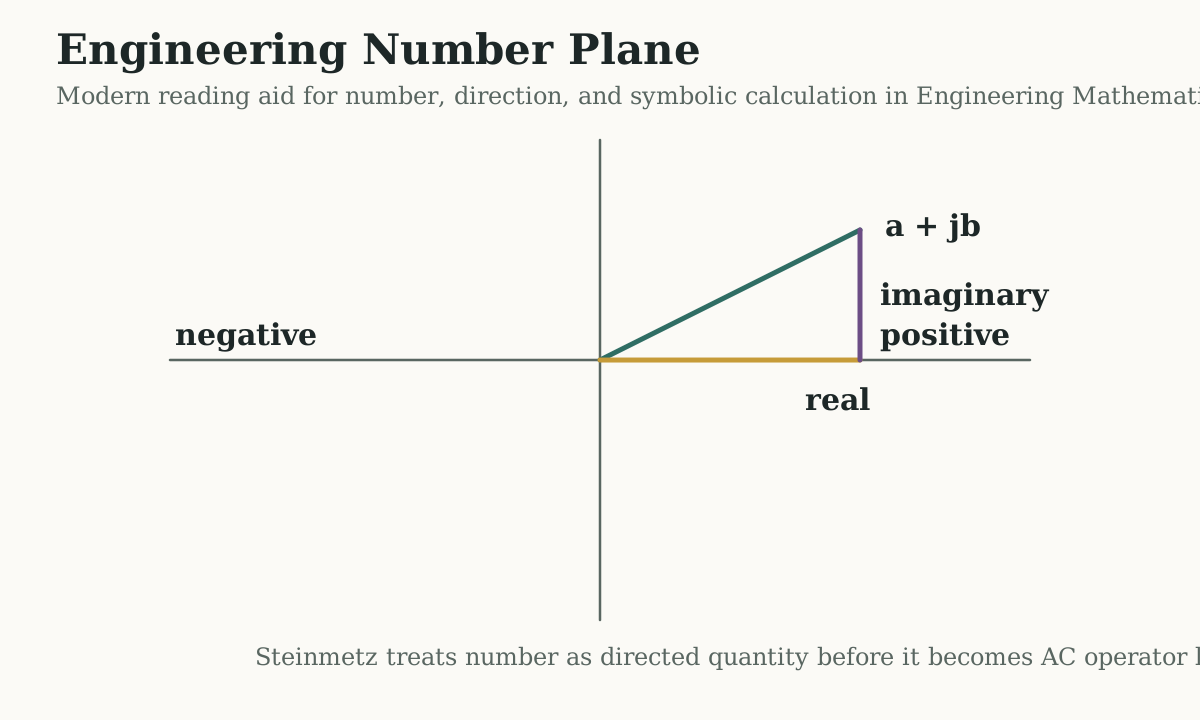
Modern reading aid for number, direction, and symbolic calculation in Engineering Mathematics.
complex-quantities, number, symbolic-method
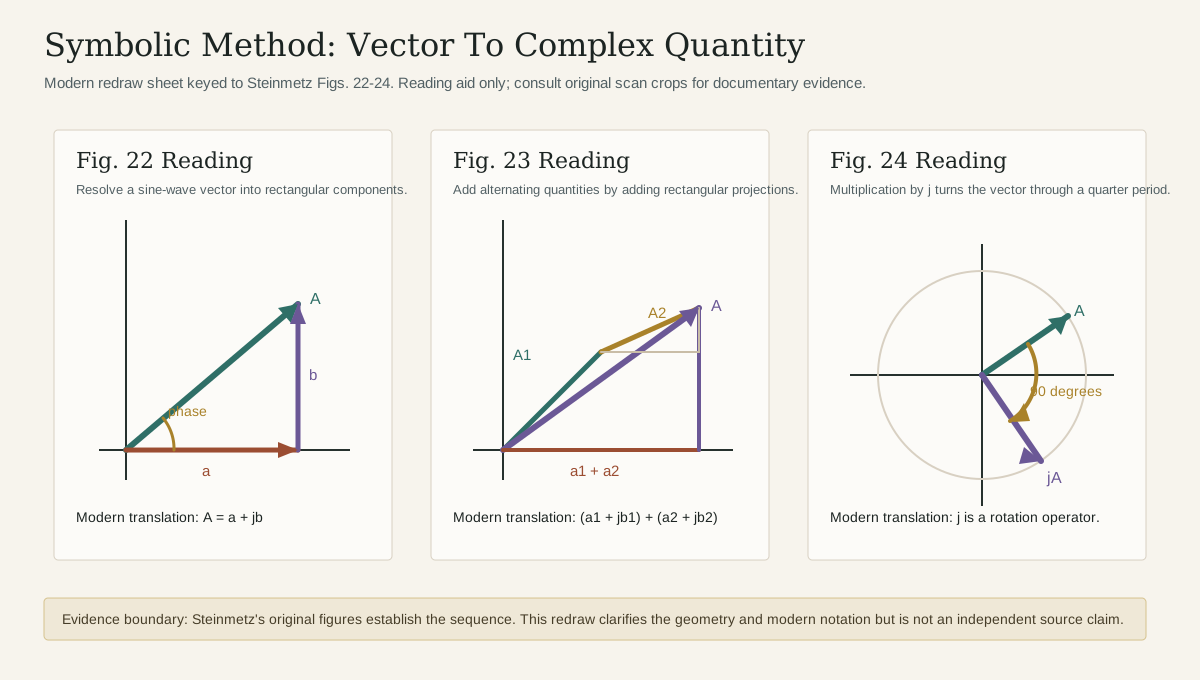
Modern redraw sheet for rectangular components, resultant addition, and quarter-period j rotation.
symbolic-method, complex-quantities, phasor, operator-j
Modern reading aid for vector and complex-number representation of alternating quantities.
symbolic-method, complex-quantities, phase, phasor
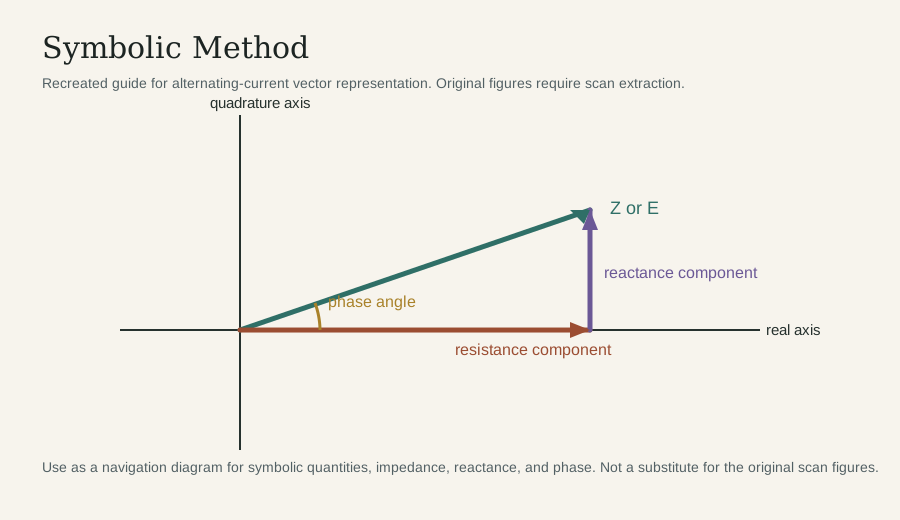
Modern guide for resistance, reactance, impedance, phase angle, and symbolic quantities.
impedance, reactance, power-factor, symbolic-method
Highest-Priority Formula Leads
Section titled “Highest-Priority Formula Leads”| Candidate | Family | OCR/PDF text | Routes |
|---|---|---|---|
theory-calculation-transient-electric-phenomena-oscillations-eq-candidate-0272strong-formula-candidate | transients-oscillation | At the moment 0 = 0, let the e.m.f. e = E cos (0 - 00) be | source research review |
theoretical-elements-electrical-engineering-eq-candidate-0102strong-formula-candidate | symbolic-ac | e = 2 7r/n$ sin r the instantaneous generated e.m.f. | source research review |
theory-calculation-alternating-current-phenomena-1900-eq-candidate-0240strong-formula-candidate | symbolic-ac | is r - j (x -f x0} = r = .6, x + x0 = 0, and tan S>0 = 0 ; | source research review |
theory-calculation-alternating-current-phenomena-eq-candidate-0167strong-formula-candidate | symbolic-ac | B = 6’ + jh” = 6(cos 13 + j sin /3) | source research review |
theory-calculation-alternating-current-phenomena-eq-candidate-0294strong-formula-candidate | symbolic-ac | is r - j {x + Xo) = r = 0.6, x -{- Xo = 0, and tan do = 0; that | source research review |
theory-calculation-electric-apparatus-eq-candidate-0028strong-formula-candidate | symbolic-ac | = - J = (tan a - j) (7) | source research review |
theory-calculation-transient-electric-phenomena-oscillations-eq-candidate-0276strong-formula-candidate | transients-oscillation | Since e = E cos (0 - 00) = impressed e.m.f., | source research review |
theory-calculation-transient-electric-phenomena-oscillations-eq-candidate-0296strong-formula-candidate | transients-oscillation | i = -z | cos (I? - 00- 0J- i~x° cos (00 + OJ j (9) | source research review |
Highest-Priority Figure Leads
Section titled “Highest-Priority Figure Leads”| Candidate | Caption lead | Section | Routes |
|---|---|---|---|
theory-calculation-alternating-current-phenomena-fig-010Fig. 10 | 21 Fig. 10. phase angle — /3’ = — (a’ — ??]) = 10 A, and the equations of | Chapter 4: Vector Representation | source research review |
theory-calculation-alternating-current-phenomena-fig-031Fig. 31 | CAPACIir AND RESISTANCE Fig. 31. Fig. 32. | Chapter 6: Topographic Method | source research review |
theory-calculation-alternating-current-phenomena-fig-033Fig. 33 | RESISTANCE AND LEAKAGE Fig. 33. 16 I TRANSMISSION | Chapter 6: Topographic Method | source research review |
theory-calculation-alternating-current-phenomena-fig-035Fig. 35 | RESISTANCE AND LEAKAGE Fig. 35. their difference of phase are plotted in Fig. 35 in rectangular | Chapter 6: Topographic Method | source research review |
theory-calculation-alternating-current-phenomena-fig-049Fig. 49 | 7 1.8 Fig. 49. The sign in the complex expression of admittance is always opposite to that of impedance; this is obvious, since if the cur- | Chapter 8: Admittance, Conductance, Susceptance | source research review |
theory-calculation-alternating-current-phenomena-fig-051Fig. 51 | Eo E Fig. 51. M | Chapter 9: Circuits Containing Resistance, Inductive Reactance, And Condensive Reactance | source research review |
theory-calculation-alternating-current-phenomena-fig-052Fig. 52 | Eo Fig. 52. Fig. 53. | Chapter 9: Circuits Containing Resistance, Inductive Reactance, And Condensive Reactance | source research review |
theory-calculation-alternating-current-phenomena-fig-053Fig. 53 | Fig. 52. Fig. 53. 2. Reactance in Series with a Circuit | Chapter 9: Circuits Containing Resistance, Inductive Reactance, And Condensive Reactance | source research review |