Skip to content

Alternating Current Phenomena

Original Source Access

Theory and Calculation of Alternating Current Phenomena

Edition alignment is still under review, so scan checking is required before quoting exact text or notation.

sources/theory-calculation-alternating-current-phenomena/raw/alternating-current-phenomena-local.pdf
Open inline scan reader

This is one of the central Steinmetz texts for the entire project. It contains the technical language that later becomes standard electrical engineering: impedance, reactance, admittance, conductance, susceptance, symbolic representation, vector methods, effective values, transformers, harmonics, and polyphase systems.

It should eventually become one of the deepest parts of the archive because many modern readers know the formulas but have lost the older conceptual language around them.

The first public page now treats this source as the home base for symbolic AC mathematics. It is where the archive should preserve the older words and geometries around phase, opposition, stored energy, loss, and wave shape before translating them into present-day phasor language.

The OCR table of contents and structural split point toward these major blocks:

  • Introduction, impedance, reactance, and effective resistance
  • Instantaneous and integral values
  • Electromagnetic induction
  • Vector representation
  • Symbolic method
  • Admittance, conductance, and susceptance
  • Resistance, inductance, and capacity
  • Transmission line resistance and reactance
  • Effective resistance and hysteresis
  • Dielectric losses
  • Distributed capacity and inductance
  • Transformers and induction machines
  • Harmonics and wave-shape distortion
  • Polyphase systems
  • Impedance
  • Reactance
  • Admittance
  • Conductance
  • Susceptance
  • Symbolic method
  • Effective resistance
  • Magnetic hysteresis
  • Dielectric hysteresis
  • Transformer equivalent circuit
  • Higher harmonics
  • Polyphase transformation

Impedance and Reactance

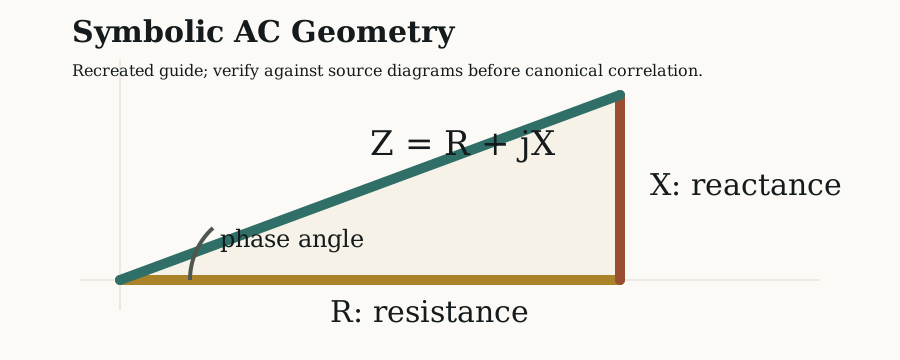
These should be decoded as both calculation tools and physical language. The modern formula is compact, but the old vocabulary keeps the opposition between resistance-like loss and reactance-like energy storage visible.

Symbolic Method

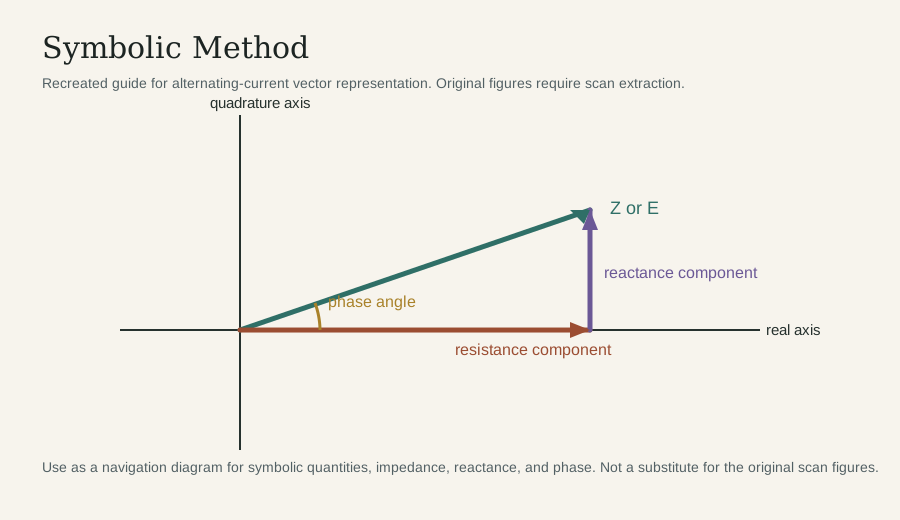
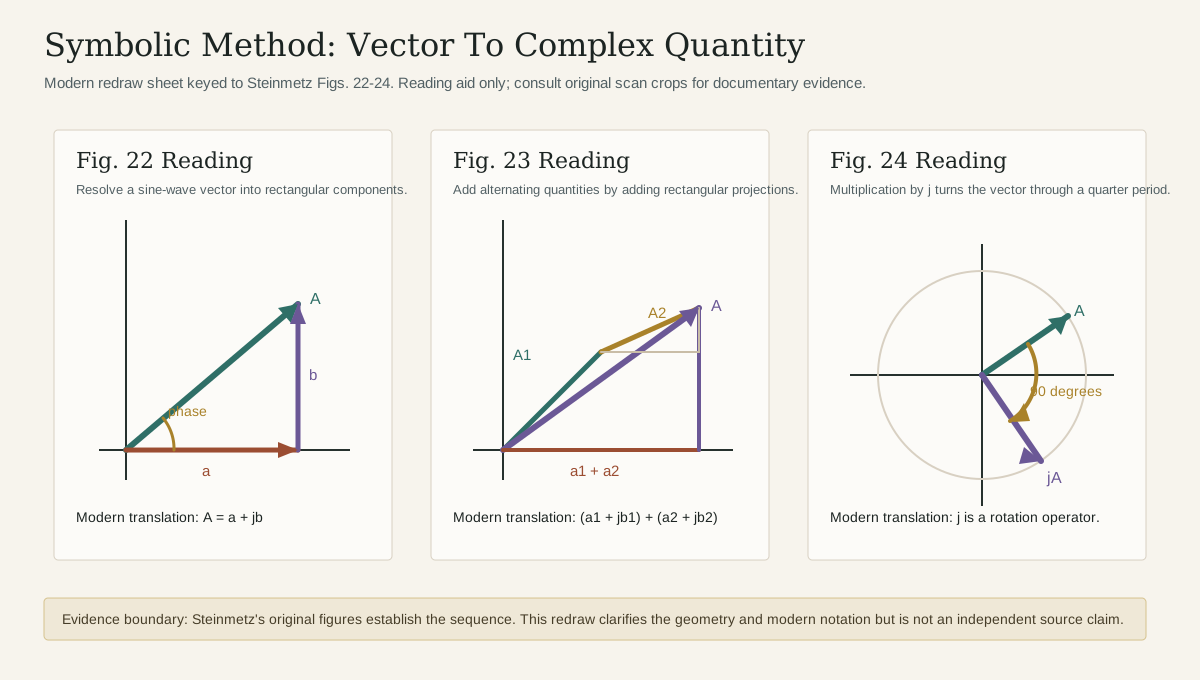
The symbolic method is a way to calculate alternating quantities while retaining phase. The archive should show how this becomes the modern complex-number phasor method without losing Steinmetz’s geometric presentation.

Loss and Hysteresis

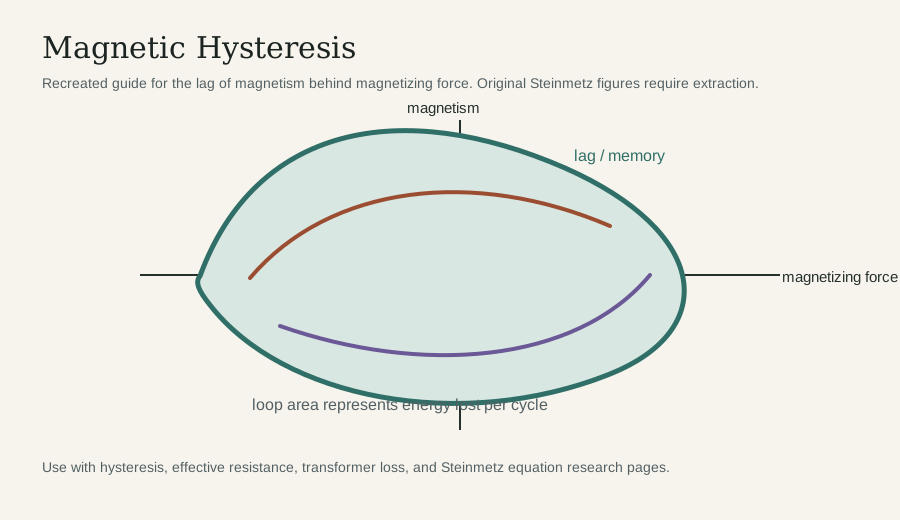
Magnetic and dielectric losses are critical because they connect circuit behavior to material behavior. These pages need exact extraction of equations, curves, and language before interpretation is attached.

Modern Electrical Engineering Interpretation

This source is where the archive should build modern phasor/complex-number translations while preserving Steinmetz’s own terms. A good page should show the original statement, the modern equivalent formula, and the physical meaning, then connect it to present-day circuit analysis.

Ether-Field Interpretive Reading

Interpretive only: the old language around magnetic hysteresis, dielectric loss, field energy, and reactance may be useful to field-centered readings. The page must separate Steinmetz’s engineering statements from modern ether-field interpretation.

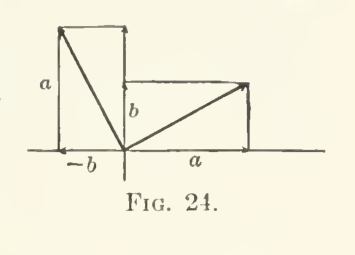
Original scan crop of Steinmetz Fig. 24 quarter-period rotation
Original symbolic-method crop

Fig. 24 from Chapter V, showing the quarter-period meaning of j.

Modern redraw sheet for Steinmetz symbolic-method figures
Symbolic-method redraw sheet

A source-keyed guide for the vector-to-complex-number transition.

Recreated symbolic method phasor guide
Symbolic method

Magnitude, phase, resistance, and reactance as a calculable geometry.

Recreated magnetic hysteresis loop guide
Hysteresis

Lag, energy loss, and effective resistance in magnetic materials.

Recreated impedance and reactance triangle guide
Impedance geometry

Resistance, reactance, magnitude, and phase angle as one symbolic quantity.

  • Structural split: 37 chapter candidates
  • Figure candidates: 145
  • Promoted original scan crops: 4
  • Equation candidates: 300 capped
  • OCR quality: useful for discovery; exact formulas and edition alignment require review

Generated source dashboard: this section joins the source overview to the book coverage atlas, source text reader, chapter workbench, visual maps, and formula maps. Counts are candidate research aids until scan verification promotes them.

37

processed sections

109,539

candidate words

300

formula candidates

145

figure candidates

4

promoted crops

What This Source Currently Gives The Archive

Section titled “What This Source Currently Gives The Archive”

Theory and Calculation of Alternating Current Phenomena currently contributes 37 processed sections and 109,539 candidate OCR/PDF-text words to the archive. Its strongest tracked evidence clusters are Impedance / reactance, Waves / transmission lines, Magnetism.

This is a routing judgment based on processed metadata, not a final historical claim. The strongest next move for any exact quotation, equation, or diagram is still to open the source scan and check the page image.
ThemeCandidate HitsEvidence Route
Impedance / reactance1,066Open theme evidence
Waves / transmission lines826Open theme evidence
Magnetism800Open theme evidence
Dielectricity / capacity453Open theme evidence
Field language386Open theme evidence
Alternating current313Open theme evidence
Complex quantities251Open theme evidence
Radiation / light244Open theme evidence

Chapter 6: Topographic Method

lines 3267-3618 - 1,780 words

Signals

Dielectricity / capacity, Waves / transmission lines, Impedance / reactance

Ether
Candidate material

8 equations - 8 figures - 0 quotes

Chapter 9: Circuits Containing Resistance, Inductive Reactance, And Condensive Reactance

lines 4674-6992 - 3,916 words

Signals

Impedance / reactance, Alternating current, Dielectricity / capacity

Ether
Candidate material

8 equations - 8 figures - 0 quotes

Chapter 7: Polar Coordinates And Polar Diagrams

lines 3619-4087 - 2,051 words

Signals

Waves / transmission lines, Complex quantities, Impedance / reactance

Ether
Candidate material

8 equations - 7 figures - 0 quotes

Chapter 4: Vector Representation

lines 2149-2759 - 3,435 words

Signals

Waves / transmission lines, Magnetism, Impedance / reactance

Light, Frequency
Candidate material

8 equations - 4 figures - 0 quotes

Chapter 2: Instantaneous Values And Integral Values

lines 1684-2011 - 1,100 words

Signals

Waves / transmission lines, Magnetism, Alternating current

No current concept hits
Candidate material

8 equations - 2 figures - 0 quotes

Chapter 5: Symbolic Method

lines 2760-3266 - 2,253 words

Signals

Waves / transmission lines, Complex quantities, Impedance / reactance

Frequency
Candidate material

8 equations - 1 figures - 0 quotes

Chapter 1: Introduction

lines 1120-1683 - 2,869 words

Signals

Waves / transmission lines, Impedance / reactance, Magnetism

Frequency, Light
Candidate material

8 equations - 0 figures - 0 quotes

Chapter 8: Admittance, Conductance, Susceptance

lines 4088-4673 - 1,363 words

Signals

Impedance / reactance, Alternating current, Complex quantities

No current concept hits
Candidate material

8 equations - 1 figures - 0 quotes

TermCandidate HitsUse
counter e.m.f.70Review in workbench before promoting to glossary.
ether41Review in workbench before promoting to glossary.
effective resistance33Review in workbench before promoting to glossary.
electrostatic capacity1Review in workbench before promoting to glossary.
wave length1Review in workbench before promoting to glossary.

Source custody

Verify title page, edition, page images, and OCR line boundaries before final quotation.

Mathematics

Use the formula map to locate equations, then correct OCR symbols and preserve Steinmetz notation before modern translation.

Interpretation boundary

Modern engineering and ether-field readings belong after source anchoring, with labels kept visible.