Reactance
Steinmetz Usage
Section titled “Steinmetz Usage”Reactance is the component of AC opposition that stands in quadrature with current. The OCR candidate repeatedly distinguishes it from resistance: resistance consumes power, while reactance corresponds to a voltage component displaced by 90 degrees.
Steinmetz treats inductive reactance and “condensive reactance” as opposite in sign.
Modern Equivalent
Section titled “Modern Equivalent”The sign convention must be checked against the edition before canonical wording is finalized.
Plain-English Explanation
Section titled “Plain-English Explanation”Reactance is opposition caused by fields storing and returning energy. Inductance stores energy magnetically. Capacity stores energy electrostatically. In AC, this stored energy shifts voltage and current out of phase.
Why It Matters
Section titled “Why It Matters”Reactance is the hinge connecting circuit algebra to field energy. It is also the bridge to resonance, phase control, transformers, transmission lines, and transient oscillations.
Modern Engineering Warning
Reactance is measured in ohms, but it is not resistance. Treating it as merely another kind of friction erases the field-storage meaning that Steinmetz’s older vocabulary keeps visible.
Related Pages
Section titled “Related Pages”Reader Synthesis
Section titled “Reader Synthesis”What Steinmetz Is Doing Here
Reactance is where Steinmetz keeps field storage visible inside circuit calculation.
The current strongest source route is Theory and Calculation of Alternating Current Phenomena, with 502 candidate hits across 26 sections.
Modern Translation
Modern engineering treats inductive and capacitive reactance as frequency-dependent quadrature opposition.
This page currently tracks 2490 candidate occurrences across 13 sources and 188 sections.
Mathematical And Visual Route
Use inductive reactance, condensive/capacitive reactance, phase displacement, impedance triangle, and power-factor relations.
Use the math/visual bridge lower on this page to jump into formula families, source visual maps, and candidate figure leads.
Interpretive Boundary
This is a strong field-interpretation bridge, but the source claim remains AC circuit behavior and energy exchange.
Layer labels stay active: source claim, modern equivalent, mathematical reconstruction, historical note, and interpretive reading are not interchangeable.
Best Steinmetz Passages To Read First
Section titled “Best Steinmetz Passages To Read First”| Passage | Hits | Location | Open |
|---|---|---|---|
| Chapter 14: Constant-Potential Constant-Current Trans Formation Theory and Calculation of Electric Circuits | 180 | lines 24023-27995 | read - research review |
| Chapter 12: Reactance Of Induction Apparatus Theory and Calculation of Electric Circuits | 62 | lines 22634-23465 | read - research review |
| Chapter 9: Circuits Containing Resistance, Inductive Reactance, And Condensive Reactance Theory and Calculation of Alternating Current Phenomena | 59 | lines 4674-6992 | read - research review |
| Mathematical Appendix 5: Appendix: Synchronous Operation Investigation of Some Trouble in the Generating System of the Commonwealth Edison Co. | 58 | PDF pages 27-68, lines 2165-5013 | read - research review |
Research Position
Section titled “Research Position”- Tracked vocabulary: Reactance.
- Concordance: Reactance.
- Source discipline: the table above is for reading and navigation; exact quotation still requires scan verification.
- Reader route: read the passage first, then return here for modern translation, mathematical reconstruction, visual routes, and interpretation boundaries.
- Editorial rule: expand this page by promoting scan-checked passages, equations, and diagrams from the linked workbench pages, not by adding unsourced generalizations.
Source Expansion Impact
Section titled “Source Expansion Impact”Reactance sits at the center of the next AC-method expansion.
Watch for how Steinmetz separates resistance, reactance, and stored-field exchange across editions and papers.
| Source Target | Year | Status | Why It Matters Here |
|---|---|---|---|
| Complex Quantities and Their Use in Electrical Engineering | 1894 | Registered Authority Target | This should become the flagship source for how Steinmetz made alternating-current calculation algebraic, geometric, and teachable. |
| The General Equations of the Electric Circuit | 1908 | Registered Authority Target | This paper bridges steady-state symbolic method, differential equations, and the general circuit theory behind later source books. |
| Systems of Electric Transmission and Distribution | 1900 | Registered Authority Target | This should connect Steinmetz’s high theory to practical power-system layout and AC distribution choices. |
Source-Grounded Dossier
Section titled “Source-Grounded Dossier”Generated evidence layer: this dossier is built from the processed concept concordance. Counts and snippets are OCR/PDF-text aids, not final quotations. Verify against scans before making exact claims.
Candidate occurrences tracked for this page.
Sources with at least one hit.
Sections, lectures, chapters, or report divisions to review.
What The Current Corpus Shows
Section titled “What The Current Corpus Shows”Read this concept page through the linked source passages first. Use the dossier to locate Steinmetz’s wording, then add modern, mathematical, historical, and interpretive layers only with labels.
The strongest current source concentration is Theory and Calculation of Alternating Current Phenomena with 502 candidate hits across 26 sections.
The dossier is meant to turn a concept page into a reading path: begin with Steinmetz’s source wording, then use the research links only when you need candidate counts, snippets, mathematical reconstruction, historical context, or interpretive layers.
Terms And Aliases Tracked
Section titled “Terms And Aliases Tracked”condensive reactance, inductive reactance, reactance, reactive
Concordance Records
Section titled “Concordance Records”Source Distribution
Section titled “Source Distribution”Priority Passages To Read
Section titled “Priority Passages To Read”Chapter 14: Constant-Potential Constant-Current Trans Formation - 180 candidate hits
Source: Theory and Calculation of Electric Circuits (1917)
Location: lines 24023-27995 - Tracked concepts: Reactance
... stant-voltage supply source, are Huch as U) approach constant-voltage constant-current tran.sfonnation, as in for instance the case in very long transmission line«, or>^;n-<:ircuit- ing may lead to dangeroiLs or even destructive voltage rh¥% 128. With an inductive reactance inserted in series to an alt^^r- 245 246 ELECTRIC CIRCUITS nating-current non-...... rted in series to an alt^^r- 245 246 ELECTRIC CIRCUITS nating-current non-inductive circuit, at constant-supply voltage, the current in this circuit is approximately constant, as long as the resistance of the circuit is small compared with the series inductive reactance. Let ^0 = Co = constant impressed alternating voltage; r = resistance of non-induc...Chapter 12: Reactance Of Induction Apparatus - 62 candidate hits
Source: Theory and Calculation of Electric Circuits (1917)
Location: lines 22634-23465 - Tracked concepts: Reactance
CHAPTER XII REACTANCE OF INDUCTION APPARATUS 109. An electric current passing through a conductor is ac- companied by a magnetic field surrounding this conductor, and this magnetic field is as integral a part of the phenomenon, as is the energy dissipation by the resistance o ...... d "non-inductive" circuit. With continuous current in stationary conditions, the inductance, L, has no effect on the energy flow; with alternating current of frequency, /, the inductance, L, consumes a voltage 2 x/Li, and is, therefore, represented by the reactance, x = 2x/L, which is measured in ohms, and differs from the ohmic resistance, r, merely...Chapter 9: Circuits Containing Resistance, Inductive Reactance, And Condensive Reactance - 59 candidate hits
Source: Theory and Calculation of Alternating Current Phenomena (1916)
Location: lines 4674-6992 - Tracked concepts: Reactance
CHAPTER IX CIRCUITS CONTAINING RESISTANCE, INDUCTIVE REACTANCE, AND CONDENSIVE REACTANCE 53. Having, in the foregoing, re-established Ohm's law and Kirchhoff 's laws as being also the fundamental laws of alternating- current circuits, when expressed in their complex form, E = ZI, or, 7 = YE, and "EE = 0 in a cl ...CHAPTER IX CIRCUITS CONTAINING RESISTANCE, INDUCTIVE REACTANCE, AND CONDENSIVE REACTANCE 53. Having, in the foregoing, re-established Ohm's law and Kirchhoff 's laws as being also the fundamental laws of alternating- current circuits, when expressed in their complex form, E = ZI, or, 7 = YE, and "EE = 0 in a closed circuit, S/ = 0 at ...Mathematical Appendix 5: Appendix: Synchronous Operation - 58 candidate hits
Source: Investigation of Some Trouble in the Generating System of the Commonwealth Edison Co. (1919)
Location: PDF pages 27-68, lines 2165-5013 - Tracked concepts: Reactance
... ngle 2w. That is, the one alternator has the voltage phase (<f> to), the other the voltage phase (0+w). We may assume the alternators as of equal voltage, since a voltage difference superposes on the synchronizing energy current due to the phase difference, a reactive magnetizing current due to the voltage difference without materially changing the en...... [ = 2E sin co sin (2) and the interchange currentwbeteen the alternators is: 2E . i = sin co sin (<j> a) (3) where: z = r2+x 2 is the impedance of the circuit between the two alternators, and the phase angle a is given by: x tan a = - r and: r= resistance x = reactance of the circuit between the alternators (including their internal resistances and re...Chapter 22: Armature Reactions Of Alternators - 52 candidate hits
Source: Theory and Calculation of Alternating Current Phenomena (1916)
Location: lines 23971-25134 - Tracked concepts: Reactance
... ective self-induction, that is, instead of the counter m.m.f. of the armature reaction, the e.m.f. considered, which would be generated by the magnetic flux, which the arma- ture reaction would produce. That is, both effects are com- bined in an effective reactance, the "synchronous reactance." While armature reaction and self-inductance are similar i...... is, instead of the counter m.m.f. of the armature reaction, the e.m.f. considered, which would be generated by the magnetic flux, which the arma- ture reaction would produce. That is, both effects are com- bined in an effective reactance, the "synchronous reactance." While armature reaction and self-inductance are similar in ARMATURE REACTIONS OF ALTE...Chapter 13: Reactance Of Synchronous Machines - 43 candidate hits
Source: Theory and Calculation of Electric Circuits (1917)
Location: lines 23466-24022 - Tracked concepts: Reactance
CHAPTER XIII REACTANCE OF SYNCHRONOUS MACHINES 119. The synchronous machine - ^alternating-current generator, synchronous motor or synchronous condenser - consists of an armature containing one or more electric circuits traversed by alternating currents and synchronously revo ...... ts and synchronously revolving relative to a unidirectional magnetic field, excited by direct current. The armature circuit, like every electric circuit, has a resistance, r, in which power is being dissipated by the current, /, and an in- ductance, L, or reactance, a; = 2 irfL^ which represents the mag- netic flux produced by the current in the armat...Reading Layers To Build Out
Section titled “Reading Layers To Build Out”| Layer | What to add next |
|---|---|
| Steinmetz wording | Pull exact source passages only after scan verification; keep OCR text labeled until then. |
| Modern engineering reading | Translate the source usage into present electrical-engineering or physics language without erasing the older vocabulary. |
| Mathematical layer | Link equations, variables, diagrams, and worked examples when the concept has formula candidates. |
| Historical layer | Identify whether the term is still used, renamed, absorbed into modern theory, or historically obsolete. |
| Ether-field interpretation | Keep interpretive readings separate from Steinmetz’s explicit claim and from modern physics. |
| Open questions | Record places where the concordance suggests a lead but the scan or edition has not yet been checked. |
Next Editorial Actions
Section titled “Next Editorial Actions”- Open the highest-priority source-text passages above and verify the wording against scans.
- Promote exact definitions, equations, diagrams, and hidden-gem passages into this page with source references.
- Add related concept links, equation pages, and diagram pages once the evidence is scan checked.
- Keep speculative or Wheeler-style readings in explicitly labeled interpretation blocks.
Math And Visual Evidence Map
Section titled “Math And Visual Evidence Map”Generated bridge: this section crosslinks the concept page with the formula atlas, figure atlas, source visual maps, and source formula maps. It is a routing layer, not final interpretation.
Formula candidates routed to this concept.
Figure candidates routed to this concept.
Modern guide diagrams related to this concept.
Formula Families To Review
Section titled “Formula Families To Review”Apparatus, Machines, And Power Systems - Impedance, Reactance, And Admittance - Inductance, Capacity, And Stored Energy
Source Maps For This Concept
Section titled “Source Maps For This Concept”theory-calculation-alternating-current-phenomena visuals - theory-calculation-alternating-current-phenomena formulas - theory-calculation-electric-circuits visuals - theory-calculation-electric-circuits formulas - theory-calculation-alternating-current-phenomena-1900 visuals - theory-calculation-alternating-current-phenomena-1900 formulas - theoretical-elements-electrical-engineering visuals - theoretical-elements-electrical-engineering formulas - theory-calculation-alternating-current-phenomena-1897 visuals - theory-calculation-alternating-current-phenomena-1897 formulas - theory-calculation-transient-electric-phenomena-oscillations visuals - theory-calculation-transient-electric-phenomena-oscillations formulas
Related Modern Guide Diagrams
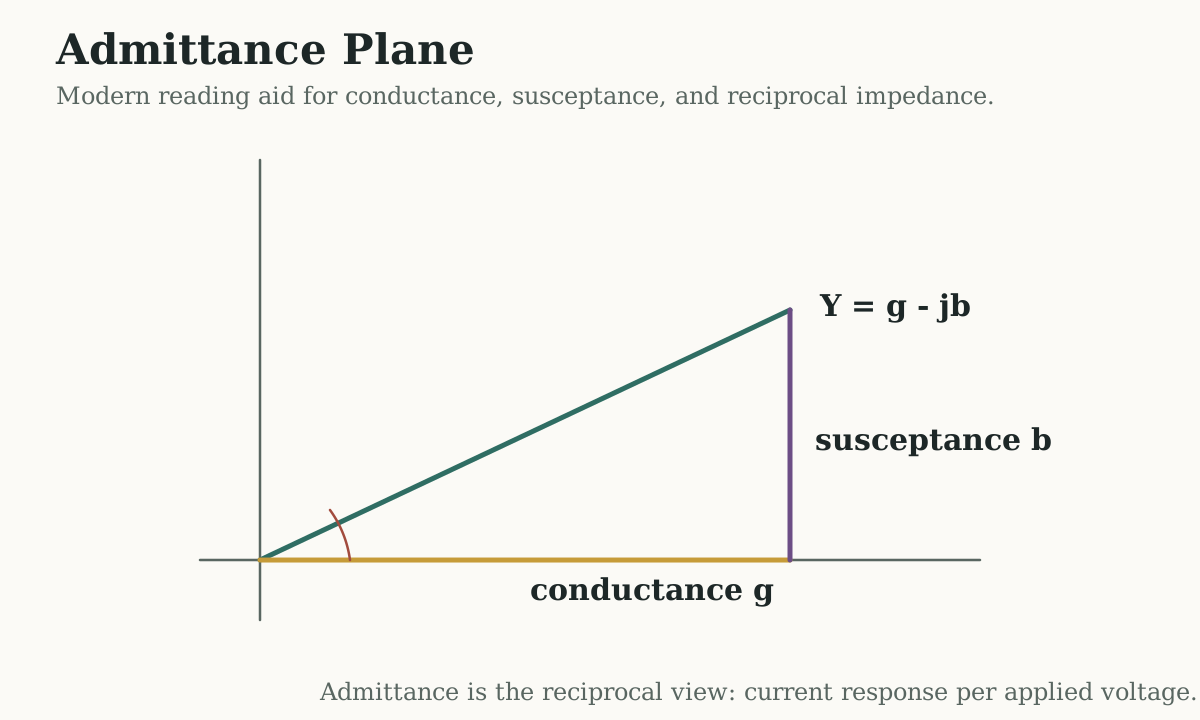
Section titled “Related Modern Guide Diagrams”Modern reading aid for conductance, susceptance, and reciprocal impedance.
admittance, conductance, susceptance, symbolic-method
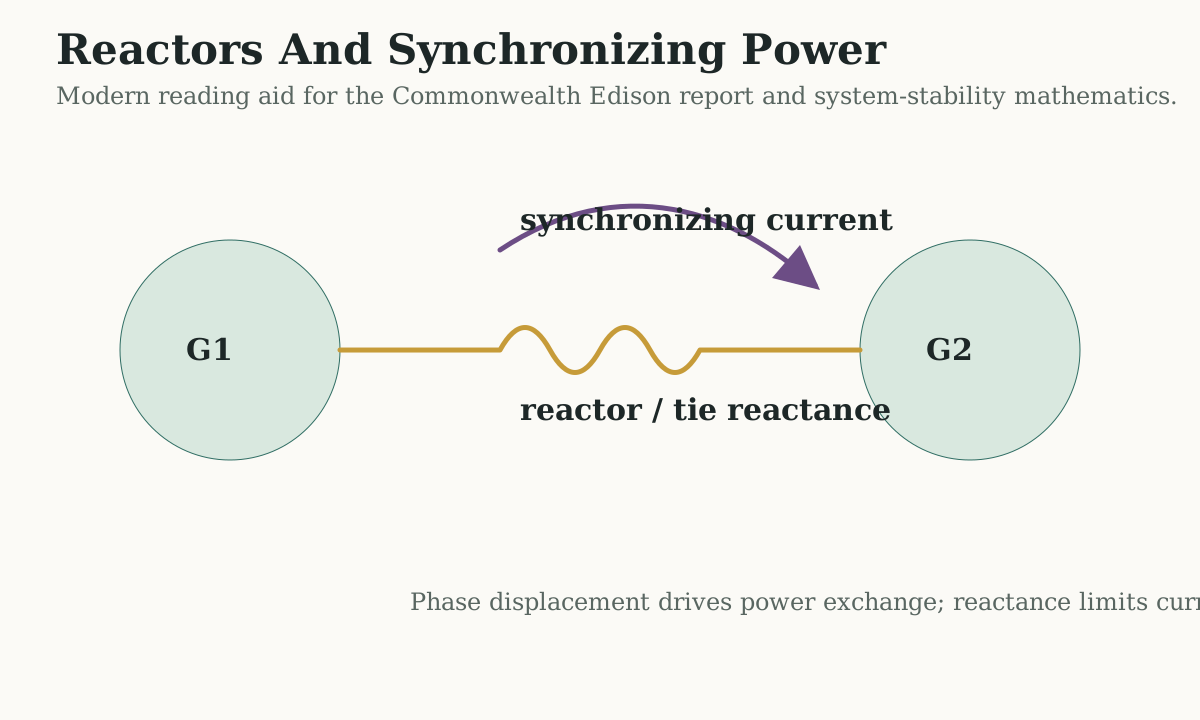
Modern reading aid for the Commonwealth Edison report and system-stability mathematics.
synchronizing-power, power-limiting-reactors, reactance
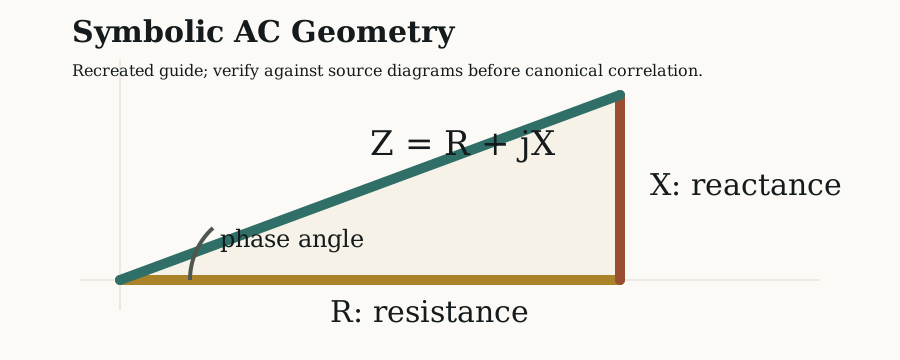
Modern guide for resistance, reactance, impedance, phase angle, and symbolic quantities.
impedance, reactance, power-factor, symbolic-method
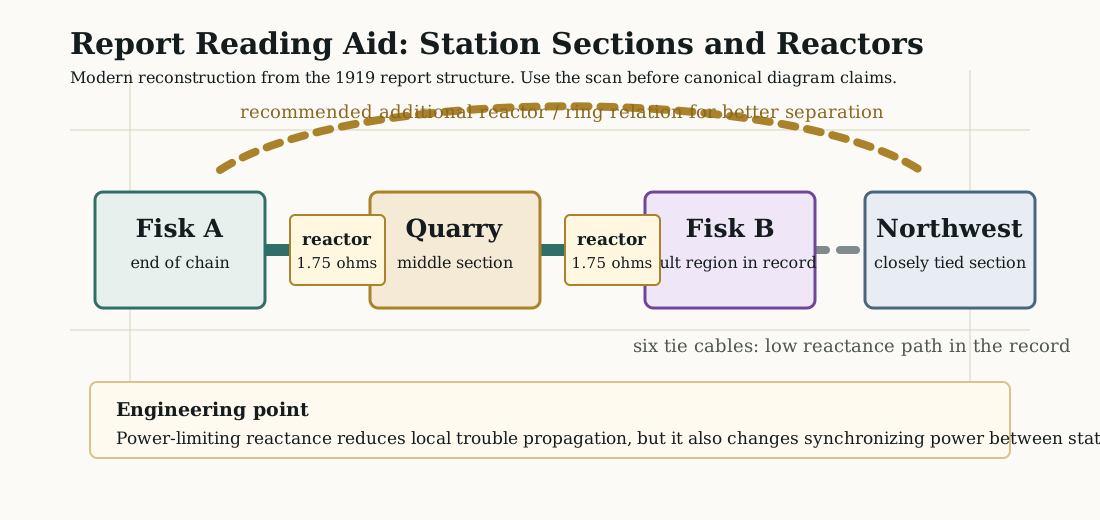
Modern reading aid for station sections, power-limiting reactors, tie cables, and synchronism.
power-limiting-reactors, synchronizing-power, reactance, power-systems
Highest-Priority Formula Leads
Section titled “Highest-Priority Formula Leads”| Candidate | Family | OCR/PDF text | Routes |
|---|---|---|---|
theory-calculation-transient-electric-phenomena-oscillations-eq-candidate-0272strong-formula-candidate | transients-oscillation | At the moment 0 = 0, let the e.m.f. e = E cos (0 - 00) be | source research review |
theory-calculation-alternating-current-phenomena-1900-eq-candidate-0240strong-formula-candidate | symbolic-ac | is r - j (x -f x0} = r = .6, x + x0 = 0, and tan S>0 = 0 ; | source research review |
theory-calculation-alternating-current-phenomena-eq-candidate-0294strong-formula-candidate | symbolic-ac | is r - j {x + Xo) = r = 0.6, x -{- Xo = 0, and tan do = 0; that | source research review |
theory-calculation-transient-electric-phenomena-oscillations-eq-candidate-0276strong-formula-candidate | transients-oscillation | Since e = E cos (0 - 00) = impressed e.m.f., | source research review |
theory-calculation-transient-electric-phenomena-oscillations-eq-candidate-0296strong-formula-candidate | transients-oscillation | i = -z | cos (I? - 00- 0J- i~x° cos (00 + OJ j (9) | source research review |
theory-calculation-alternating-current-phenomena-1897-eq-candidate-0161strong-formula-candidate | symbolic-ac | but E = E^y I^E^j z. If x^ > - 2,t-, it raises, if ;r < - 2 jr, | source research review |
theory-calculation-alternating-current-phenomena-1900-eq-candidate-0156strong-formula-candidate | apparatus-systems | E.M.F. of the generator OE°, where Z0 = r0 - jx0 = inter- | source research review |
theory-calculation-alternating-current-phenomena-1900-eq-candidate-0281strong-formula-candidate | inductance-capacity | Then, if E0 = impressed E.M.F.,- | source research review |
Highest-Priority Figure Leads
Section titled “Highest-Priority Figure Leads”| Candidate | Caption lead | Section | Routes |
|---|---|---|---|
theory-calculation-alternating-current-phenomena-fig-049Fig. 49 | 7 1.8 Fig. 49. The sign in the complex expression of admittance is always opposite to that of impedance; this is obvious, since if the cur- | Chapter 8: Admittance, Conductance, Susceptance | source research review |
theory-calculation-alternating-current-phenomena-fig-051Fig. 51 | Eo E Fig. 51. M | Chapter 9: Circuits Containing Resistance, Inductive Reactance, And Condensive Reactance | source research review |
theory-calculation-alternating-current-phenomena-fig-052Fig. 52 | Eo Fig. 52. Fig. 53. | Chapter 9: Circuits Containing Resistance, Inductive Reactance, And Condensive Reactance | source research review |
theory-calculation-alternating-current-phenomena-fig-053Fig. 53 | Fig. 52. Fig. 53. 2. Reactance in Series with a Circuit | Chapter 9: Circuits Containing Resistance, Inductive Reactance, And Condensive Reactance | source research review |
theory-calculation-alternating-current-phenomena-fig-054Fig. 54 | ohms inductance-’— reactance-^condensance Fig. 54. E^, are shown for various conditions of a receiver circuit and | Chapter 9: Circuits Containing Resistance, Inductive Reactance, And Condensive Reactance | source research review |
theory-calculation-alternating-current-phenomena-fig-055Fig. 55 | 0 Fig. 55. Fig. 56. | Chapter 9: Circuits Containing Resistance, Inductive Reactance, And Condensive Reactance | source research review |
theory-calculation-alternating-current-phenomena-fig-056Fig. 56 | Fig. 55. Fig. 56. Fig. 57. | Chapter 9: Circuits Containing Resistance, Inductive Reactance, And Condensive Reactance | source research review |
theory-calculation-alternating-current-phenomena-fig-057Fig. 57 | Fig. 56. Fig. 57. is, the current and e.m.f. in the supply circuit are in phase with | Chapter 9: Circuits Containing Resistance, Inductive Reactance, And Condensive Reactance | source research review |