Complex Quantities
Steinmetz’s Meaning
Section titled “Steinmetz’s Meaning”In the symbolic-method chapter, Steinmetz presents complex quantities as an engineering language for alternating sine waves. The complex expression holds both magnitude and phase, and it lets the engineer combine waves by operating on their rectangular components.
The important historical point is the order of explanation. Steinmetz does not begin by asking the reader to accept an abstract imaginary number. He begins with a vector, resolves it into rectangular components, marks the vertical component with j, then defines j through the rotation operation.
Modern Equivalent
Section titled “Modern Equivalent”Modern electrical engineering uses complex numbers for phasors, impedance, admittance, power, transfer functions, and frequency-domain circuit analysis.
The notation is standard today, but Steinmetz’s presentation helps recover why it works: the algebra is carrying geometry.
Diagrammatic Explanation
Section titled “Diagrammatic Explanation”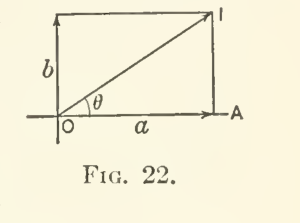
Magnitude and phase are translated into two rectangular quantities.
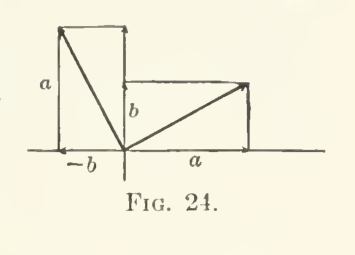
The symbol j becomes a quarter-period rotation operator.
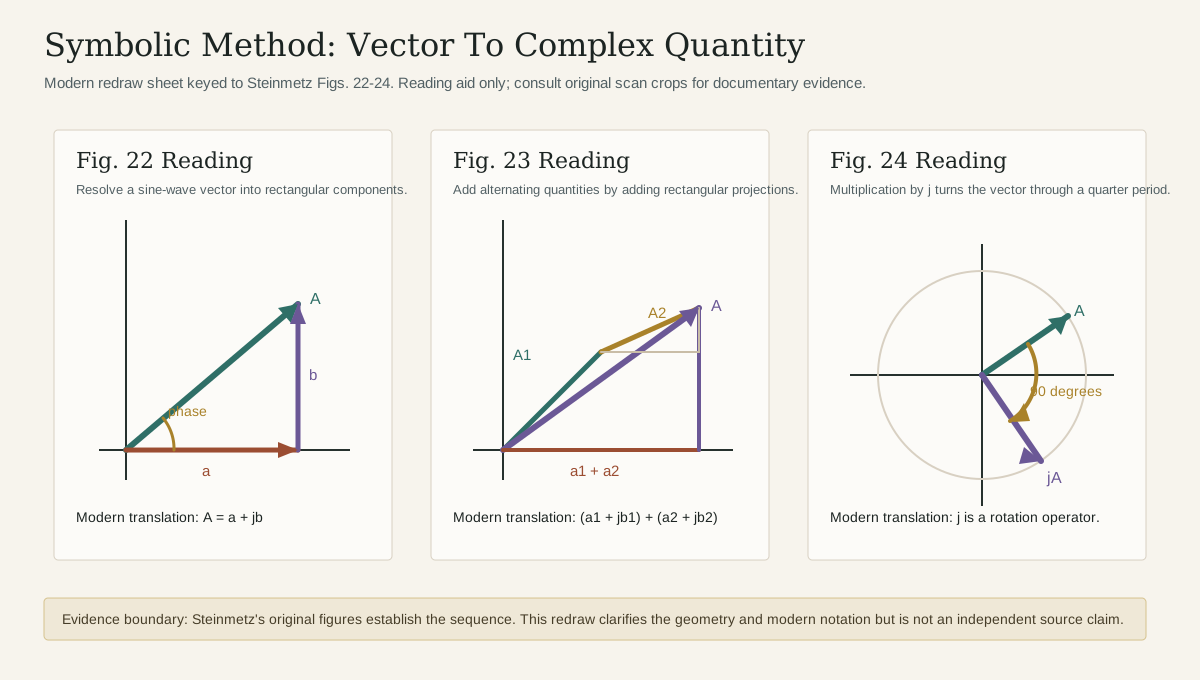
The full visual sequence from vector to rectangular components to j rotation.
The phasor and symbolic form tool lets readers vary magnitude and phase while watching the real and quadrature components change.
Relation To Other Concepts
Section titled “Relation To Other Concepts”| Related Concept | Connection |
|---|---|
| Symbolic Method | The practical method built from complex quantities. |
| Impedance | Resistance and reactance become components of one complex quantity. |
| Reactance | The quadrature component becomes calculable without losing its phase meaning. |
| Power Factor | Phase displacement becomes visible through the relation between real and apparent power. |
Why It Matters
Section titled “Why It Matters”Complex quantities are one of Steinmetz’s deepest acts of translation. They preserve the geometry of alternating phenomena while making it calculable. That is why a page on j belongs in a historical archive, not only in a modern math appendix.
Modern Electrical Engineering Interpretation
This is the foundation of phasor analysis. The modern reader should understand complex quantities as a compression of rotating sinusoidal behavior into a fixed frequency-domain representation.
Ether-Field Interpretive Reading
Interpretive only: the quadrature structure can be read as preserving a distinction between direct, dissipative action and phase-shifted field exchange. This may be useful to field-centered readers, but the archive does not treat that reading as Steinmetz’s explicit ontology unless the source text says so.
Open Research Tasks
Section titled “Open Research Tasks”- Compare AC Chapter V with Steinmetz’s Engineering Mathematics treatment of general number.
- Verify whether later editions adjust the terminology around imaginary unit, general number, or complex imaginary quantity.
- Build an annotated derivation from
I = a + jbtoZ = r + jxandE = ZI.
Reader Synthesis
Section titled “Reader Synthesis”What Steinmetz Is Doing Here
Complex quantities are treated as a general engineering number system, not as decorative notation.
The current strongest source route is Theory and Calculation of Alternating Current Phenomena, with 41 candidate hits across 9 sections.
Modern Translation
Modern readers should connect the page to phasors, complex planes, rotating quantities, and sinusoidal steady-state analysis.
This page currently tracks 156 candidate occurrences across 10 sources and 48 sections.
Mathematical And Visual Route
Prioritize rectangular/polar conversion, multiplication by j, magnitude, phase, and division of complex quantities.
Use the math/visual bridge lower on this page to jump into formula families, source visual maps, and candidate figure leads.
Interpretive Boundary
Any philosophical reading must follow the mathematical layer, because Steinmetz’s immediate purpose is calculational power.
Layer labels stay active: source claim, modern equivalent, mathematical reconstruction, historical note, and interpretive reading are not interchangeable.
Best Steinmetz Passages To Read First
Section titled “Best Steinmetz Passages To Read First”| Passage | Hits | Location | Open |
|---|---|---|---|
| Chapter 5: Symbolic Method Theory and Calculation of Alternating Current Phenomena | 13 | lines 2760-3266 | read - research review |
| Chapter 1: The General Number Engineering Mathematics: A Series of Lectures Delivered at Union College | 11 | lines 915-3491 | read - research review |
| Chapter 5: Symbouc Mbthod Theory and Calculation of Alternating Current Phenomena | 10 | lines 2744-3229 | read - research review |
| Chapter 30: Quartbr-Fhase System Theory and Calculation of Alternating Current Phenomena | 9 | lines 27501-29124 | read - research review |
Research Position
Section titled “Research Position”- Tracked vocabulary: Complex Quantities.
- Concordance: Complex Quantities.
- Source discipline: the table above is for reading and navigation; exact quotation still requires scan verification.
- Reader route: read the passage first, then return here for modern translation, mathematical reconstruction, visual routes, and interpretation boundaries.
- Editorial rule: expand this page by promoting scan-checked passages, equations, and diagrams from the linked workbench pages, not by adding unsourced generalizations.
Source Expansion Impact
Section titled “Source Expansion Impact”The missing flagship is Steinmetz’s 1893/1894 complex-quantities paper.
The current page is grounded in processed textbooks; the proceedings paper will become the primary origin-point once scanned and sectioned.
| Source Target | Year | Status | Why It Matters Here |
|---|---|---|---|
| Complex Quantities and Their Use in Electrical Engineering | 1894 | Registered Authority Target | This should become the flagship source for how Steinmetz made alternating-current calculation algebraic, geometric, and teachable. |
| The General Equations of the Electric Circuit | 1908 | Registered Authority Target | This paper bridges steady-state symbolic method, differential equations, and the general circuit theory behind later source books. |
| The General Equations of the Electric Circuit-III | 1919 | Registered Authority Target | The continuation lets the archive show development over time rather than treating general circuit equations as a one-off article. |
Source-Grounded Dossier
Section titled “Source-Grounded Dossier”Generated evidence layer: this dossier is built from the processed concept concordance. Counts and snippets are OCR/PDF-text aids, not final quotations. Verify against scans before making exact claims.
Candidate occurrences tracked for this page.
Sources with at least one hit.
Sections, lectures, chapters, or report divisions to review.
What The Current Corpus Shows
Section titled “What The Current Corpus Shows”Read this concept page through the linked source passages first. Use the dossier to locate Steinmetz’s wording, then add modern, mathematical, historical, and interpretive layers only with labels.
The strongest current source concentration is Theory and Calculation of Alternating Current Phenomena with 41 candidate hits across 9 sections.
The dossier is meant to turn a concept page into a reading path: begin with Steinmetz’s source wording, then use the research links only when you need candidate counts, snippets, mathematical reconstruction, historical context, or interpretive layers.
Terms And Aliases Tracked
Section titled “Terms And Aliases Tracked”complex quantities, complex quantity, imaginary quantities, imaginary quantity
Concordance Records
Section titled “Concordance Records”Source Distribution
Section titled “Source Distribution”Priority Passages To Read
Section titled “Priority Passages To Read”Chapter 5: Symbolic Method - 13 candidate hits
Source: Theory and Calculation of Alternating Current Phenomena (1916)
Location: lines 2760-3266 - Tracked concepts: Complex Quantities
... eriod; that is, leading the wave by one-quarter period. Similarly - Multiplying by - j jneans lagging the wave by one-quarter period. Since j^ = - 1, it is j = v^^=n:; and j is the imaginary unit, and the sine wave is represented by a complex imaginary quantity or general number, a ^- jb. As the imaginary unit, j, has no numerical meaning in the syste...... imaginary quantity or general number, a ^- jb. As the imaginary unit, j, has no numerical meaning in the system of ordinary numbers, this definition of j = V - 1 does not contradict its original introduction as a distinguishing index. For the Algebra of Complex Quantities see Appendix I. For a more complete discussion thereof see " Engineering Mathema...Chapter 1: The General Number - 11 candidate hits
Source: Engineering Mathematics: A Series of Lectures Delivered at Union College (1911)
Location: lines 915-3491 - Tracked concepts: Complex Quantities
... rature with each other can be expressed by the plus si^n, and the result of combination thereby expressed by OB^-BP = 3+2j. THE GENERAL NUMBER. 17 Such a combination of an ordinary number and a quadra- ture number is called a general number or a complex quantity. The quadrature number jh thus enormously extends the field of usefulness of algebra, by a...... ors in space. In the quaternion calculus methods have been devised to deal with space problems. The quaternion calculus, however, has not yet found an engineering appHcation comparable with that of the general number, or, as it is frequently called, the complex quantity. The reason is that the quaternion is not an algebraic quantity, and the laws of a...Chapter 5: Symbouc Mbthod - 10 candidate hits
Source: Theory and Calculation of Alternating Current Phenomena (1897)
Location: lines 2744-3229 - Tracked concepts: Complex Quantities
... ing the wave through one-quarter period. Fig. 24, Similarly, - Multiplying by - / means advancing the wave through -one-quarter period. since y^ = ~ 1, y = V- 1 ; that is, - j is the imaginary unity and the sine wave is represented by a complex imaginary quantity ^ a -\- jb. As the imaginary unit j has no numerical meaning in the system of ordinary nu...... ry quantity ^ a -\- jb. As the imaginary unit j has no numerical meaning in the system of ordinary numbers, this definition ofy = V- 1 does not contradict its original introduction as a distinguish- ing index. For a more exact definition of this complex imaginary quantity, reference may be made to the text books of mathematics. 28. In the polar diagra...Chapter 30: Quartbr-Fhase System - 9 candidate hits
Source: Theory and Calculation of Alternating Current Phenomena (1897)
Location: lines 27501-29124 - Tracked concepts: Complex Quantities
... ual distribution of load, but are liable to become un- balanced at unequal distribution of load ; the three-wire quarter-phase system is unbalanced in voltage and phase, even at equal distribution of load. APPENDICES APPENDIX I. ALGEBRA OF COMPLEX IMAGINARY QUANTITIES. INTRODUCTION. 267. The system of numbers, of which the science of algebra treats, f...... ction under any circumstances, the system of abso- lute numbers has to be expanded by the introduction of the negative number: - a = (- 1) X a, where (- 1) is the negative unit. Thereby the system of numbers is subdivided in the 270,271] COMPLEX IMAGINARY QUANTITIES. 403 positive and negative numbers, and the operation of sub- traction possible for al...Chapter 32: Quarter-Phase System - 9 candidate hits
Source: Theory and Calculation of Alternating Current Phenomena (1900)
Location: lines 25904-27405 - Tracked concepts: Complex Quantities
... al distribution of load, but are liable to become un- balanced at unequal distribution of load ; the three-wire quarter-phase system is unbalanced in voltage and phase, even at equal distribution of load. APPENDICES. APPENDIX I. ALGEBRA OF COMPLEX IMAGINARY QUANTITIES. INTRODUCTION. 296. The system of numbers, of which the science of algebra treats, f...... of subtraction under any circumstances, the system of abso- lute numbers has to be expanded by the introduction of the negative number: _ « = (_ 1) X «, .where (- 1) is the negative unit. Thereby the system of numbers is subdivided in the COMPLEX IMAGINARY QUANTITIES. 491 positive and negative numbers, and the operation of sub- traction possible for a...Chapter 5: Symbolic Method - 9 candidate hits
Source: Theory and Calculation of Alternating Current Phenomena (1900)
Location: lines 2322-2773 - Tracked concepts: Complex Quantities
... ing the wave through one-quarter period. Fig. 24. Similarly, - Multiplying by - j means advancing the wave through one-quarter period. since y'2 = - 1, j = V- 1 ; that is, - j is the imaginary unit, and the sine wave is represented by a complex imaginary quantity, a -+- jb. As the imaginary unit j has no numerical meaning in the system of ordinary num...... ary quantity, a -+- jb. As the imaginary unit j has no numerical meaning in the system of ordinary numbers, this definition of/ = V- 1 does not contradict its original introduction as a distinguish- ing index. For a more exact definition of this complex imaginary quantity, reference may be made to the text books of mathematics. 28. In the polar diagra...Reading Layers To Build Out
Section titled “Reading Layers To Build Out”| Layer | What to add next |
|---|---|
| Steinmetz wording | Pull exact source passages only after scan verification; keep OCR text labeled until then. |
| Modern engineering reading | Translate the source usage into present electrical-engineering or physics language without erasing the older vocabulary. |
| Mathematical layer | Link equations, variables, diagrams, and worked examples when the concept has formula candidates. |
| Historical layer | Identify whether the term is still used, renamed, absorbed into modern theory, or historically obsolete. |
| Ether-field interpretation | Keep interpretive readings separate from Steinmetz’s explicit claim and from modern physics. |
| Open questions | Record places where the concordance suggests a lead but the scan or edition has not yet been checked. |
Next Editorial Actions
Section titled “Next Editorial Actions”- Open the highest-priority source-text passages above and verify the wording against scans.
- Promote exact definitions, equations, diagrams, and hidden-gem passages into this page with source references.
- Add related concept links, equation pages, and diagram pages once the evidence is scan checked.
- Keep speculative or Wheeler-style readings in explicitly labeled interpretation blocks.
Math And Visual Evidence Map
Section titled “Math And Visual Evidence Map”Generated bridge: this section crosslinks the concept page with the formula atlas, figure atlas, source visual maps, and source formula maps. It is a routing layer, not final interpretation.
Formula candidates routed to this concept.
Figure candidates routed to this concept.
Modern guide diagrams related to this concept.
Formula Families To Review
Section titled “Formula Families To Review”Engineering Mathematics Foundations - Symbolic AC And Complex Quantities
Source Maps For This Concept
Section titled “Source Maps For This Concept”theory-calculation-alternating-current-phenomena-1897 visuals - theory-calculation-alternating-current-phenomena-1897 formulas - theory-calculation-alternating-current-phenomena-1900 visuals - theory-calculation-alternating-current-phenomena-1900 formulas - theory-calculation-alternating-current-phenomena visuals - theory-calculation-alternating-current-phenomena formulas - theory-calculation-transient-electric-phenomena-oscillations visuals - theory-calculation-transient-electric-phenomena-oscillations formulas - engineering-mathematics visuals - engineering-mathematics formulas - theory-calculation-electric-circuits visuals - theory-calculation-electric-circuits formulas
Related Modern Guide Diagrams
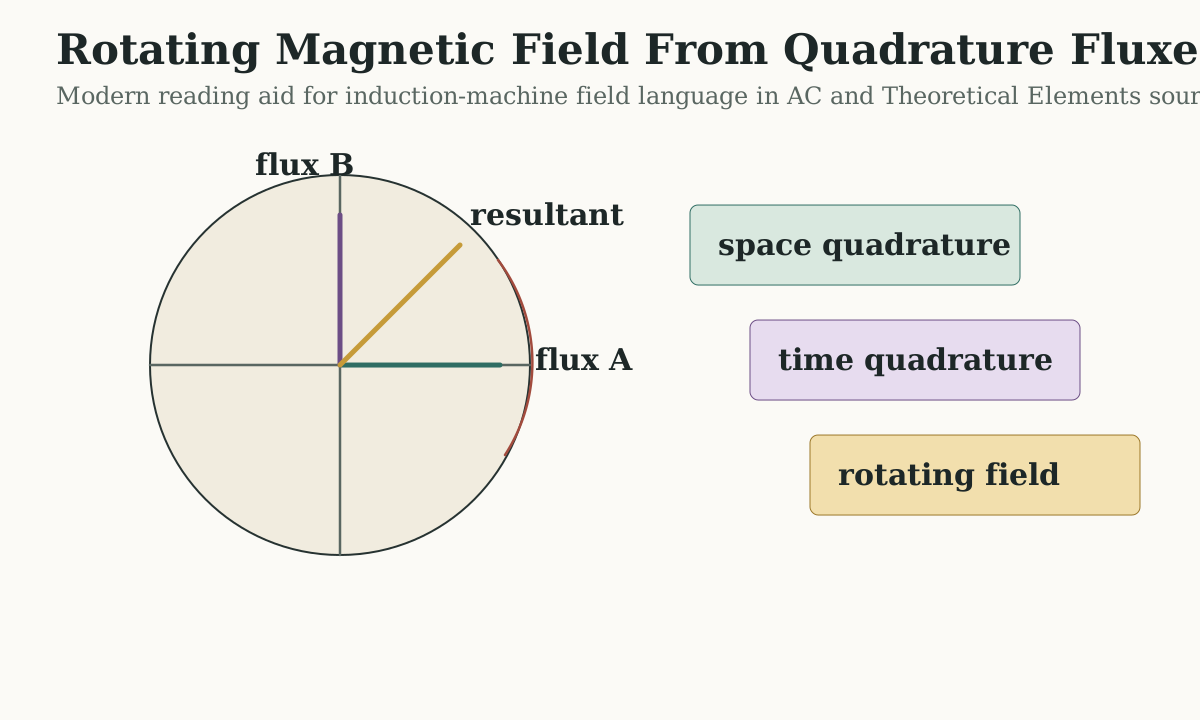
Section titled “Related Modern Guide Diagrams”Modern reading aid for induction-machine field language in AC and Theoretical Elements sources.
symbolic-method, magnetism, phase, induction-motor
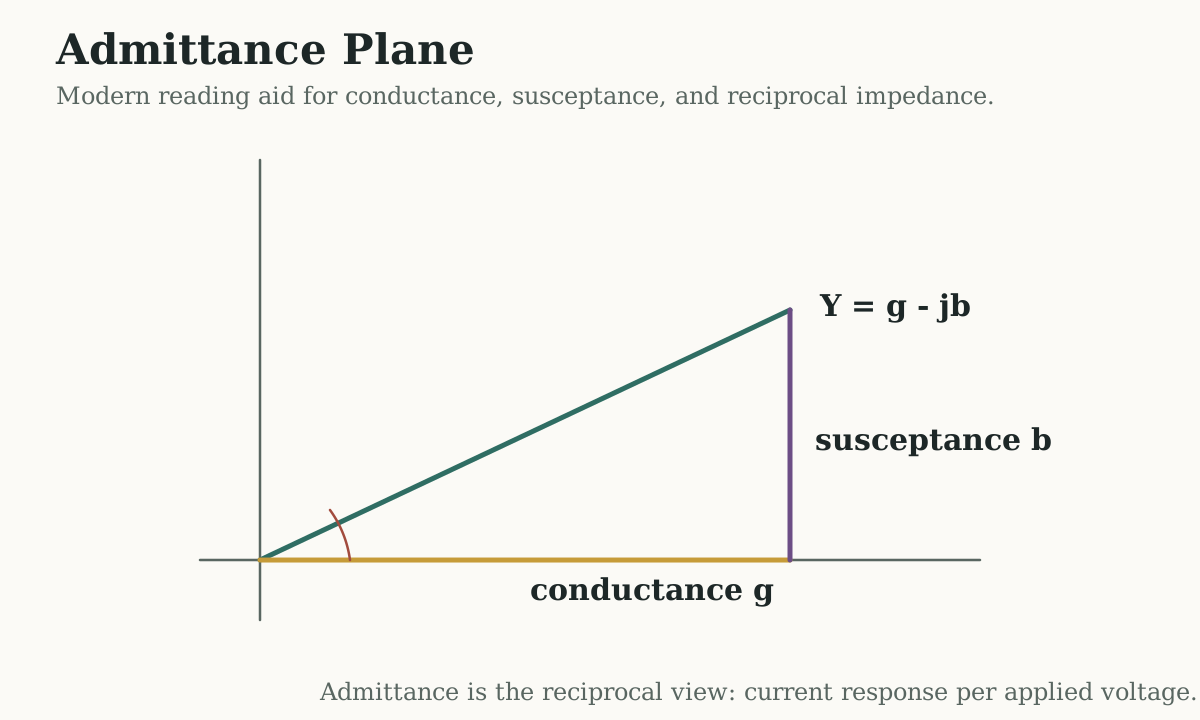
Modern reading aid for conductance, susceptance, and reciprocal impedance.
admittance, conductance, susceptance, symbolic-method
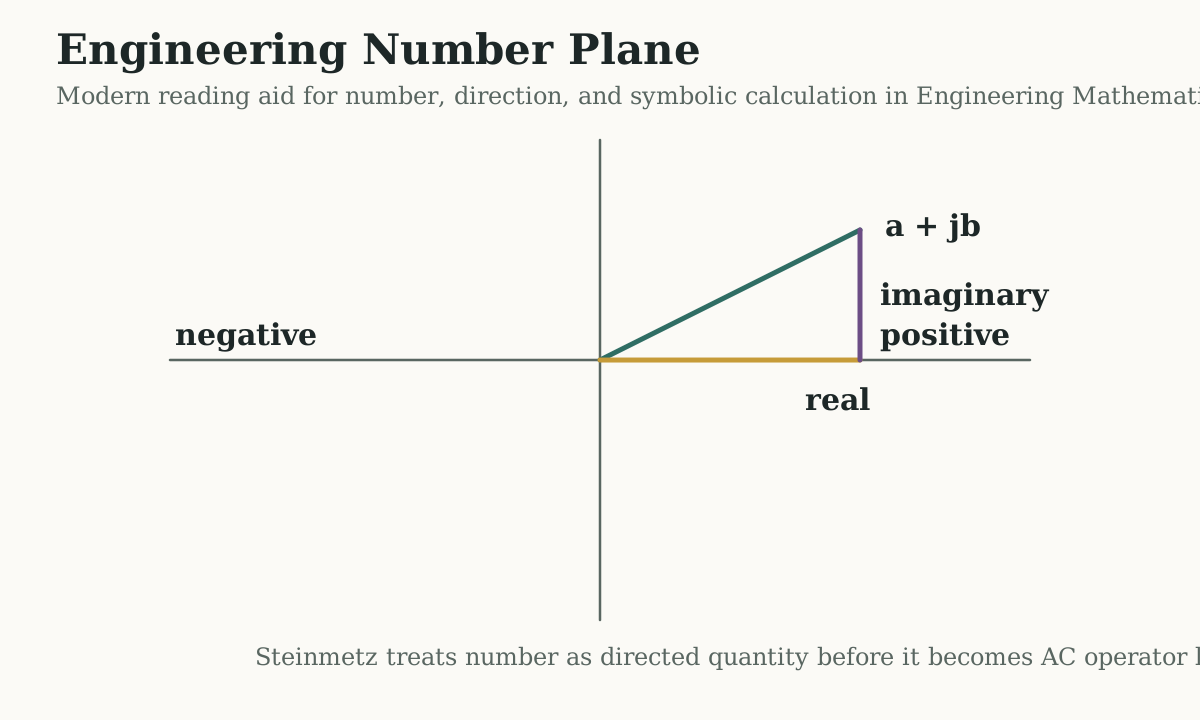
Modern reading aid for number, direction, and symbolic calculation in Engineering Mathematics.
complex-quantities, number, symbolic-method
Modern redraw sheet for rectangular components, resultant addition, and quarter-period j rotation.
symbolic-method, complex-quantities, phasor, operator-j
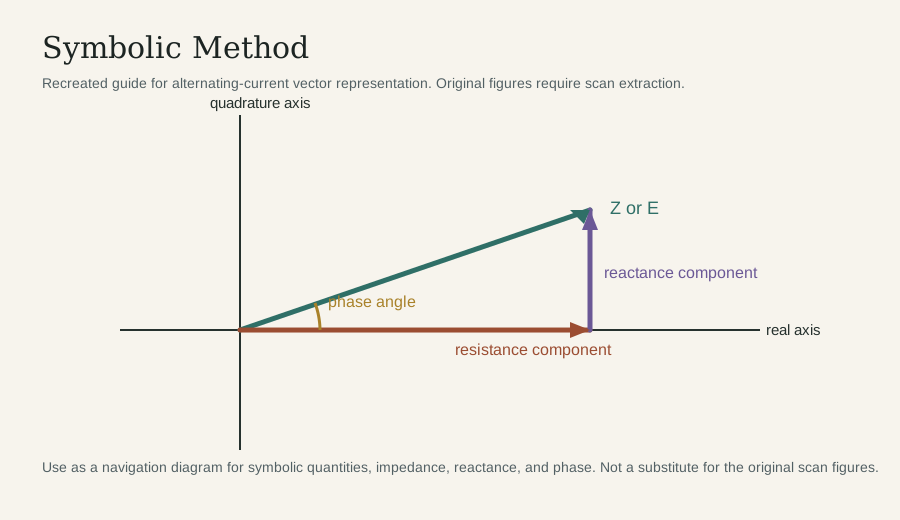
Modern reading aid for vector and complex-number representation of alternating quantities.
symbolic-method, complex-quantities, phase, phasor
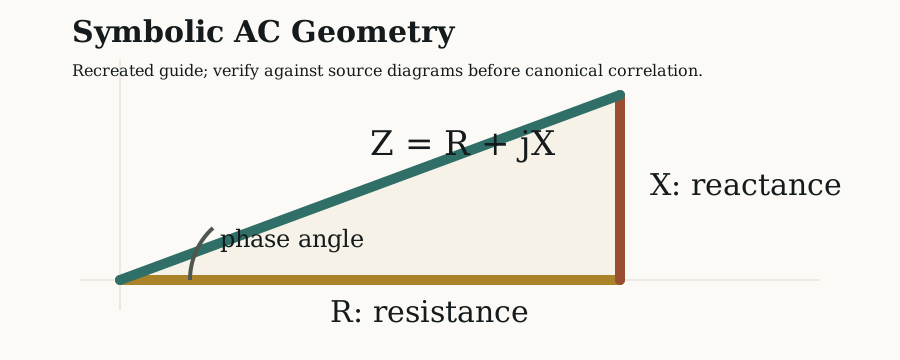
Modern guide for resistance, reactance, impedance, phase angle, and symbolic quantities.
impedance, reactance, power-factor, symbolic-method
Highest-Priority Formula Leads
Section titled “Highest-Priority Formula Leads”| Candidate | Family | OCR/PDF text | Routes |
|---|---|---|---|
engineering-mathematics-eq-candidate-0273strong-formula-candidate | engineering-math | Let A = a(cos a+j sin a) be divided by J5 = 6(cos ,5+y sin /5), | source research review |
engineering-mathematics-eq-candidate-0286strong-formula-candidate | engineering-math | If, A=ai +ja2 = a (cos a+j sin a), then | source research review |
engineering-mathematics-eq-candidate-0150strong-formula-candidate | engineering-math | and ai + ja2 = a (cos 6 + j sin d) ; | source research review |
engineering-mathematics-eq-candidate-0151strong-formula-candidate | engineering-math | or ai -\-ja2 = A(cos 0+j sin 6). | source research review |
theory-calculation-alternating-current-phenomena-1900-eq-candidate-0240strong-formula-candidate | symbolic-ac | is r - j (x -f x0} = r = .6, x + x0 = 0, and tan S>0 = 0 ; | source research review |
theory-calculation-alternating-current-phenomena-eq-candidate-0167strong-formula-candidate | symbolic-ac | B = 6’ + jh” = 6(cos 13 + j sin /3) | source research review |
theory-calculation-alternating-current-phenomena-eq-candidate-0294strong-formula-candidate | symbolic-ac | is r - j {x + Xo) = r = 0.6, x -{- Xo = 0, and tan do = 0; that | source research review |
theory-calculation-transient-electric-phenomena-oscillations-eq-candidate-0296strong-formula-candidate | transients-oscillation | i = -z | cos (I? - 00- 0J- i~x° cos (00 + OJ j (9) | source research review |
Highest-Priority Figure Leads
Section titled “Highest-Priority Figure Leads”| Candidate | Caption lead | Section | Routes |
|---|---|---|---|
theory-calculation-alternating-current-phenomena-1900-fig-011Fig. 11 | nates by a vector, which by its length, OC, denotes the in- Fig. 11. tensity, and by its amplitude, AOC, the phase, of the sine | Chapter 4: Graphic Representation | source research review |
theory-calculation-alternating-current-phenomena-1897-fig-009Fig. 9 | in the direction of the vector, giving the positive half-wave, Fig. 9. and once in opposition to the vector, giving the negative | Chapter 4: Graphic Befrisxintation | source research review |
theory-calculation-alternating-current-phenomena-1897-fig-011Fig. 11 | nates by a vector, which by its length, OC, denotes tlie in- Fig. 11. tensity, and by its amplitude, AOC, the phase, of the sine | Chapter 4: Graphic Befrisxintation | source research review |
theory-calculation-alternating-current-phenomena-1900-fig-022Fig. 22 | the graphical representation. Fig. 22. 25. We have seen that the alternating sine wave is represented in intensity, as well as phase, by a vector, Of, | Chapter 5: Symbolic Method | source research review |
theory-calculation-alternating-current-phenomena-1897-fig-016Fig. 16 | Eo = V(^ cos a> + Jry + {E^m u> -f Jx)\ Fig. 16. If, however, the current in the receiving circuit is | Chapter 4: Graphic Befrisxintation | source research review |
theory-calculation-alternating-current-phenomena-1900-fig-024Fig. 24 | riod ; tJiat is, retarding the wave through one-quarter period. Fig. 24. Similarly, — | Chapter 5: Symbolic Method | source research review |
theory-calculation-alternating-current-phenomena-1900-fig-039Fig. 39 | E Fig. 39. Z-jx0 r—j(x + x0}‘ | Chapter 8: Circuits Containing Resistance, Inductance, And Capacity | source research review |
theory-calculation-alternating-current-phenomena-1900-fig-041Fig. 41 | -t-CONDENSANCE Fig. 41. E0 = 100 volts, and the following conditions of receiver circuit •— z= 1 Qj r = 1>0> x= 0 (Curve j) | Chapter 8: Circuits Containing Resistance, Inductance, And Capacity | source research review |