Power Factor
Conceptual Role
Section titled “Conceptual Role”Power factor measures how much of an AC voltage-current relation produces real power rather than wattless exchange. It belongs beside impedance, reactance, admittance, conductance, and susceptance.
Modern Equivalent
Section titled “Modern Equivalent”where phi is the phase angle between voltage and current.
Steinmetz Reading
Section titled “Steinmetz Reading”Steinmetz’s AC language repeatedly distinguishes active or power components from wattless or reactive components. Power factor is the practical operating measure of that distinction.
The source work still needed here is exact: find the passages where Steinmetz uses “power factor,” “wattless,” and component language, then anchor them to scan-checked citations.
Why It Matters
Section titled “Why It Matters”Power factor is where symbolic geometry becomes system economics. Low power factor can mean high current for the same useful power, larger conductors, larger losses, and more demanding apparatus ratings.
Ether-Field Interpretive Reading
Interpretive only: a field-centered reading may describe wattless current as energy moving into and out of field storage rather than being consumed. This is compatible with modern reactive power language, but any broader ether interpretation must remain labeled.
Research Tasks
Section titled “Research Tasks”- Extract Steinmetz’s exact power-factor wording from the AC source.
- Link power factor to wattless current, reactance, admittance, and transformer excitation.
- Add a worked numerical example.
Reader Synthesis
Section titled “Reader Synthesis”What Steinmetz Is Doing Here
The processed corpus gives this concept a source trail across Steinmetz’s books and lectures. Read the source distribution first, because the meaning often changes between radiation, AC calculation, apparatus, and transients.
The current strongest source route is Theory and Calculation of Electric Apparatus, with 206 candidate hits across 14 sections.
Modern Translation
Translate the older wording into modern electrical-engineering language only after the source location is visible.
This page currently tracks 671 candidate occurrences across 11 sources and 101 sections.
Mathematical And Visual Route
Use the linked equation atlas and source formula maps to decide whether this concept has a mathematical layer, a diagrammatic layer, or mainly a terminology layer.
Use the math/visual bridge lower on this page to jump into formula families, source visual maps, and candidate figure leads.
Interpretive Boundary
Interpretive readings are welcome in this archive only when they are labeled and separated from Steinmetz’s explicit wording.
Layer labels stay active: source claim, modern equivalent, mathematical reconstruction, historical note, and interpretive reading are not interchangeable.
Best Steinmetz Passages To Read First
Section titled “Best Steinmetz Passages To Read First”| Passage | Hits | Location | Open |
|---|---|---|---|
| Chapter 20: Single-Phase Commutator Motors Theory and Calculation of Electric Apparatus | 64 | lines 23906-30087 | read - research review |
| Chapter 4: Induction Motor With Secondary Excitation Theory and Calculation of Electric Apparatus | 50 | lines 5555-8554 | read - research review |
| Chapter 14: Constant-Potential Constant-Current Trans Formation Theory and Calculation of Electric Circuits | 42 | lines 24023-27995 | read - research review |
| Chapter 16: Induction Motor Theory and Calculation of Alternating Current Phenomena | 28 | lines 13649-16361 | read - research review |
Research Position
Section titled “Research Position”- Tracked vocabulary: Power Factor.
- Concordance: Power Factor.
- Source discipline: the table above is for reading and navigation; exact quotation still requires scan verification.
- Reader route: read the passage first, then return here for modern translation, mathematical reconstruction, visual routes, and interpretation boundaries.
- Editorial rule: expand this page by promoting scan-checked passages, equations, and diagrams from the linked workbench pages, not by adding unsourced generalizations.
Source-Grounded Dossier
Section titled “Source-Grounded Dossier”Generated evidence layer: this dossier is built from the processed concept concordance. Counts and snippets are OCR/PDF-text aids, not final quotations. Verify against scans before making exact claims.
Candidate occurrences tracked for this page.
Sources with at least one hit.
Sections, lectures, chapters, or report divisions to review.
What The Current Corpus Shows
Section titled “What The Current Corpus Shows”Read this concept page through the linked source passages first. Use the dossier to locate Steinmetz’s wording, then add modern, mathematical, historical, and interpretive layers only with labels.
The strongest current source concentration is Theory and Calculation of Electric Apparatus with 206 candidate hits across 14 sections.
The dossier is meant to turn a concept page into a reading path: begin with Steinmetz’s source wording, then use the research links only when you need candidate counts, snippets, mathematical reconstruction, historical context, or interpretive layers.
Terms And Aliases Tracked
Section titled “Terms And Aliases Tracked”power factor, power-factor, wattless component, wattless current
Concordance Records
Section titled “Concordance Records”Source Distribution
Section titled “Source Distribution”Priority Passages To Read
Section titled “Priority Passages To Read”Chapter 20: Single-Phase Commutator Motors - 64 candidate hits
Source: Theory and Calculation of Electric Apparatus (1917)
Location: lines 23906-30087 - Tracked concepts: Power Factor
... resistance, which represents the power loss. In addition thereto, in the alternating-cur rent motor voltage is consumed by the inductance, which is wattless or reactive and therefore causes a lag of current behind the vol- tage, that is, a lowering of the power-factor. While in the direct- current motor good design requires the combination of a strong...... While in the direct- current motor good design requires the combination of a strong field and a relatively weak armature, so as to reduce the armature reaction on the field to a minimum, in the design of the alter- iiatiiig-current motor considerations of power-factor predominate; that is, to secure low self-inductance and therewith a high power- fact...Chapter 4: Induction Motor With Secondary Excitation - 50 candidate hits
Source: Theory and Calculation of Electric Apparatus (1917)
Location: lines 5555-8554 - Tracked concepts: Power Factor
... ating magnetizing current is a wattless reactive current, the result is, that the alternating-current input into the induction motor is always lagging, the more so, the larger a part of the total current is given by the magnetizing current. To secure good power-factor in an induction motor, the magnetizing current, that i«, the current which produces...... erload capacity has to be met, etc. In such motors of necessity the exciting current or current at no-load - which is practically all magnetizing current - is a very large part of full-load current, and while fair efficiencies may nevertheless be secured, power-factor and apparent efficiency necessarily are very low. As illustration is shown in Fig. 2...Chapter 14: Constant-Potential Constant-Current Trans Formation - 42 candidate hits
Source: Theory and Calculation of Electric Circuits (1917)
Location: lines 24023-27995 - Tracked concepts: Power Factor
... n series with this circuit. The impedance of this circuit then is Z = r + jxof and, absolute, and thus the current, / = ^* = -^ (1) ^ r + jxo and the absolute value is eo Co the phase angle of the supply circuit is given by (2) and the power factor. tan ^0 = - (3) T cos ^0 = -• (4) z ^ ^ If in this case, r is small compared with Xq, it is ,-^£o _-l (5...... l theorem. V • • • \xj hence, : (6) 6o I = - Xo 2xo2^8xo* -r . . . that is, for small values of r, the current, z, is approximately constant, and is 6o I = - Xo CONSTANT-CURRENT TRANSFORMATION 247 For small values of r, the power-factor cosfl - - is very low, however. Allowing a variation of current of 10 per cent, from short- circuit or no-load, r =...Chapter 16: Induction Motor - 28 candidate hits
Source: Theory and Calculation of Alternating Current Phenomena (1900)
Location: lines 13649-16361 - Tracked concepts: Power Factor
... e the motor is in operation. 256 ALTERNATING-CURRENT PHENOMENA. Since, necessarily, ri<*, ''<•< and since the starting current is, approximately, 7 =f , we have, Ta < would be the theoretical torque developed at 100 per cent efficiency and power factor, by E.M.F., E0, and current, /, at synchronous speed. Thus, T0<T00, and the ratio between the starti...... in absolute units, = = N (f* + r22) W where N= frequency. The power output is torque times speed, thus : The power input is, ^•l2 + The voltampere input, o2 ( Vi + V,) /o2 ( Vi - V8) hence, efficiency, J\ _ a, (I - s) J? Vi + V2 power factor, apparent efficiency, <2o torque efficiency, * a. ./V Vi + V. * That 5s the ratio of actual torque to torque wh...Chapter 23: Review - 24 candidate hits
Source: Theory and Calculation of Electric Apparatus (1917)
Location: lines 32138-32819 - Tracked concepts: Power Factor
... change of the inductivity of the load, hasmade njGfl compounding unsuitahie for the modern high-power altcrnu- ton. Condenser Motor. - 77. Single-phase induction motor with condenser in tertiary circuit on stator, for producing shirting torque and high power-factor. The space angle between pri- mary and tertiary stator circuit usually is 45° to 60°, a...... r-factor. The space angle between pri- mary and tertiary stator circuit usually is 45° to 60°, and often a three-phase motor is used, with single-phase supply on one phase. and condenser on a Becond phase. With the small amount of capacity, sufficient for power-factor compensation, usually the starting torque is small, unless a starting resistance is...Chapter 14: Dielectric Losses - 20 candidate hits
Source: Theory and Calculation of Alternating Current Phenomena (1916)
Location: lines 14334-15409 - Tracked concepts: Power Factor
... dielectric fields, but is so small, that it usually is overshadowed by the other losses. In alternating dielectric fields in solid materials, such as in condensers, coil insulation, etc., a loss is commonly observed which gives an approximately constant power-factor of the elec- tric energizing circuit, over a wide range of voltage and of fre- quency,...... rved which gives an approximately constant power-factor of the elec- tric energizing circuit, over a wide range of voltage and of fre- quency, from less than a fraction of 1 per cent, up to a few per cent. 150 DIELECTRIC LOSSES 151 Constancy of the power-factor with the frequency, means that the loss is proportional to the frequency, as the current i,...Reading Layers To Build Out
Section titled “Reading Layers To Build Out”| Layer | What to add next |
|---|---|
| Steinmetz wording | Pull exact source passages only after scan verification; keep OCR text labeled until then. |
| Modern engineering reading | Translate the source usage into present electrical-engineering or physics language without erasing the older vocabulary. |
| Mathematical layer | Link equations, variables, diagrams, and worked examples when the concept has formula candidates. |
| Historical layer | Identify whether the term is still used, renamed, absorbed into modern theory, or historically obsolete. |
| Ether-field interpretation | Keep interpretive readings separate from Steinmetz’s explicit claim and from modern physics. |
| Open questions | Record places where the concordance suggests a lead but the scan or edition has not yet been checked. |
Next Editorial Actions
Section titled “Next Editorial Actions”- Open the highest-priority source-text passages above and verify the wording against scans.
- Promote exact definitions, equations, diagrams, and hidden-gem passages into this page with source references.
- Add related concept links, equation pages, and diagram pages once the evidence is scan checked.
- Keep speculative or Wheeler-style readings in explicitly labeled interpretation blocks.
Math And Visual Evidence Map
Section titled “Math And Visual Evidence Map”Generated bridge: this section crosslinks the concept page with the formula atlas, figure atlas, source visual maps, and source formula maps. It is a routing layer, not final interpretation.
Formula candidates routed to this concept.
Figure candidates routed to this concept.
Modern guide diagrams related to this concept.
Formula Families To Review
Section titled “Formula Families To Review”Impedance, Reactance, And Admittance - Power, Energy, Work, And Efficiency - Symbolic AC And Complex Quantities
Source Maps For This Concept
Section titled “Source Maps For This Concept”theory-calculation-electric-apparatus visuals - theory-calculation-electric-apparatus formulas - theory-calculation-alternating-current-phenomena visuals - theory-calculation-alternating-current-phenomena formulas - theory-calculation-alternating-current-phenomena-1900 visuals - theory-calculation-alternating-current-phenomena-1900 formulas - theoretical-elements-electrical-engineering visuals - theoretical-elements-electrical-engineering formulas - theory-calculation-electric-circuits visuals - theory-calculation-electric-circuits formulas - theory-calculation-alternating-current-phenomena-1897 visuals - theory-calculation-alternating-current-phenomena-1897 formulas
Related Modern Guide Diagrams
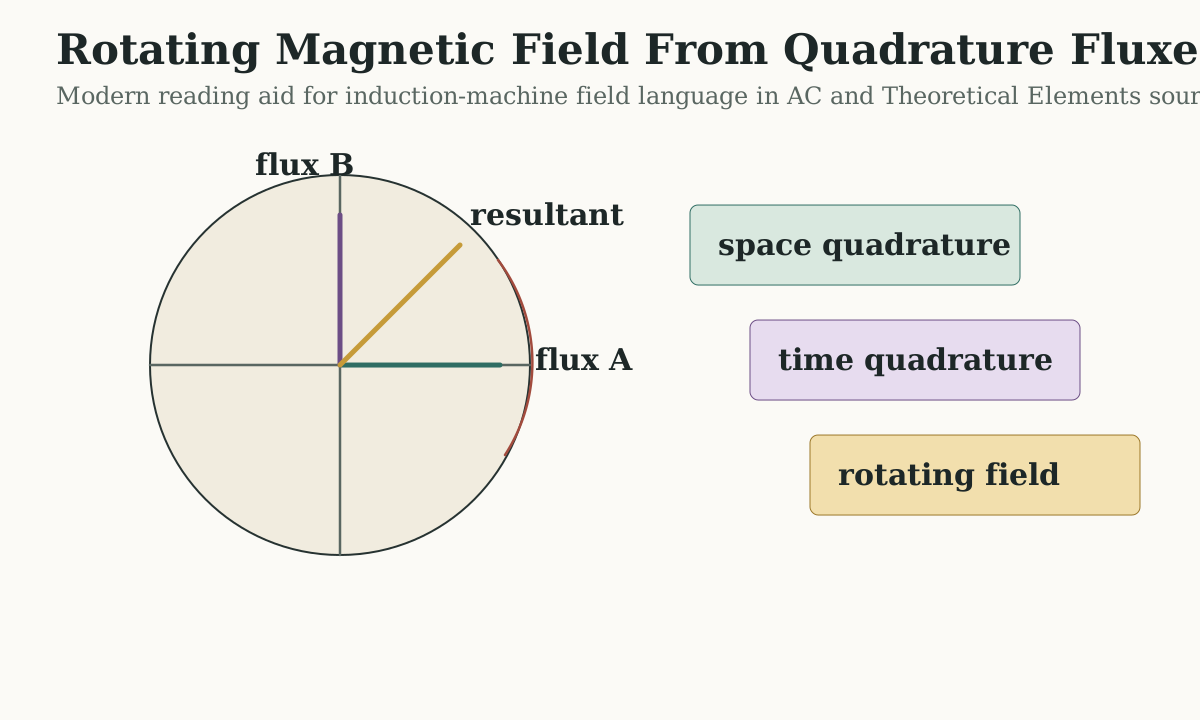
Section titled “Related Modern Guide Diagrams”Modern reading aid for induction-machine field language in AC and Theoretical Elements sources.
symbolic-method, magnetism, phase, induction-motor
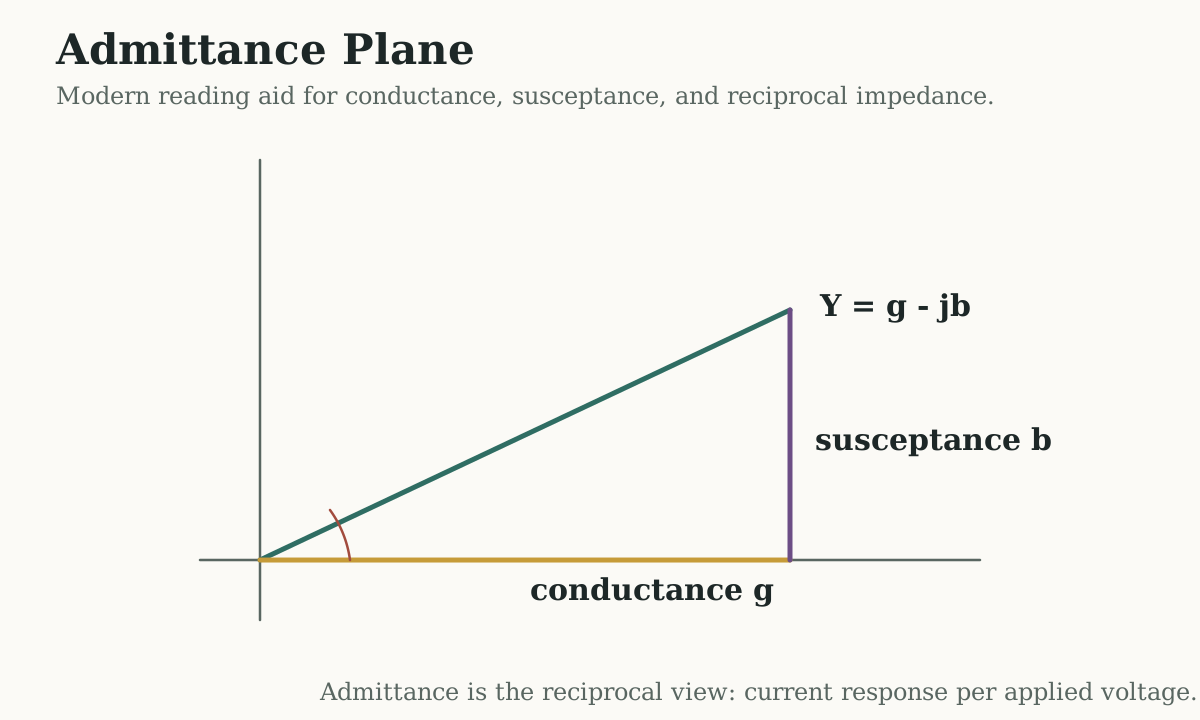
Modern reading aid for conductance, susceptance, and reciprocal impedance.
admittance, conductance, susceptance, symbolic-method
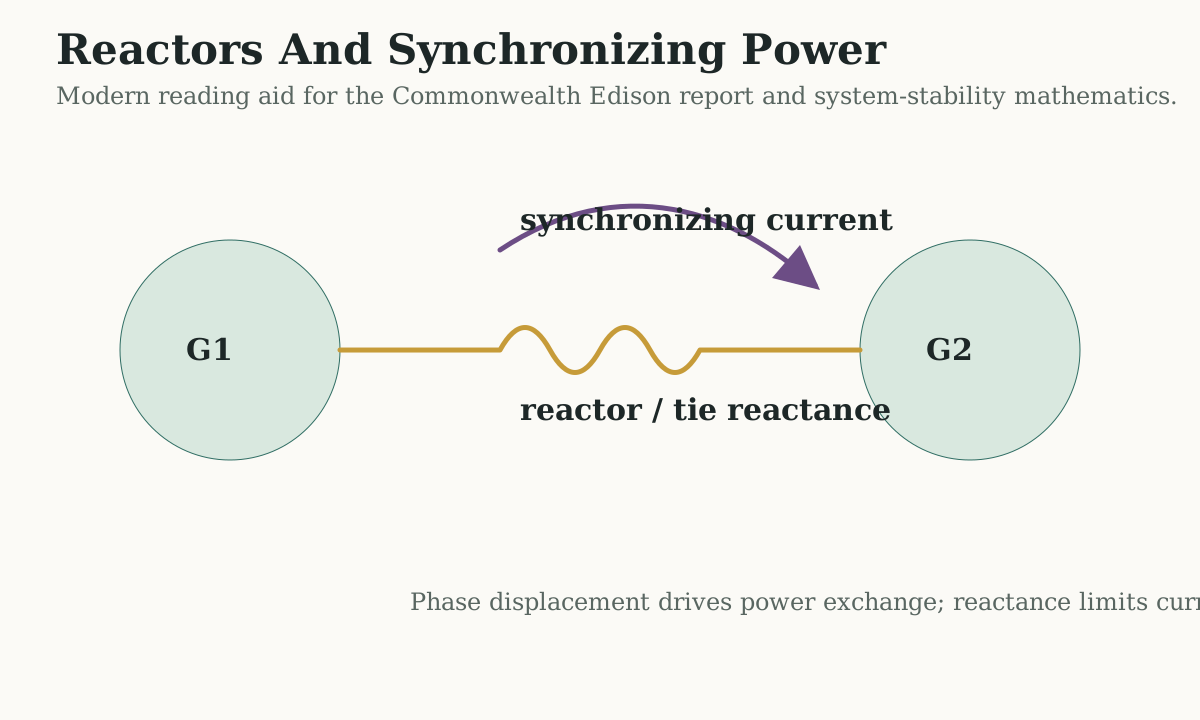
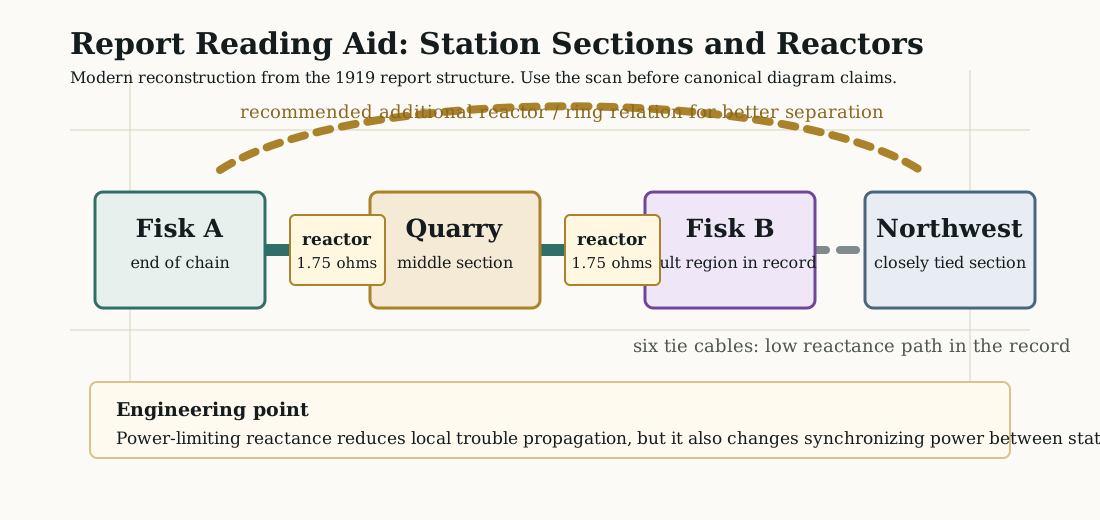
Modern reading aid for the Commonwealth Edison report and system-stability mathematics.
synchronizing-power, power-limiting-reactors, reactance
Modern reading aid for vector and complex-number representation of alternating quantities.
symbolic-method, complex-quantities, phase, phasor
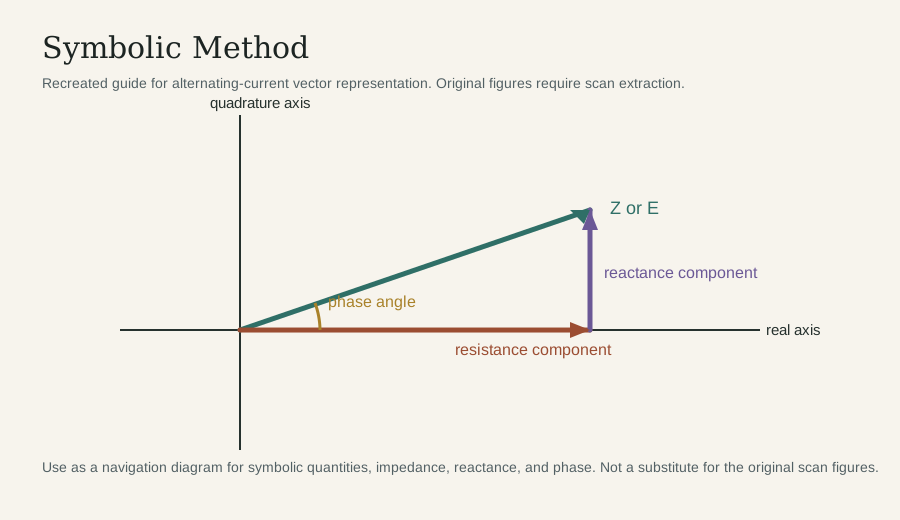
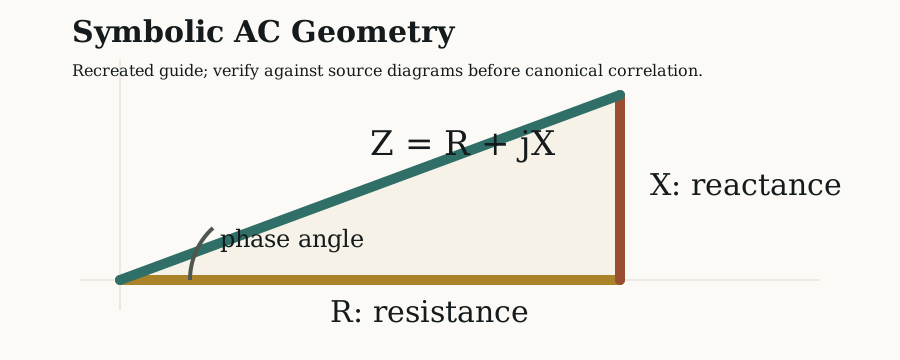
Modern guide for resistance, reactance, impedance, phase angle, and symbolic quantities.
impedance, reactance, power-factor, symbolic-method
Modern reading aid for station sections, power-limiting reactors, tie cables, and synchronism.
power-limiting-reactors, synchronizing-power, reactance, power-systems
Highest-Priority Formula Leads
Section titled “Highest-Priority Formula Leads”| Candidate | Family | OCR/PDF text | Routes |
|---|---|---|---|
theoretical-elements-electrical-engineering-eq-candidate-0102strong-formula-candidate | symbolic-ac | e = 2 7r/n$ sin r the instantaneous generated e.m.f. | source research review |
theory-calculation-alternating-current-phenomena-1900-eq-candidate-0240strong-formula-candidate | symbolic-ac | is r - j (x -f x0} = r = .6, x + x0 = 0, and tan S>0 = 0 ; | source research review |
theory-calculation-alternating-current-phenomena-eq-candidate-0167strong-formula-candidate | symbolic-ac | B = 6’ + jh” = 6(cos 13 + j sin /3) | source research review |
theory-calculation-alternating-current-phenomena-eq-candidate-0294strong-formula-candidate | symbolic-ac | is r - j {x + Xo) = r = 0.6, x -{- Xo = 0, and tan do = 0; that | source research review |
theory-calculation-electric-apparatus-eq-candidate-0028strong-formula-candidate | symbolic-ac | = - J = (tan a - j) (7) | source research review |
theory-calculation-alternating-current-phenomena-1900-eq-candidate-0001strong-formula-candidate | symbolic-ac | 1.) Ohm’s law : i = e j r, where r, the resistance, is a | source research review |
theory-calculation-alternating-current-phenomena-1900-eq-candidate-0131strong-formula-candidate | symbolic-ac | or, if E = e -\-je’ is the impressed E.M.F., and 7 = i ’ -\- ji’ | source research review |
theory-calculation-alternating-current-phenomena-eq-candidate-0206strong-formula-candidate | symbolic-ac | /, upon the e.m.f., or by IE cos d, where 9 = angle of time- | source research review |
Highest-Priority Figure Leads
Section titled “Highest-Priority Figure Leads”| Candidate | Caption lead | Section | Routes |
|---|---|---|---|
theory-calculation-electric-apparatus-fig-058Fig. 58 | which represents the current distribution per phase through the air gap of the induction machine, shown by the diagrams F of Fig. 58. The corresponding flux distribution, $, in Fig. 58, expressed by a trignometric ser… | Chapter 7: Higher Harmonics In Induction Motors | source research review |
theory-calculation-electric-apparatus-fig-068Fig. 68 | In Fig. 68 the drawn tinea correspond to non-inductive bftd The regulation for 45° lagging load is shown by dotted lines in Fig. 68. e’o shows the quadrature component of the monocyclic voltage. e ii, at non-inductive… | Chapter 14: Phase Conversion And Single-Phase Generation | source research review |
theory-calculation-electric-apparatus-fig-128Fig. 128 | circuitcd turn, S, as shown in Fig. 128, This gives a periodic variation of the effective reluctance, from ft minimum, shown in Fig. 128, to a maximum in the position shown in dotted lines in Fig. 128. This latter str… | Chapter 16: Reaction Machines | source research review |
theory-calculation-electric-apparatus-fig-151Fig. 151 | P&D Fig. 151. 180. As example are shown, in Fig. 151, with the speed as abscissae, the curves of a single-phase induction motor, having | Chapter 19: Alternating- Current Motors In General | source research review |
theory-calculation-electric-apparatus-fig-166Fig. 166 | is less than 90” liehind the primary current, more than 90° ahead of the secondary current, the more so the higher is the inductivity of the secondary circuit, as shown by the transformer diagram, Fig. 166. Herefrom i… | Chapter 20: Single-Phase Commutator Motors | source research review |
theory-calculation-electric-apparatus-fig-186Fig. 186 | c = c2#2; co#> + #1 = 0; lo = co/i; It = 0. Fig. 186. 7. Series repulsion motor with secondary excitation : | Chapter 20: Single-Phase Commutator Motors | source research review |
theory-calculation-electric-apparatus-fig-187Fig. 187 | /m Fig. 187. 10. Rotor-excited series motor with conductive compensation : | Chapter 20: Single-Phase Commutator Motors | source research review |
theory-calculation-electric-apparatus-fig-188Fig. 188 | brush short-circuit c* = 0.04; that is, the same constants as used in the repulsion motor, Fig. 188. Curves are plotted for the voltage ratios; t = 0: inductively compensated series motor, Fig. 189. | Chapter 20: Single-Phase Commutator Motors | source research review |