Hysteresis
Steinmetz Usage
Section titled “Steinmetz Usage”Hysteresis is the lag of magnetic response behind magnetizing force, together with the energy loss associated with cycling magnetic material through changing field conditions. It is one of Steinmetz’s historically central contributions to electrical engineering.
The seeded OCR for Alternating Current Phenomena includes magnetic hysteresis, dielectric hysteresis, effective resistance, wave-shape distortion, and transformer behavior. These links matter because hysteresis is not merely a material curiosity; it appears in practical AC loss, apparatus design, and waveform behavior.
Modern Equivalent
Section titled “Modern Equivalent”Modern readers encounter hysteresis in B-H curves, core loss, magnetic material modeling, transformer design, motor design, and nonlinear systems more generally.
Diagrammatic Explanation
Section titled “Diagrammatic Explanation”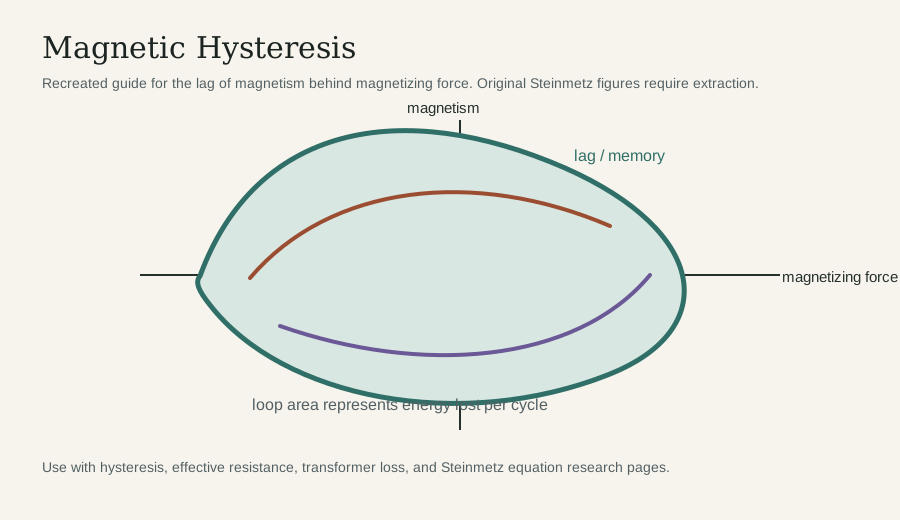
Mathematical Direction
Section titled “Mathematical Direction”The archive now has a candidate equation page for the Steinmetz Hysteresis Law. It remains source-located but not scan-final because the exact historical units and notation need page-level verification.
Use the Hysteresis Loop and Steinmetz Loss tool as a visual calculator for the law. The tool keeps eta adjustable so it does not pretend that the historical unit translation has already been finalized.
Ether-Field Interpretive Reading
Interpretive only: hysteresis is a strong candidate for field-memory or field-lag interpretations. Such readings should be clearly separated from Steinmetz’s engineering statements and from modern magnetic material theory.
Reader Synthesis
Section titled “Reader Synthesis”What Steinmetz Is Doing Here
Hysteresis is both material memory and engineering loss. Steinmetz’s importance is that he made magnetic lag calculable enough for apparatus design.
The current strongest source route is Theory and Calculation of Electric Circuits, with 1115 candidate hits across 27 sections.
Modern Translation
Modern engineering reads this through B-H loops, core loss, magnetic material behavior, and empirical loss laws.
This page currently tracks 7432 candidate occurrences across 14 sources and 258 sections.
Mathematical And Visual Route
The Steinmetz hysteresis law, effective resistance, frequency, flux density, and energy per cycle are the core mathematical route.
Use the math/visual bridge lower on this page to jump into formula families, source visual maps, and candidate figure leads.
Interpretive Boundary
Ether-field readings may describe lag or memory as field behavior, but the source layer is magnetic material loss and apparatus calculation.
Layer labels stay active: source claim, modern equivalent, mathematical reconstruction, historical note, and interpretive reading are not interchangeable.
Best Steinmetz Passages To Read First
Section titled “Best Steinmetz Passages To Read First”| Passage | Hits | Location | Open |
|---|---|---|---|
| Chapter 20: Single-Phase Commutator Motors Theory and Calculation of Electric Apparatus | 247 | lines 23906-30087 | read - research review |
| Chapter 12: Effective Resistance And Reactance Theory and Calculation of Alternating Current Phenomena | 199 | lines 10718-13483 | read - research review |
| Chapter 8: Shaping Of Waves By Magnetic Saturation Theory and Calculation of Electric Circuits | 181 | lines 12962-16963 | read - research review |
| Chapter 12: Reactance Of Induction Apparatus Theory and Calculation of Electric Circuits | 178 | lines 22634-23465 | read - research review |
Research Position
Section titled “Research Position”- Tracked vocabulary: Hysteresis, Magnetism.
- Concordance: Hysteresis - Magnetism.
- Source discipline: the table above is for reading and navigation; exact quotation still requires scan verification.
- Reader route: read the passage first, then return here for modern translation, mathematical reconstruction, visual routes, and interpretation boundaries.
- Editorial rule: expand this page by promoting scan-checked passages, equations, and diagrams from the linked workbench pages, not by adding unsourced generalizations.
Source Expansion Impact
Section titled “Source Expansion Impact”The next corpus wave should make hysteresis far more source-complete.
Until the 1892 paper is in custody, the page should keep using already processed books and lectures while marking the original law paper as the highest acquisition target.
| Source Target | Year | Status | Why It Matters Here |
|---|---|---|---|
| On the Law of Hysteresis | 1892 | Registered Authority Target | This is the origin point for Steinmetz’s magnetic-loss reputation. It should eventually anchor the hysteresis concept page, the Steinmetz equation page, and modern core-loss comparison. |
| Mechanical Forces in Magnetic Fields | 1910 | Registered Authority Target | This is the highest-value pending source for force, stress, pressure, and tension vocabulary in magnetic fields. |
Source-Grounded Dossier
Section titled “Source-Grounded Dossier”Generated evidence layer: this dossier is built from the processed concept concordance. Counts and snippets are OCR/PDF-text aids, not final quotations. Verify against scans before making exact claims.
Candidate occurrences tracked for this page.
Sources with at least one hit.
Sections, lectures, chapters, or report divisions to review.
What The Current Corpus Shows
Section titled “What The Current Corpus Shows”Read this concept as both material physics and engineering loss accounting. The archive should preserve Steinmetz’s magnetic vocabulary before translating it into modern loss models.
The strongest current source concentration is Theory and Calculation of Electric Circuits with 1115 candidate hits across 27 sections.
The dossier is meant to turn a concept page into a reading path: begin with Steinmetz’s source wording, then use the research links only when you need candidate counts, snippets, mathematical reconstruction, historical context, or interpretive layers.
Terms And Aliases Tracked
Section titled “Terms And Aliases Tracked”hysteresis, magnetic lag, molecular friction, flux, magnetic, magnetism, magnetization, magnetizing, reluctance
Concordance Records
Section titled “Concordance Records”Source Distribution
Section titled “Source Distribution”Priority Passages To Read
Section titled “Priority Passages To Read”Chapter 20: Single-Phase Commutator Motors - 247 candidate hits
Source: Theory and Calculation of Electric Apparatus (1917)
Location: lines 23906-30087 - Tracked concepts: Hysteresis, Magnetism
... e an = e. l this diagram, and in the preceding approximate calculat magnetic flux, *, has been assumed in phase with the curren l reality, however, the equivalent sine wave of magn $, lags behind the equivalent sine wave of exciting curren he angle of hysteresis lag, and still further by the po ase tx, on- the file, on, ,/- etic ,/. wcr SINGLE-PHASE C...... e.m.f. of rotation is not entirely a power e.m.f., but contains a wattless lagging component. The e.m.f. of alternation, OE0, is 90° ahead of O*, hence less than 90° ahead of OI, and therefore contains a power component representing the power consumed by hysteresis, eddy currents, and the short-circuit current under the brushes. Completing now the dia...Chapter 12: Effective Resistance And Reactance - 199 candidate hits
Source: Theory and Calculation of Alternating Current Phenomena (1916)
Location: lines 10718-13483 - Tracked concepts: Hysteresis, Magnetism
... the electric conductor b}^ a current of uniform density, the effective resistance represents the total expenditure of power. Since in an alternating-current circuit, in general power is expended not only in the conductor, but also outside of it, through hysteresis, secondary currents, etc., the effective resist- ance frequently differs from the true o...... the cause of most of the difficulties met in dealing analytically with alternating-current circuits containing iron. 90. The foremost sources of energy loss in alternating-current circuits, outside of the true ohmic resistance loss, are as follows : 1. Molecular friction, as, (a) Magnetic hysteresis; (6) Dielectric hysteresis. 2. Primary electric curr...Chapter 8: Shaping Of Waves By Magnetic Saturation - 181 candidate hits
Source: Theory and Calculation of Electric Circuits (1917)
Location: lines 12962-16963 - Tracked concepts: Hysteresis, Magnetism
... . 66. It is interesting to note that in, the peak reactance, ia approxi- mately constant, that is, does not decrease with increasing mag- netic saturation. (The higher value at beginning saturation, for / - 20, may possibly be due to an inaccuracy in the hysteresis cycle of Fig. 55, a too great steepness near the zero value, rather than being actual.)...... ransformer increases approximately ^/26 = 4.47 times, and the maximum voltage peak 20 times above the full-load voltage of the transformer. As the shape of the magnetic flux density and voltage waves are determined by the current and flux relation of the hysteresis cy- cles, and the latter are entirely empirical and can not be expressed mathematically...Chapter 12: Reactance Of Induction Apparatus - 178 candidate hits
Source: Theory and Calculation of Electric Circuits (1917)
Location: lines 22634-23465 - Tracked concepts: Hysteresis, Magnetism
... such cases, the magnetic fields of the reactance of the electric circuit may be merely a more or less fictitious component of the resultant mag- netic field. The industrial importance hereof is that many phenomena, such as the loss of power by magnetic hysteresis, the m.m.f. required for field excitation, etc., are related to the resultant magnetic fi...... actance is not entirely arbitrary. Assuming we assign all the reactance to the primary, and consider the secondary as having no reactance. Then the mutual mag- netic flux and mutual induced voltage would be cf = jP = jPo - [ro + i (xo + xi)] /o and the hysteresis loss in the transformer would correspond hereto, by the usual assumption in transformer c...Chapter 4: Magnetism - 165 candidate hits
Source: Theory and Calculation of Electric Circuits (1917)
Location: lines 6942-9061 - Tracked concepts: Hysteresis, Magnetism
CHAPTER IV MAGNETISM Hysteresis 36. Unlike the electric current, which requires power for its maintenance, the maintenance of a magnetic flux does not require energy expenditure (the energy consumed by the magnetizing current in the ohmic resistance of the magnetizing winding being an ...... on, at least in those materials, which have permeabilities materially higher than unity. Thus, if a magnetic flux is periodically changed, between + B and - B, or between Bi and Bz, as by an alternating or pul- sating current, a dissipation of energy by molecular friction occurs during each magnetic cycle. Experiment shows that the energy consumed per...Chapter 10: Effective Resistance And Reactance - 164 candidate hits
Source: Theory and Calculation of Alternating Current Phenomena (1900)
Location: lines 6957-8383 - Tracked concepts: Hysteresis, Magnetism
... electric conductor by a current of uniform density, the effective resistance repre- sents the total expenditure of energy. Since, in an alternating-current circuit in general, energy is expended not only in the conductor, but also outside of it, through hysteresis, secondary currents, etc., the effective resistance frequently differs from the true ohm...... cause of most of the difficulties met in dealing analytically with alternating-current circuits containing iron. 73. The foremost sources of energy loss in alternating- current circuits, outside of the true ohmic resistance loss, are as follows : 1.) Molecular friction, as, a.) Magnetic hysteresis ; b.) Dielectric hysteresis. 106 .ALTERNATING-CURRENT...Reading Layers To Build Out
Section titled “Reading Layers To Build Out”| Layer | What to add next |
|---|---|
| Steinmetz wording | Pull exact source passages only after scan verification; keep OCR text labeled until then. |
| Modern engineering reading | Translate the source usage into present electrical-engineering or physics language without erasing the older vocabulary. |
| Mathematical layer | Link equations, variables, diagrams, and worked examples when the concept has formula candidates. |
| Historical layer | Identify whether the term is still used, renamed, absorbed into modern theory, or historically obsolete. |
| Ether-field interpretation | Keep interpretive readings separate from Steinmetz’s explicit claim and from modern physics. |
| Open questions | Record places where the concordance suggests a lead but the scan or edition has not yet been checked. |
Next Editorial Actions
Section titled “Next Editorial Actions”- Open the highest-priority source-text passages above and verify the wording against scans.
- Promote exact definitions, equations, diagrams, and hidden-gem passages into this page with source references.
- Add related concept links, equation pages, and diagram pages once the evidence is scan checked.
- Keep speculative or Wheeler-style readings in explicitly labeled interpretation blocks.
Math And Visual Evidence Map
Section titled “Math And Visual Evidence Map”Generated bridge: this section crosslinks the concept page with the formula atlas, figure atlas, source visual maps, and source formula maps. It is a routing layer, not final interpretation.
Formula candidates routed to this concept.
Figure candidates routed to this concept.
Modern guide diagrams related to this concept.
Formula Families To Review
Section titled “Formula Families To Review”Magnetism, Hysteresis, And Core Loss - Power, Energy, Work, And Efficiency
Source Maps For This Concept
Section titled “Source Maps For This Concept”theory-calculation-electric-circuits visuals - theory-calculation-electric-circuits formulas - theory-calculation-electric-apparatus visuals - theory-calculation-electric-apparatus formulas - theoretical-elements-electrical-engineering visuals - theoretical-elements-electrical-engineering formulas - theory-calculation-alternating-current-phenomena visuals - theory-calculation-alternating-current-phenomena formulas - theory-calculation-alternating-current-phenomena-1900 visuals - theory-calculation-alternating-current-phenomena-1900 formulas - theory-calculation-alternating-current-phenomena-1897 visuals - theory-calculation-alternating-current-phenomena-1897 formulas
Related Modern Guide Diagrams
Section titled “Related Modern Guide Diagrams”Modern reading aid for the Steinmetz law and magnetic energy loss per cycle.
hysteresis, magnetic-loss, effective-resistance
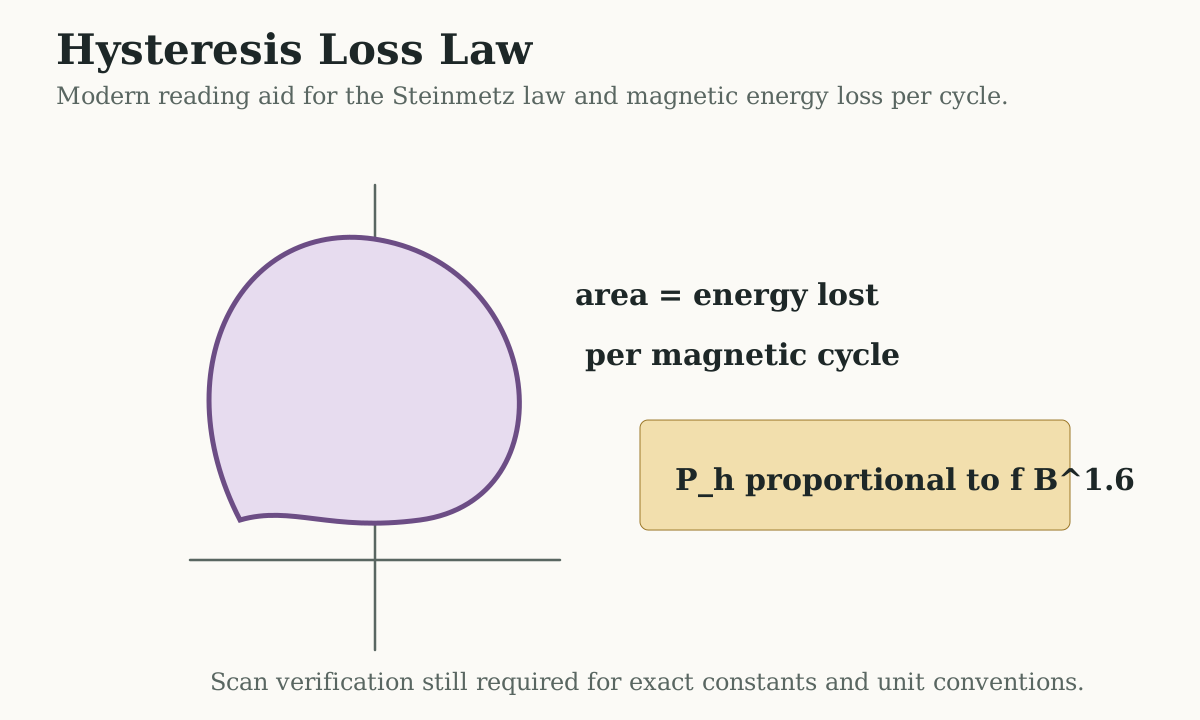
Modern guide for magnetic lag, loop area, and energy loss per cycle.
hysteresis, magnetism, magnetic-loss, effective-resistance
Highest-Priority Formula Leads
Section titled “Highest-Priority Formula Leads”| Candidate | Family | OCR/PDF text | Routes |
|---|---|---|---|
theory-calculation-electric-circuits-eq-candidate-0244strong-formula-candidate | magnetism-hysteresis | Pi’actically non-magnetic, lowers the permeability to /x = 1.4. | source research review |
theory-calculation-alternating-current-phenomena-1897-eq-candidate-0002strong-formula-candidate | power-energy | 2.) Joule’s law : P= i^r, where P is the rate at which | source research review |
theory-calculation-alternating-current-phenomena-1900-eq-candidate-0002strong-formula-candidate | power-energy | 2.) Joule’s law: P= izr, where P is the rate at which | source research review |
theory-calculation-alternating-current-phenomena-1900-eq-candidate-0003strong-formula-candidate | power-energy | 3.) The power equation : P0 = ei, where P0 is the | source research review |
theory-calculation-alternating-current-phenomena-eq-candidate-0002strong-formula-candidate | power-energy | 2. Joule’s law: P = ^^r, where P is the power, or the rate at | source research review |
theory-calculation-electric-circuits-eq-candidate-0124strong-formula-candidate | magnetism-hysteresis | - 1.12, jB= - 1.0: the rising magnetization curve B ’” then passes | source research review |
theoretical-elements-electrical-engineering-eq-candidate-0130strong-formula-candidate | power-energy | The e.m.f. consumed by resistance r is EI = 7r, thus the | source research review |
theory-calculation-electric-circuits-eq-candidate-0119strong-formula-candidate | inductance-capacity | ”decreasing magnetic characteristic,” and at -H = 0, we are not | source research review |
Highest-Priority Figure Leads
Section titled “Highest-Priority Figure Leads”| Candidate | Caption lead | Section | Routes |
|---|---|---|---|
theory-calculation-electric-circuits-fig-031Fig. 31 | (13) Fig. 31. the maximum possible hysteresis loss. | Chapter 4: Magnetism | source research review |
theory-calculation-electric-circuits-fig-063Fig. 63 | The magnetic flux wave, B, becomes more and more 9at-topped with increasing saturation, and finally practically rectangular, in Fig. 63. The curves 60 to 63 are drawn with the same maximum values | Chapter 8: Shaping Of Waves By Magnetic Saturation | source research review |
theory-calculation-electric-circuits-fig-070Fig. 70 | \\ Fig. 70. The enormous reduction of the voltage peak by an air-gap of | Chapter 8: Shaping Of Waves By Magnetic Saturation | source research review |
theoretical-elements-electrical-engineering-fig-154Fig. 154 | I. Low core-loss type, Fig. 154 II. Low t*r loss type, Fig. 155 | Apparatus Section 1: Alternating-current Transformer: Low Core-loss Type, | source research review |
theory-calculation-electric-circuits-fig-094Fig. 94 | of effective resistances, 22, as the values of r-., for pulsations between i + bi and i — bi, and such a curve is shown as R in Fig. 94. We may say, that the arc, when shunted by an oscillating circuit, has an effecti… | Chapter 10: Instability Of Circuits : The Arc | source research review |
theory-calculation-electric-circuits-fig-107Fig. 107 | ^i-1.9 00 - 60°; ^0=7.6. Fig. 107. and the magnetic distribution in the transformer, during the moments marked as a, 6, c, d, e, /, g, in Fig. 107, is shown in | Chapter 12: Reactance Of Induction Apparatus | source research review |
theory-calculation-electric-circuits-fig-105Fig. 105 | and the magnetic distribution in the transformer, during the moments marked as a, 6, c, d, e, /, g, in Fig. 107, is shown in Fig. 105. In Fig. 105a, the primary flux is larger than the secondary, and all leakage fluxe… | Chapter 12: Reactance Of Induction Apparatus | source research review |
theory-calculation-electric-circuits-fig-124Fig. 124 | 8INQIC*PHA8E Fig. 124. the losses in these transformers have not been included, since | Chapter 14: Constant-Potential Constant-Current Trans Formation | source research review |