Distributed Constants
Meaning
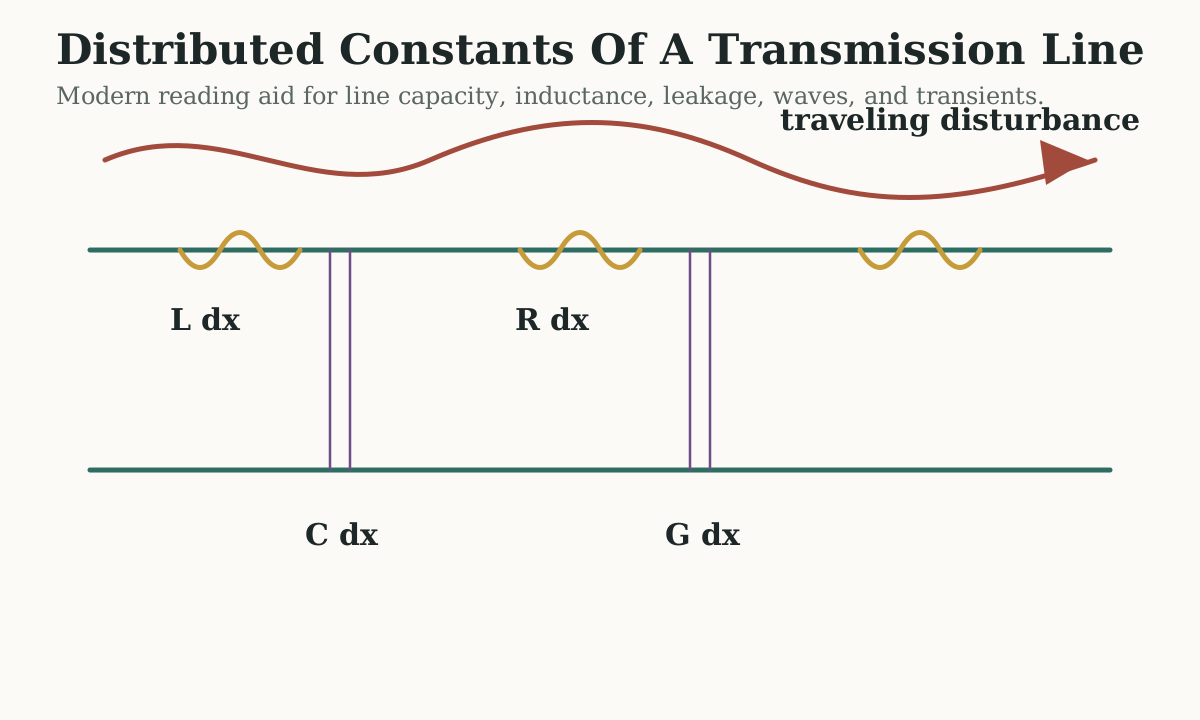
Section titled “Meaning”Distributed constants are resistance, inductance, capacity, and leakage spread along a conductor, line, cable, or winding instead of concentrated at one point. Once constants are distributed, the circuit can behave as a wave system.
Modern Equivalent
Section titled “Modern Equivalent”Modern transmission-line notation often uses per-unit-length constants:
For an ideal lossless line:
Why Steinmetz Matters Here
Section titled “Why Steinmetz Matters Here”Steinmetz’s transient work forces the reader to stop treating every electrical system as an instantaneous lumped circuit. Long lines, high-potential apparatus, transformer coils, cables, and conductors can require a field-propagation view.
Modern Engineering Interpretation
This becomes modern transmission-line theory, surge propagation, reflection, standing waves, and insulation coordination.
Interactive Translation
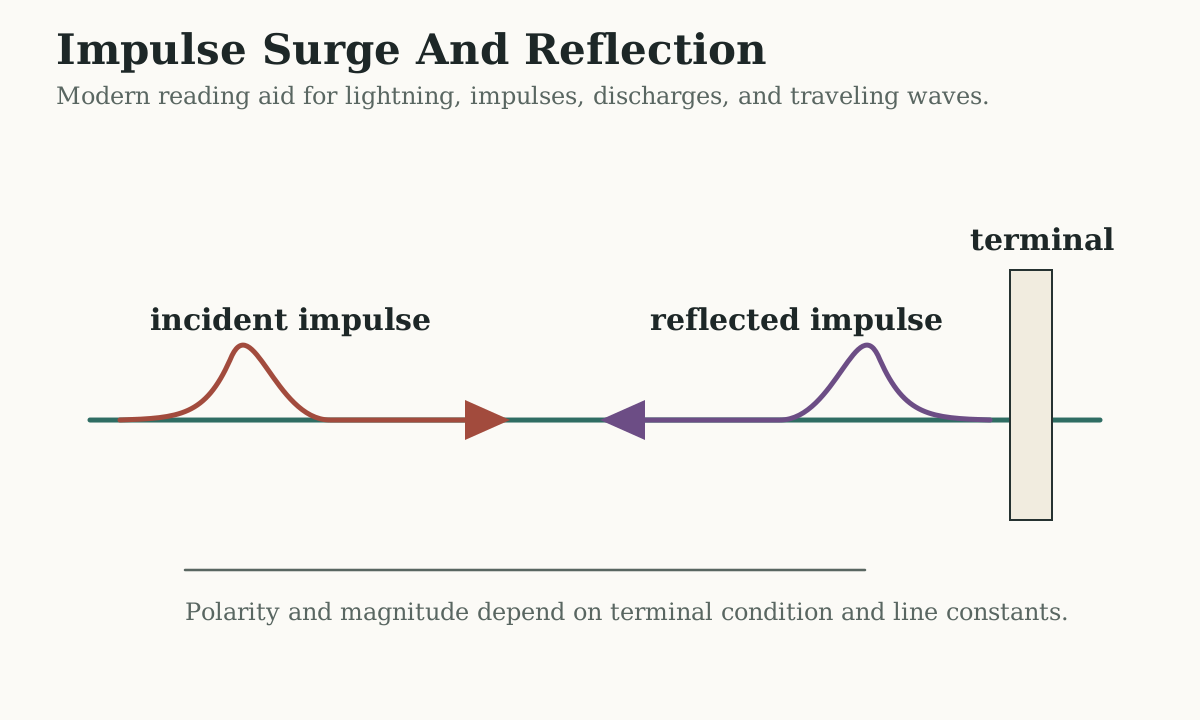
Section titled “Interactive Translation”The Lightning and Surge Traveling Wave tool gives a modern visualization of a disturbance moving along a distributed line and reflecting from a terminal load.
Tesla-Era Comparison
Tesla-era high-frequency and impulse experiments often live in the same territory: distributed capacity, inductance, resonance, discharge, and wave propagation. The comparison must be technical, not mythic.
Related Pages
Section titled “Related Pages”Reader Synthesis
Section titled “Reader Synthesis”What Steinmetz Is Doing Here
Distributed constants move the reader beyond lumped circuits into lines whose resistance, inductance, capacity, and leakage are spread through space.
The current strongest source route is Theory and Calculation of Transient Electric Phenomena and Oscillations, with 112 candidate hits across 23 sections.
Modern Translation
Modern readers should connect this to transmission-line theory, propagation velocity, reflections, standing waves, and surge behavior.
This page currently tracks 252 candidate occurrences across 10 sources and 42 sections.
Mathematical And Visual Route
Follow line inductance/capacity, velocity, wavelength, attenuation, reflection, and natural period.
Use the math/visual bridge lower on this page to jump into formula families, source visual maps, and candidate figure leads.
Interpretive Boundary
Field interpretations are useful here because the line is not merely a component; it is an extended electromagnetic system.
Layer labels stay active: source claim, modern equivalent, mathematical reconstruction, historical note, and interpretive reading are not interchangeable.
Best Steinmetz Passages To Read First
Section titled “Best Steinmetz Passages To Read First”| Passage | Hits | Location | Open |
|---|---|---|---|
| Chapter 4: Traveling Waves Theory and Calculation of Transient Electric Phenomena and Oscillations | 33 | lines 30244-31450 | read - research review |
| Lecture 8: Traveling Waves Elementary Lectures on Electric Discharges, Waves and Impulses, and Other Transients | 27 | lines 5279-6124 | read - research review |
| Lecture 8: Traveling Waves Elementary Lectures on Electric Discharges, Waves and Impulses, and Other Transients | 27 | lines 4745-5520 | read - research review |
| Chapter 13: Distributed Capacity, Inductance, Resistance, And Leakage Theory and Calculation of Alternating Current Phenomena | 23 | lines 9741-11604 | read - research review |
Research Position
Section titled “Research Position”- Tracked vocabulary: Distributed Constants, Wave Propagation.
- Concordance: Distributed Constants - Wave Propagation.
- Source discipline: the table above is for reading and navigation; exact quotation still requires scan verification.
- Reader route: read the passage first, then return here for modern translation, mathematical reconstruction, visual routes, and interpretation boundaries.
- Editorial rule: expand this page by promoting scan-checked passages, equations, and diagrams from the linked workbench pages, not by adding unsourced generalizations.
Source Expansion Impact
Section titled “Source Expansion Impact”Distributed constants gain a much stronger line-and-cable route in the next wave.
This should connect line theory, natural period, cable charge/discharge, and practical transmission systems.
| Source Target | Year | Status | Why It Matters Here |
|---|---|---|---|
| The Natural Period of a Transmission Line and the Frequency of Lightning Discharge Therefrom | 1898 | Planned Acquisition | This is the missing early bridge between line constants, natural oscillation, and lightning-frequency reasoning. |
| Cable Charge and Discharge | 1923 | Registered Authority Target | This is the direct source for cable transients and should strengthen the line/capacity side of the archive. |
| Systems of Electric Transmission and Distribution | 1900 | Registered Authority Target | This should connect Steinmetz’s high theory to practical power-system layout and AC distribution choices. |
Source-Grounded Dossier
Section titled “Source-Grounded Dossier”Generated evidence layer: this dossier is built from the processed concept concordance. Counts and snippets are OCR/PDF-text aids, not final quotations. Verify against scans before making exact claims.
Candidate occurrences tracked for this page.
Sources with at least one hit.
Sections, lectures, chapters, or report divisions to review.
What The Current Corpus Shows
Section titled “What The Current Corpus Shows”Read this concept page through the linked source passages first. Use the dossier to locate Steinmetz’s wording, then add modern, mathematical, historical, and interpretive layers only with labels.
The strongest current source concentration is Theory and Calculation of Transient Electric Phenomena and Oscillations with 112 candidate hits across 23 sections.
The dossier is meant to turn a concept page into a reading path: begin with Steinmetz’s source wording, then use the research links only when you need candidate counts, snippets, mathematical reconstruction, historical context, or interpretive layers.
Terms And Aliases Tracked
Section titled “Terms And Aliases Tracked”distributed capacity, distributed constants, distributed inductance, standing wave, traveling wave, travelling wave, wave front, wave propagation
Concordance Records
Section titled “Concordance Records”Distributed Constants - Wave Propagation
Source Distribution
Section titled “Source Distribution”Priority Passages To Read
Section titled “Priority Passages To Read”Chapter 4: Traveling Waves - 33 candidate hits
Source: Theory and Calculation of Transient Electric Phenomena and Oscillations (1909)
Location: lines 30244-31450 - Tracked concepts: Wave Propagation
CHAPTER IV. TRAVELING WAVES. 20. As seen in Chapter III, especially in electric power cir- cuits, overhead or underground, the longest existing standing wave has a wave length which is so small compared with the critical wave length - where the frequency becomes zero - that the effect of the damping constant on the frequency and the wave length is negligi...... the fre- quency constant q and the wave length constant k can be neglected, that is, frequency and wave length assumed as inde- pendent of the energy loss in the circuit. Usually, therefore, the equations (74) and (75) can be applied in dealing with the traveling wave. In these equations the distance traveled by the wave per second is used as unit len...Lecture 8: Traveling Waves - 27 candidate hits
Source: Elementary Lectures on Electric Discharges, Waves and Impulses, and Other Transients (1914)
Location: lines 5279-6124 - Tracked concepts: Distributed Constants, Wave Propagation
LECTURE VIII. TRAVELING WAVES. 33. In a stationary oscillation of a circuit having uniformly distributed capacity and inductance, that is, the transient of a circuit storing energy in the dielectric and magnetic field, current and voltage are given by the expression i = ioe-"^ cos ((/> T CO - 7), ^ . . e = eoe~"' sin ((^ =F co - 7), where <j) is the time...... y dis- tance angle co, and at any time t, that is, time angle 0, then is p = ei, = eo^e~2"* cos (0 =F co - 7) sin (0 =F co - 7), = ^6-^«'sin2(0Ta>-7), (2) and the average power flow is Po = avg p, (3) = 0. Hence, in a stationary oscillation, or standing wave of a uni- form circuit, the average flow of power, po, is zero, and no power flows along the c...Lecture 8: Traveling Waves - 27 candidate hits
Source: Elementary Lectures on Electric Discharges, Waves and Impulses, and Other Transients (1911)
Location: lines 4745-5520 - Tracked concepts: Distributed Constants, Wave Propagation
LECTURE VIII. TRAVELING WAVES. 33. In a stationary oscillation of a circuit having uniformly distributed capacity and inductance, that is, the transient of a circuit storing energy in the dielectric and magnetic field, current and voltage are given ^by the expression i = iQe~ut cos (0 T co - 7), ) e = e0e~ut sin (</> T co - 7), ) where 0 is the time angle...... tance angle co, and at any time t, that is, time angle <£, then is p = ei, = e0ioe~2ut cos (</> T co - 7) sin (0 =F co - 7), = ^|V2«<sin2(c/>=Fco-7), (2) and the average power flow is Po = avg p, (3) = 0. Hence, in a stationary oscillation, or standing wave of a uni- form circuit, the average flow of power, p0, is zero, and no power flows along the ci...Chapter 13: Distributed Capacity, Inductance, Resistance, And Leakage - 23 candidate hits
Source: Theory and Calculation of Alternating Current Phenomena (1900)
Location: lines 9741-11604 - Tracked concepts: Distributed Constants
CHAPTER XIII. DISTRIBUTED CAPACITY, INDUCTANCE, RESISTANCE, AND LEAKAGE. 107. As far as capacity has been considered in the foregoing chapters, the assumption has been made that the condenser or other source of negative reactance is shunted across the circuit at a definite point. In many ...... hole length of the conductor, so that the circuit can be considered as shunted by an infinite number of infinitely small condensers infi nitely near together, as diagrammatically shown in Fig. 83. iiiimiiiiumiiiT TTTTTTTTTT.TTTTTTTTTT i Fig. 83. Distributed Capacity. In this case the intensity as well as phase of the current, and consequently of the c...Chapter 3: Standing Waves - 15 candidate hits
Source: Theory and Calculation of Transient Electric Phenomena and Oscillations (1909)
Location: lines 29316-30243 - Tracked concepts: Wave Propagation
CHAPTER III. STANDING WAVES. 14. If the propagation constant of the wave vanishes, h = 0, the wave becomes a stationary or standing wave, and the equa- tions of the standing wave are thus derived from the general equations (50) to (61), by substituting therein h = 0, which gives R2 = V(k2 - LCm2)2; (97) hence, if k2 > LCm2, R2 = tf- LCm2; and if /c2 < LCm...Chapter 12: Dibtbisnted Capacity, Inductance, Besistance, And - 11 candidate hits
Source: Theory and Calculation of Alternating Current Phenomena (1897)
Location: lines 11564-12672 - Tracked concepts: Distributed Constants
... capacity is distributed over the whole length of the conductor, so that the circuit can be considered as shunted by an infinite number of infinitely small condensers infi. nitely near together, as diagrammatically shown in Fig. 83. 8 3 S Fig, 83. Distributed Capacity. In this case the intensity as well as phase of the current,, and consequently of the...... .M.Fs., but also the currents, at the beginning, end, and different points of the conductor, are different in intensity and in phase. Where the capacity effect of the line is small, it may with sufficient approximation be represented by one con- §103] DISTRIBUTED CAPACITY. 151 denser of the same capacity as the line, shunted across the line. Frequentl...Reading Layers To Build Out
Section titled “Reading Layers To Build Out”| Layer | What to add next |
|---|---|
| Steinmetz wording | Pull exact source passages only after scan verification; keep OCR text labeled until then. |
| Modern engineering reading | Translate the source usage into present electrical-engineering or physics language without erasing the older vocabulary. |
| Mathematical layer | Link equations, variables, diagrams, and worked examples when the concept has formula candidates. |
| Historical layer | Identify whether the term is still used, renamed, absorbed into modern theory, or historically obsolete. |
| Ether-field interpretation | Keep interpretive readings separate from Steinmetz’s explicit claim and from modern physics. |
| Open questions | Record places where the concordance suggests a lead but the scan or edition has not yet been checked. |
Next Editorial Actions
Section titled “Next Editorial Actions”- Open the highest-priority source-text passages above and verify the wording against scans.
- Promote exact definitions, equations, diagrams, and hidden-gem passages into this page with source references.
- Add related concept links, equation pages, and diagram pages once the evidence is scan checked.
- Keep speculative or Wheeler-style readings in explicitly labeled interpretation blocks.
Math And Visual Evidence Map
Section titled “Math And Visual Evidence Map”Generated bridge: this section crosslinks the concept page with the formula atlas, figure atlas, source visual maps, and source formula maps. It is a routing layer, not final interpretation.
Formula candidates routed to this concept.
Figure candidates routed to this concept.
Modern guide diagrams related to this concept.
Formula Families To Review
Section titled “Formula Families To Review”Inductance, Capacity, And Stored Energy - Transients, Oscillation, And Damping - Waves, Lines, Radiation, And Frequency
Source Maps For This Concept
Section titled “Source Maps For This Concept”theory-calculation-transient-electric-phenomena-oscillations visuals - theory-calculation-transient-electric-phenomena-oscillations formulas - elementary-lectures-electric-discharges-waves-impulses visuals - elementary-lectures-electric-discharges-waves-impulses formulas - electric-discharges-waves-impulses-1914 visuals - electric-discharges-waves-impulses-1914 formulas - theory-calculation-alternating-current-phenomena-1900 visuals - theory-calculation-alternating-current-phenomena-1900 formulas - theory-calculation-alternating-current-phenomena visuals - theory-calculation-alternating-current-phenomena formulas - theory-calculation-alternating-current-phenomena-1897 visuals - theory-calculation-alternating-current-phenomena-1897 formulas
Related Modern Guide Diagrams
Section titled “Related Modern Guide Diagrams”Modern reading aid for line capacity, inductance, leakage, waves, and transients.
distributed-constants, capacity, inductance, waves
Modern reading aid for lightning, impulses, discharges, and traveling waves.
lightning-surges, impulse-current, traveling-wave
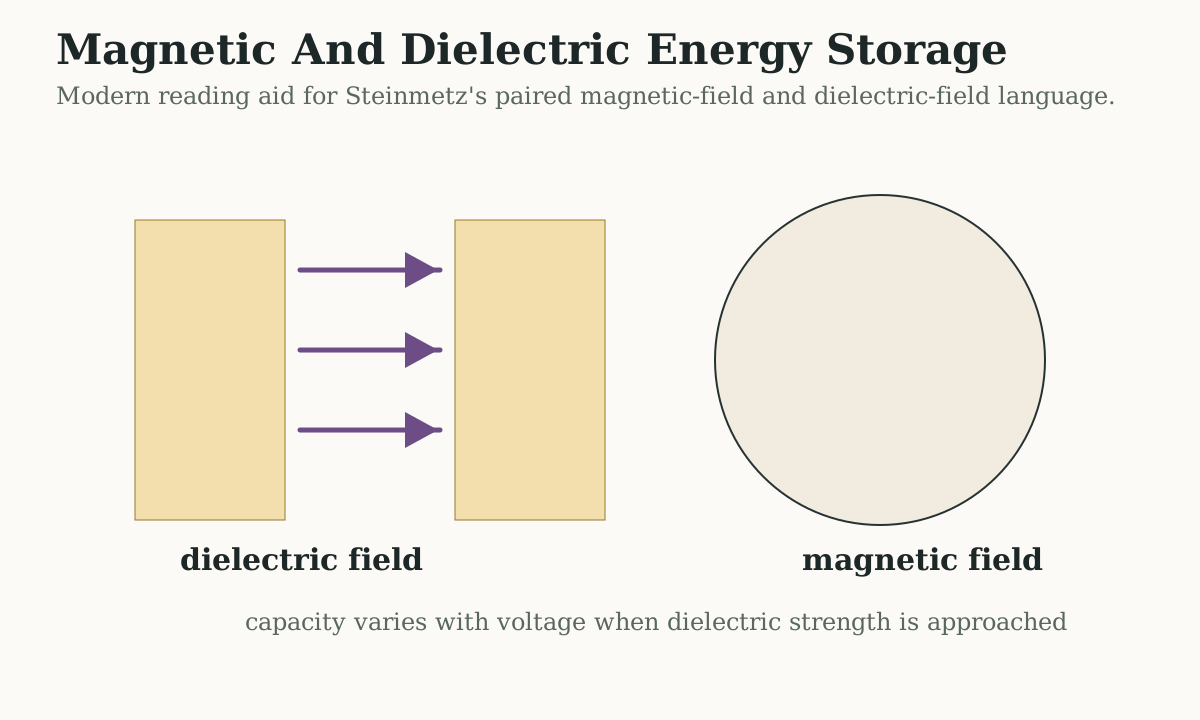
Modern reading aid for Steinmetz’s paired magnetic-field and dielectric-field language.
dielectric-field, magnetic-field, energy-storage
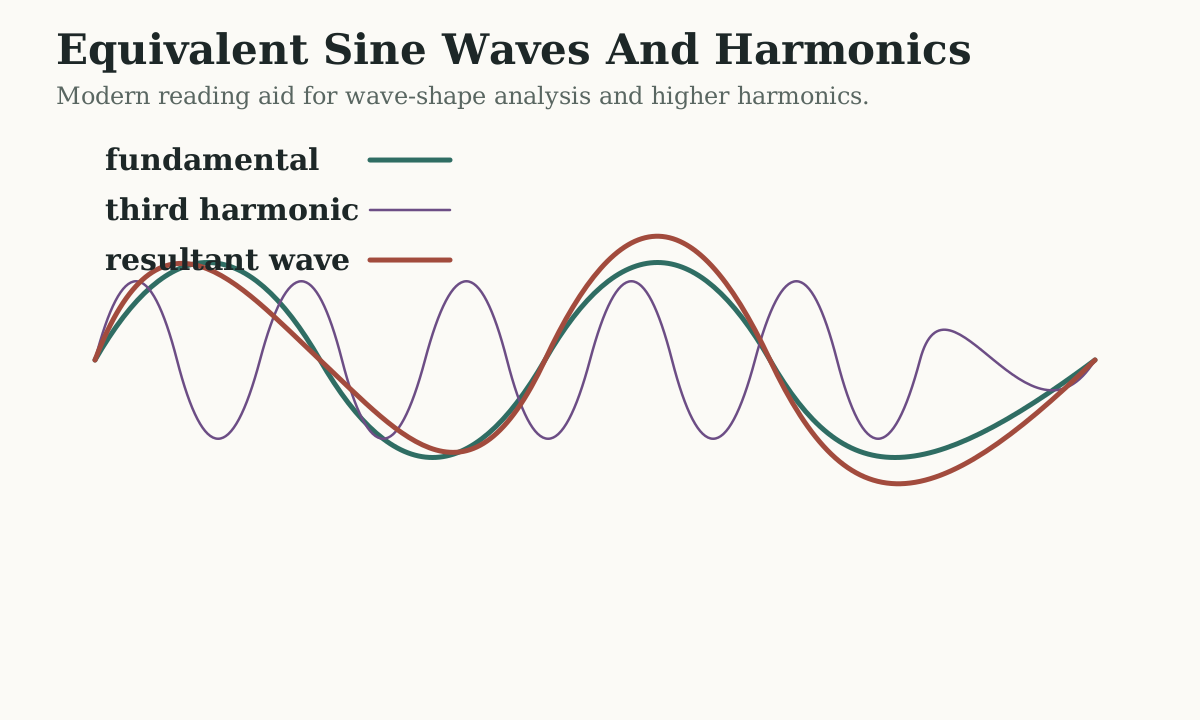
Modern reading aid for wave-shape analysis and higher harmonics.
harmonics, wave-shape, fourier-analysis
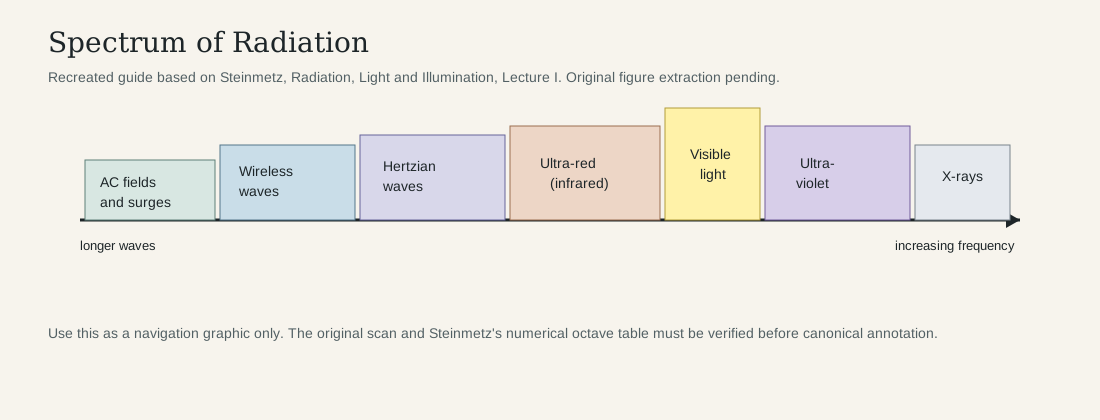
Modern navigation guide for Steinmetz’s electric-wave, visible-light, ultraviolet, and X-ray spectrum bridge.
radiation, electric-waves, frequency, spectrum, ether
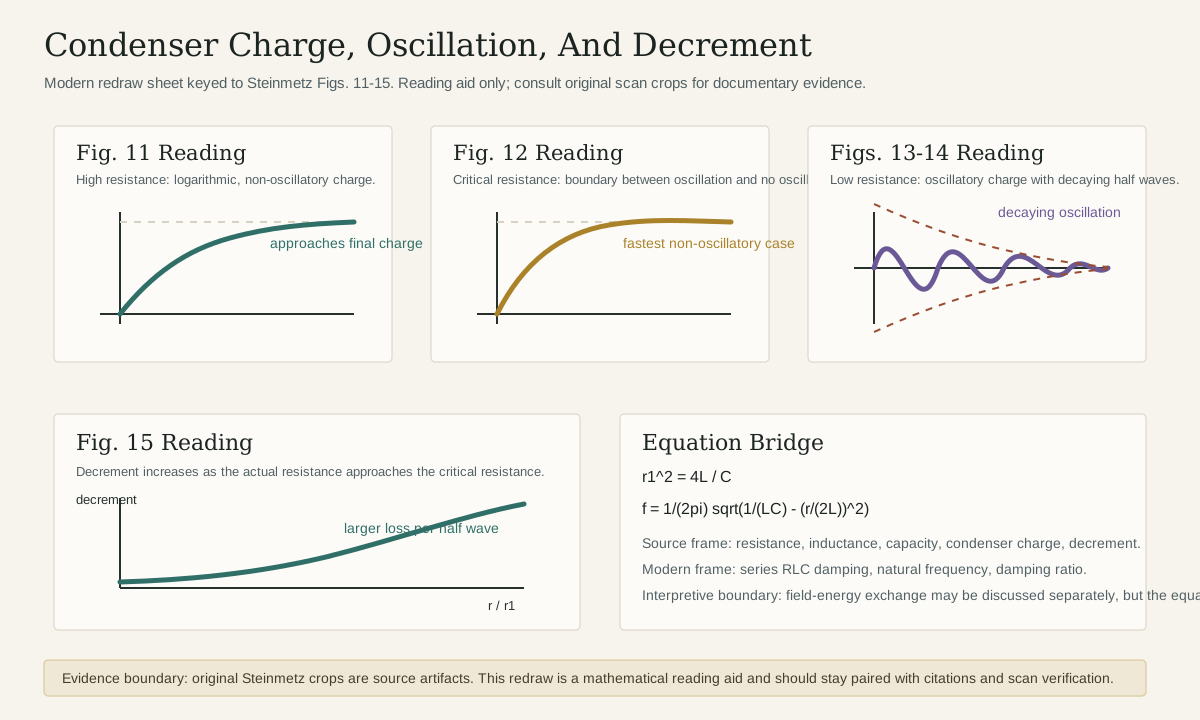
Modern redraw sheet for logarithmic charge, critical damping, oscillatory charge, and decrement.
transient-phenomena, oscillation-damping, capacity, condenser
Highest-Priority Formula Leads
Section titled “Highest-Priority Formula Leads”| Candidate | Family | OCR/PDF text | Routes |
|---|---|---|---|
theory-calculation-transient-electric-phenomena-oscillations-eq-candidate-0272strong-formula-candidate | transients-oscillation | At the moment 0 = 0, let the e.m.f. e = E cos (0 - 00) be | source research review |
electric-discharges-waves-impulses-1914-eq-candidate-0240strong-formula-candidate | transients-oscillation | e = 2;oCe-”’ sin (0 =F co - 7) j | source research review |
electric-discharges-waves-impulses-1914-eq-candidate-0293strong-formula-candidate | transients-oscillation | i = e~ ”’ J ai cos </) cos co + 6i sin cf) cos co + Ci cos 0 sin co | source research review |
elementary-lectures-electric-discharges-waves-impulses-eq-candidate-0195strong-formula-candidate | transients-oscillation | i = io cos (0 - 7) = io cos 7 cos <j> + i0 sin 7 sin | source research review |
theory-calculation-alternating-current-phenomena-1900-eq-candidate-0240strong-formula-candidate | symbolic-ac | is r - j (x -f x0} = r = .6, x + x0 = 0, and tan S>0 = 0 ; | source research review |
theory-calculation-transient-electric-phenomena-oscillations-eq-candidate-0276strong-formula-candidate | transients-oscillation | Since e = E cos (0 - 00) = impressed e.m.f., | source research review |
theory-calculation-transient-electric-phenomena-oscillations-eq-candidate-0296strong-formula-candidate | transients-oscillation | i = -z | cos (I? - 00- 0J- i~x° cos (00 + OJ j (9) | source research review |
elementary-lectures-electric-discharges-waves-impulses-eq-candidate-0220strong-formula-candidate | transients-oscillation | if = 140 cos 0.2 1 - 80 sin 0.2 1, | source research review |
Highest-Priority Figure Leads
Section titled “Highest-Priority Figure Leads”| Candidate | Caption lead | Section | Routes |
|---|---|---|---|
elementary-lectures-electric-discharges-waves-impulses-fig-001Fig. 1 | G, the line A, and the load L, a current i flows, and voltages e Fig. 1. exist, which are constant, or permanent, as long as the conditions of the circuit remain the same. If we connect in some more | Lecture 1: Nature And Origin Of Transients | source research review |
elementary-lectures-electric-discharges-waves-impulses-fig-003Fig. 3 | permanent condition corresponding to the closed switch can occur, Fig. 3. the stored energy has to be supplied from the source of power; that is, for a short time power, in supplying the stored energy, flows not | Lecture 1: Nature And Origin Of Transients | source research review |
elementary-lectures-electric-discharges-waves-impulses-fig-006Fig. 6 | changes between potential gravitational and kinetic mechanical Fig. 6. Double-energy Transient | Lecture 1: Nature And Origin Of Transients | source research review |
elementary-lectures-electric-discharges-waves-impulses-fig-025Fig. 25 | frequency, and as the result an increase of voltage and a distor- tion of the quadrature phase occurs, as shown in the oscillogram Fig. 25. Various momentary short-circuit phenomena are illustrated by the oscillograms… | Lecture 4: Single-Energy Transients In Alternating Current Circuits | source research review |
elementary-lectures-electric-discharges-waves-impulses-fig-029Fig. 29 | 2 3 4 5 Fig. 29. 6 seconds | Lecture 5: Single-Energy Transient Of Ironclad Circuit | source research review |
elementary-lectures-electric-discharges-waves-impulses-fig-033Fig. 33 | \ Fig. 33. hence, substituted in equation (28), | Lecture 6: Double-Energy Transients | source research review |
elementary-lectures-electric-discharges-waves-impulses-fig-034Fig. 34 | A B Fig. 34. However, if (8) are the equations of current and voltage at a point A of a line, shown diagrammatically in Fig. 34, at any other | Lecture 7: Line Oscillations | source research review |
theory-calculation-transient-electric-phenomena-oscillations-fig-099Fig. 99 | given for ^ = 0, where tt = t] for any other point of the line X the wave shape is the same, but all the ordinates reduced by the factor £~115* in the proportion as shown in the dotted curve in Fig. 99. Fig. 101 shows… | Chapter 4: Traveling Waves | source research review |