Elementary Lectures on Electric Discharges, Waves and Impulses, and Other Transients Visual Map
Visual Map
Section titled “Visual Map”Review layer: candidate figure references are OCR/PDF-text leads. Promoted crops are documentary scan crops that still need second-pass bibliographic and crop-coordinate review. Modern guide diagrams are explanatory reconstructions, not historical figure evidence.
Promoted original crops.
Extracted visual-review images.
Candidate figure references.
Modern guide diagrams keyed here.
Promoted Original Crops
Section titled “Promoted Original Crops”No promoted original crops are attached to this source yet. Use the figure candidates below as crop targets.
Extracted Visual Review Candidates
Section titled “Extracted Visual Review Candidates”No extracted visual candidates are promoted for this source yet.
Modern Guide Diagrams Keyed To This Source
Section titled “Modern Guide Diagrams Keyed To This Source”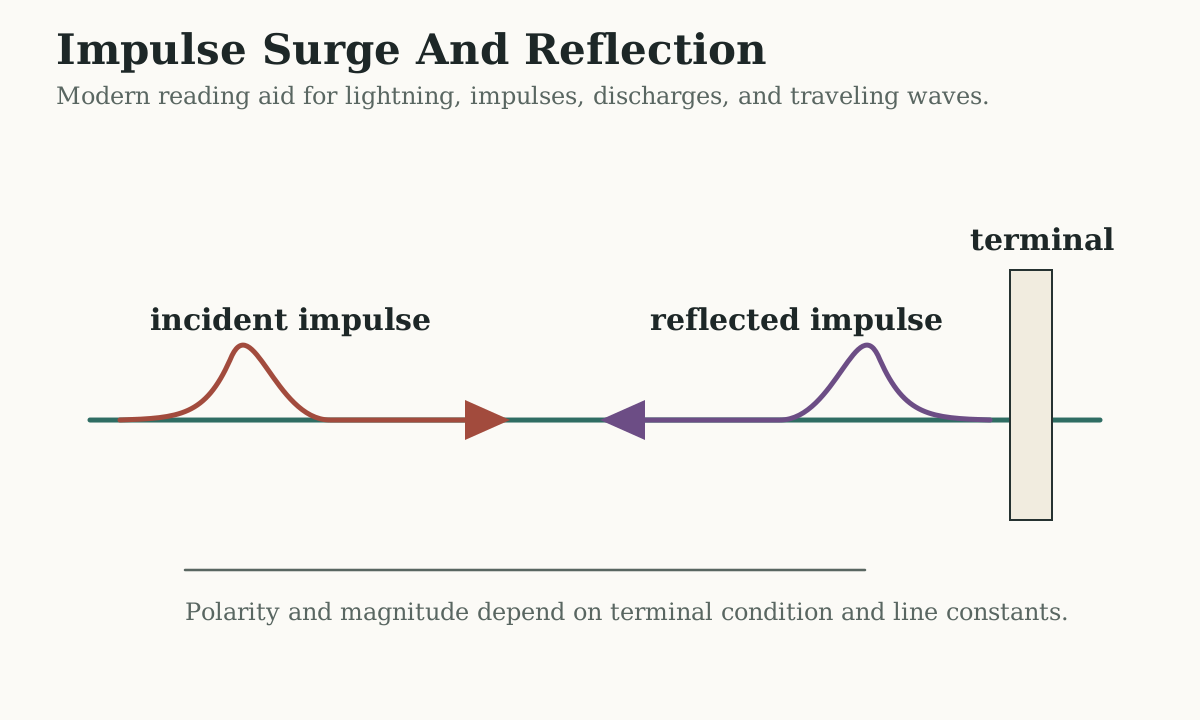
Modern reading aid for lightning, impulses, discharges, and traveling waves.
lightning-surges, impulse-current, traveling-wave
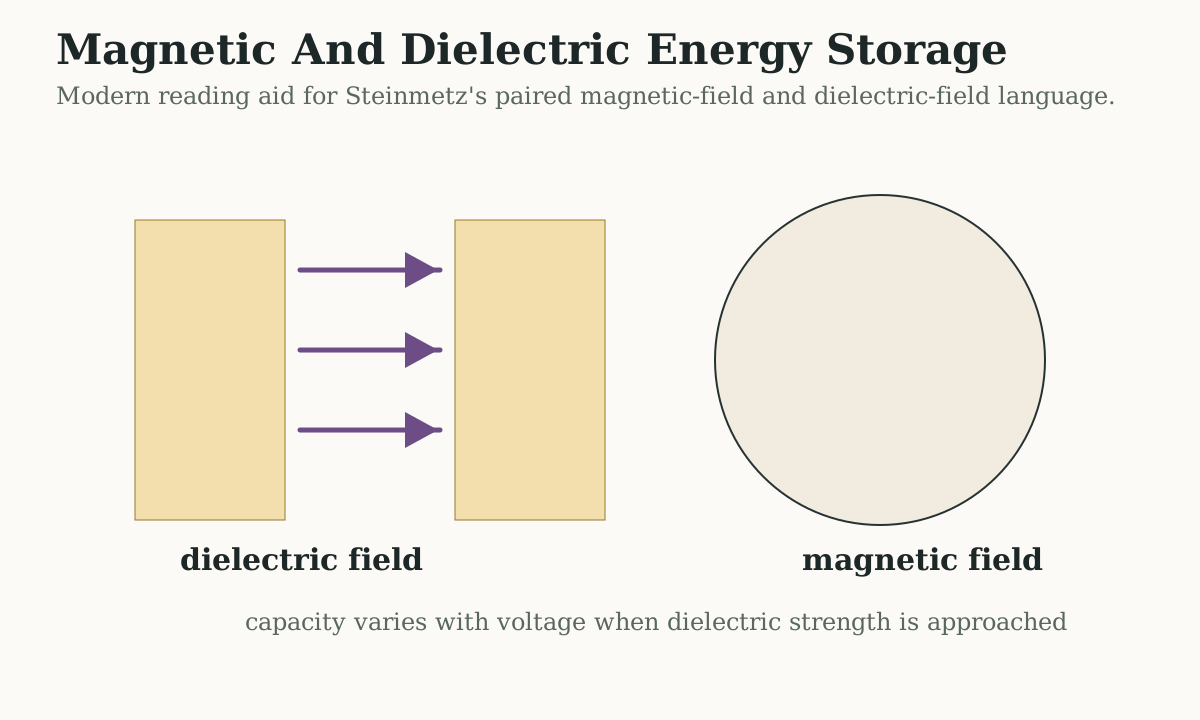
Modern reading aid for Steinmetz’s paired magnetic-field and dielectric-field language.
dielectric-field, magnetic-field, energy-storage
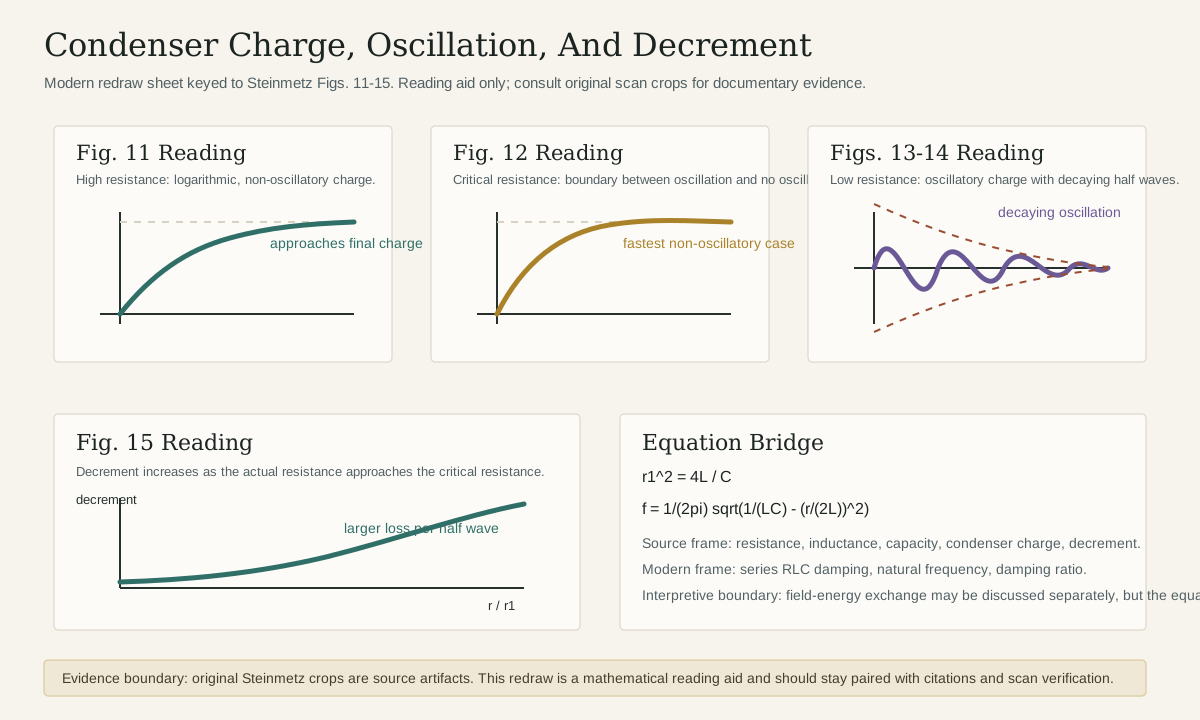
Modern redraw sheet for logarithmic charge, critical damping, oscillatory charge, and decrement.
transient-phenomena, oscillation-damping, capacity, condenser
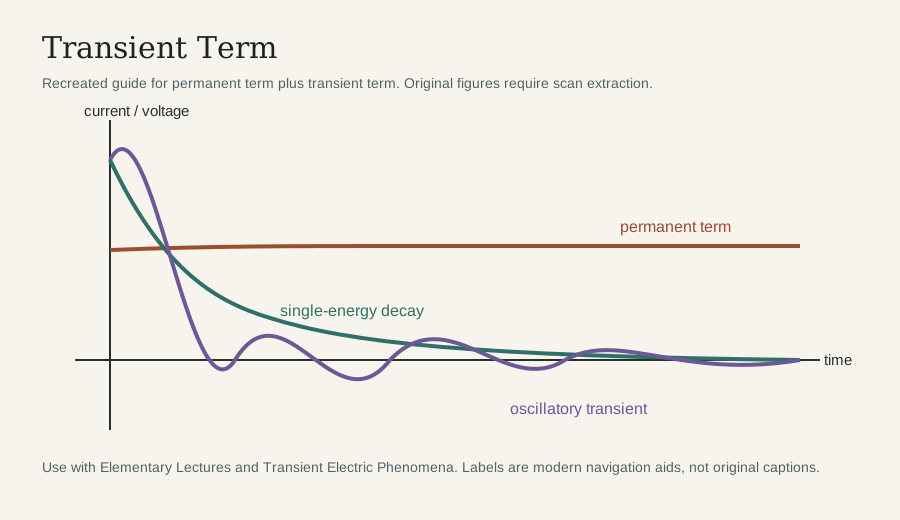
Modern guide for permanent terms, temporary terms, decay, and oscillatory readjustment.
transient-phenomena, oscillation-damping, damping, stored-energy
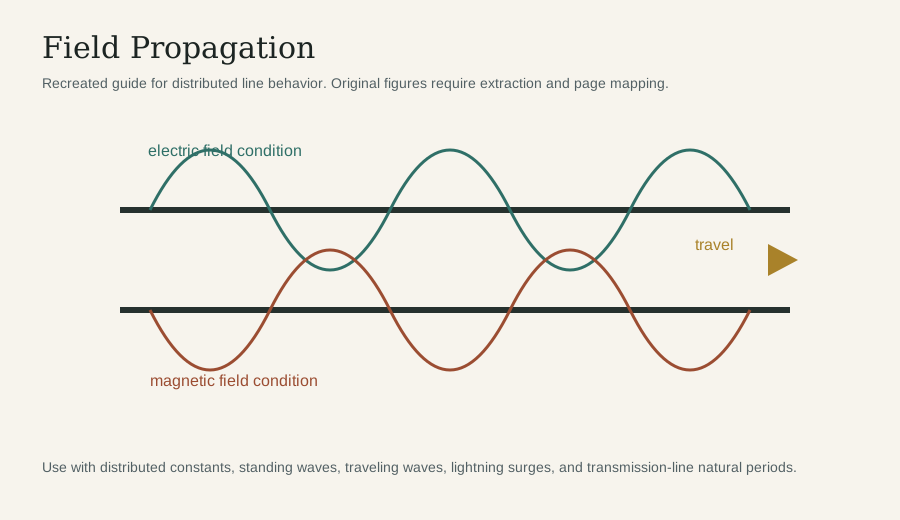
Modern reading aid for distributed constants, standing waves, traveling waves, and surge propagation.
electric-waves, distributed-constants, traveling-wave, lightning-surges
Candidate Figure References
Section titled “Candidate Figure References”| Candidate | Caption lead | Section | Routes |
|---|---|---|---|
electric-discharges-waves-impulses-1914-fig-001Fig. 1 | oo,o o Fig. 1. exist, which are constant, or permanent, as long as the conditions | Lecture 1: Nature And Origin Of Transients | source research review |
electric-discharges-waves-impulses-1914-fig-002Fig. 2 | ]C Fig. 2. Commonly, transient and permanent phenomena are super- imposed upon each other. For instance, if in the circuit Fig. 1 | Lecture 1: Nature And Origin Of Transients | source research review |
electric-discharges-waves-impulses-1914-fig-003Fig. 3 | G O Fig. 3. the stored energy has to be supplied from the source of power; that is, for a short time power, in supplying the stored energy, flows not | Lecture 1: Nature And Origin Of Transients | source research review |
electric-discharges-waves-impulses-1914-fig-025Fig. 25 | frequency, and as the result an increase of voltage and a distor- tion of the quadrature phase occurs, as shown in the oscillogram Fig. 25. Various momentary short-circuit phenomena are illustrated by the oscillograms… | Lecture 4: Single-Energy Transients In Alternating Current Circuits | source research review |
electric-discharges-waves-impulses-1914-fig-029Fig. 29 | 4 5 Fig. 29. seconds | Lecture 5: Single-Energy Tra.Nsient Of Ironclad Circuit | source research review |
electric-discharges-waves-impulses-1914-fig-033Fig. 33 | = 0.000333 sec. = 0.33 millisecond; Fig. 33. hence, substituted in equation (28), | Lecture 6: Double-Energy Transients | source research review |
electric-discharges-waves-impulses-1914-fig-034Fig. 34 | B Fig. 34. However, if (8) are the equations of current and voltage at a point A of a line, shown diagrammatically in Fig. 34, at any other | Lecture 7: Line Oscillations | source research review |
electric-discharges-waves-impulses-1914-fig-037Fig. 37 | section h consists of 4 quarter- wave units, etc. Fig. 37. Fig. 38. | Lecture 7: Line Oscillations | source research review |
electric-discharges-waves-impulses-1914-fig-038Fig. 38 | Fig. 37. Fig. 38. The same applies to case 1, and it thus follows that the wave | Lecture 7: Line Oscillations | source research review |
electric-discharges-waves-impulses-1914-fig-040Fig. 40 | Line Fig. 40. former, the high-tension switches are opened at the generator end of the transmission line. The energy stored magnetically and | Lecture 8: Traveling Waves | source research review |
electric-discharges-waves-impulses-1914-fig-042Fig. 42 | constant in the direction of propagation, as indicated by A in Fig. 42. Fig. 42. — Energy Transfer by Traveling Wave. | Lecture 8: Traveling Waves | source research review |
electric-discharges-waves-impulses-1914-fig-054Fig. 54 | which it can draw in supplying power. In permanent condition the line could not add to the power, but must consume, that is, the permanent power-transmission diagram must always be like Fig. 54. Not so, as seen, with… | Lecture 9: Oscillations Of The Compound Circuit | source research review |
electric-discharges-waves-impulses-1914-fig-055Fig. 55 | u Fig. 55. U„= 533 | Lecture 9: Oscillations Of The Compound Circuit | source research review |
electric-discharges-waves-impulses-1914-fig-056Fig. 56 | Line Fig. 56. The diagram of the power of the two waves of opposite direc- | Lecture 9: Oscillations Of The Compound Circuit | source research review |
electric-discharges-waves-impulses-1914-fig-066Fig. 66 | 0 Fig. 66. 126 ELECTRICAL DISCHARGES, WAVES AND IMPULSES | Lecture 10: Continual And Cumulative Oscillations | source research review |
electric-discharges-waves-impulses-1914-fig-008Fig. 8 | tance, the lines of magnetic force are concentric circles, shown by drawn lines in Fig. 8, page 10, and the lines of dielectric force are straight lines radiating from the conductor, shown dotted in Fig. 8. Due to the… | Lecture 10: Continual And Cumulative Oscillations | source research review |
electric-discharges-waves-impulses-1914-fig-074Fig. 74 | Bh = D — -^Goscf) — -cos t/^, Fig. 74. (42) | Lecture 10: Continual And Cumulative Oscillations | source research review |
electric-discharges-waves-impulses-1914-fig-076Fig. 76 | o O Fig. 76. ^1 t2 H . | Lecture 10: Continual And Cumulative Oscillations | source research review |