Lightning And Surges
Steinmetz Usage
Section titled “Steinmetz Usage”Lightning and high-potential surges belong to the transient side of Steinmetz’s work. These events cannot be understood only as final steady-state voltages or currents. They involve motion, reflection, line constants, dielectric stress, and short-duration energy transfer.
The transient books are especially important here because they force the reader to shift from lumped circuits to distributed behavior: a long line can carry a disturbance whose location, velocity, and terminal reflection matter.
Modern Equivalent
Section titled “Modern Equivalent”Modern electrical engineering connects this material to:
- lightning impulses,
- switching surges,
- traveling waves on transmission lines,
- surge impedance,
- reflection coefficients,
- insulation coordination,
- arresters and protective equipment.
Interactive Translation
Section titled “Interactive Translation”Use the Lightning and Surge Traveling Wave tool to see a modern reflection-coefficient reading of a surge moving along a line.
This is a modern transmission-line formula used as a reading aid. The source extraction task is to identify the exact Steinmetz passages and diagrams that belong beside it.
Why It Matters
Section titled “Why It Matters”Surges reveal the limitations of simplified AC teaching. They make time, distance, stored field energy, dielectric stress, and apparatus protection impossible to ignore.
Tesla-Era Comparison
Tesla-era electrical science often emphasizes high voltage, resonance, disruptive discharge, impulse behavior, and rapidly changing fields. Steinmetz’s surge and transient-line material should be compared to Tesla only passage by passage, with overlap and divergence kept explicit.
Ether-Field Interpretive Reading
Interpretive only: surges are a natural place for field-centered readings because they display propagation, reflection, stress, and energy redistribution. The archive should keep this interpretive layer separate from source claims and from modern transmission-line theory.
Still To Verify
Section titled “Still To Verify”- Exact Steinmetz passages on lightning, surges, impulses, and high-potential line disturbances.
- Original surge, line, and reflection diagrams for extraction and crop promotion.
- Links between this concept and the Elementary Lectures source once that source receives deeper chapter splitting.
Reader Synthesis
Section titled “Reader Synthesis”What Steinmetz Is Doing Here
The processed corpus gives this concept a source trail across Steinmetz’s books and lectures. Read the source distribution first, because the meaning often changes between radiation, AC calculation, apparatus, and transients.
The current strongest source route is General Lectures on Electrical Engineering, with 271 candidate hits across 6 sections.
Modern Translation
Translate the older wording into modern electrical-engineering language only after the source location is visible.
This page currently tracks 648 candidate occurrences across 12 sources and 70 sections.
Mathematical And Visual Route
Use the linked equation atlas and source formula maps to decide whether this concept has a mathematical layer, a diagrammatic layer, or mainly a terminology layer.
Use the math/visual bridge lower on this page to jump into formula families, source visual maps, and candidate figure leads.
Interpretive Boundary
Interpretive readings are welcome in this archive only when they are labeled and separated from Steinmetz’s explicit wording.
Layer labels stay active: source claim, modern equivalent, mathematical reconstruction, historical note, and interpretive reading are not interchangeable.
Best Steinmetz Passages To Read First
Section titled “Best Steinmetz Passages To Read First”| Passage | Hits | Location | Open |
|---|---|---|---|
| Lecture 17: Arc Lighting General Lectures on Electrical Engineering | 169 | lines 9920-12795 | read - research review |
| Lecture 11: Lightning Protection General Lectures on Electrical Engineering | 84 | lines 4931-5294 | read - research review |
| Lecture 8: Traveling Waves Elementary Lectures on Electric Discharges, Waves and Impulses, and Other Transients | 32 | lines 5279-6124 | read - research review |
| Lecture 8: Traveling Waves Elementary Lectures on Electric Discharges, Waves and Impulses, and Other Transients | 32 | lines 4745-5520 | read - research review |
Research Position
Section titled “Research Position”- Tracked vocabulary: Lightning and Surges, Protective reactance.
- Concordance: Lightning and Surges - Protective reactance.
- Source discipline: the table above is for reading and navigation; exact quotation still requires scan verification.
- Reader route: read the passage first, then return here for modern translation, mathematical reconstruction, visual routes, and interpretation boundaries.
- Editorial rule: expand this page by promoting scan-checked passages, equations, and diagrams from the linked workbench pages, not by adding unsourced generalizations.
Source Expansion Impact
Section titled “Source Expansion Impact”Lightning and surge theory is the most urgent article-acquisition cluster.
Keep existing surge statements grounded in processed transients until these articles have scan custody and equation review.
| Source Target | Year | Status | Why It Matters Here |
|---|---|---|---|
| The Natural Period of a Transmission Line and the Frequency of Lightning Discharge Therefrom | 1898 | Planned Acquisition | This is the missing early bridge between line constants, natural oscillation, and lightning-frequency reasoning. |
| Lightning Phenomena in Electric Circuits | 1907 | Registered Authority Target | This should become a cornerstone for surge theory, steep wave fronts, impulse behavior, and high-voltage protection. |
| Disruptive Strength with Transient Voltages | 1910 | Planned Acquisition | This source should strengthen insulation stress, breakdown, and surge-dielectric language. |
| Outline of Theory of Impulse Currents | 1916 | Registered Authority Target | This is a direct mathematical source for impulse-current reasoning and should feed the surge math route. |
| The Oxide Film Lightning Arrester | 1918 | Planned Acquisition | This source turns surge theory into protective apparatus and belongs beside the patent-to-theory bridge. |
| Frequency Conversion by Third Class Conductor and Mechanism of the Arcing Ground and Other Cumulative Surges | 1923 | Registered Authority Target | This is a flagship pending source for nonlinear discharge, arcing-ground behavior, frequency conversion, and cumulative surges. |
Source-Grounded Dossier
Section titled “Source-Grounded Dossier”Generated evidence layer: this dossier is built from the processed concept concordance. Counts and snippets are OCR/PDF-text aids, not final quotations. Verify against scans before making exact claims.
Candidate occurrences tracked for this page.
Sources with at least one hit.
Sections, lectures, chapters, or report divisions to review.
What The Current Corpus Shows
Section titled “What The Current Corpus Shows”Read this concept page through the linked source passages first. Use the dossier to locate Steinmetz’s wording, then add modern, mathematical, historical, and interpretive layers only with labels.
The strongest current source concentration is General Lectures on Electrical Engineering with 271 candidate hits across 6 sections.
The dossier is meant to turn a concept page into a reading path: begin with Steinmetz’s source wording, then use the research links only when you need candidate counts, snippets, mathematical reconstruction, historical context, or interpretive layers.
Terms And Aliases Tracked
Section titled “Terms And Aliases Tracked”arrester, arresters, impulse, impulses, lightning, surge, surges, Protective reactance, protective-reactance
Concordance Records
Section titled “Concordance Records”Lightning and Surges - Protective reactance
Source Distribution
Section titled “Source Distribution”Priority Passages To Read
Section titled “Priority Passages To Read”Lecture 17: Arc Lighting - 169 candidate hits
Source: General Lectures on Electrical Engineering (1908)
Location: lines 9920-12795 - Tracked concepts: Lightning and Surges
... hing has yet been done in this direction systematically and intelligently, but all has been done by trial which at the best usually means producing more light than necessary, and throw- ing away the excess of diffused light by absorption. APPENDIX II LIGHTNING AND LIGHTNING PROTECTION Paper read before the Annual Convention of the National Electric Li...... een done in this direction systematically and intelligently, but all has been done by trial which at the best usually means producing more light than necessary, and throw- ing away the excess of diffused light by absorption. APPENDIX II LIGHTNING AND LIGHTNING PROTECTION Paper read before the Annual Convention of the National Electric Light Associatio...Lecture 11: Lightning Protection - 84 candidate hits
Source: General Lectures on Electrical Engineering (1908)
Location: lines 4931-5294 - Tracked concepts: Lightning and Surges
ELEVENTH LECTURE LIGHTNING PROTECTION W"~l HEN the first telegraph circuits were strung across the country, lightning protection became necessary, and ■^ was given to these circuits at the station by connecting spark gaps between the circuit conductors and the ground. When, how ...ELEVENTH LECTURE LIGHTNING PROTECTION W"~l HEN the first telegraph circuits were strung across the country, lightning protection became necessary, and ■^ was given to these circuits at the station by connecting spark gaps between the circuit conductors and the ground. When, however, electric light and power circuits made their appearance, this protection...Lecture 8: Traveling Waves - 32 candidate hits
Source: Elementary Lectures on Electric Discharges, Waves and Impulses, and Other Transients (1914)
Location: lines 5279-6124 - Tracked concepts: Lightning and Surges
... = ^6-^«'sin2(0Ta>-7), (2) and the average power flow is Po = avg p, (3) = 0. Hence, in a stationary oscillation, or standing wave of a uni- form circuit, the average flow of power, po, is zero, and no power flows along the circuit, but there is a surge of power, of double frequency. That is, power flows first one way, during one-quarter cycle, and the...... (4) = eo^■oe-2"' cos^ (0 T co - 7), 6o^o [1 + cos 2 (</> =F CO -7)], (5) and the average flow of power is po = avg p, (6) Such a wave thus consists of a combination of a steady flow of power along the circuit, jpo, and a pulsation or surge, pi, of the same nature as that of the standing wave (2) : pi =^%-2"*cos2((/)Tco-7). (7) Such a flow of power alo...Lecture 8: Traveling Waves - 32 candidate hits
Source: Elementary Lectures on Electric Discharges, Waves and Impulses, and Other Transients (1911)
Location: lines 4745-5520 - Tracked concepts: Lightning and Surges
... = ^|V2«<sin2(c/>=Fco-7), (2) and the average power flow is Po = avg p, (3) = 0. Hence, in a stationary oscillation, or standing wave of a uni- form circuit, the average flow of power, p0, is zero, and no power flows along the circuit, but there is a surge of power, of double frequency. That is, power flows first one way, during one-quarter cycle, and...... In this case the flow of power is (4) P = = eQiQe-2ut cos2 co - 7), and the average flow of power is p0 = avg p, (5) (6) Such a wave thus consists of a combination of a steady flow of power along the circuit, p0) and a pulsation or surge, pi, of the same nature as that of the standing wave (2) : Such a flow of power along the circuit is called a trave...Chapter 5: Distributed Series Capacity - 24 candidate hits
Source: Theory and Calculation of Transient Electric Phenomena and Oscillations (1909)
Location: lines 23586-23947 - Tracked concepts: Lightning and Surges
... elements of the circuit are short enough so as to be represented, approximately, as conductor differentials, the circuit constitutes a circuit with distributed series capacity. An illustration of such a circuit' is afforded by the so-called " multi-gap lightning arrester," as shown diagrammatically in Fig. 90, which consists of a large number of metal...... of the circuit are short enough so as to be represented, approximately, as conductor differentials, the circuit constitutes a circuit with distributed series capacity. An illustration of such a circuit' is afforded by the so-called " multi-gap lightning arrester," as shown diagrammatically in Fig. 90, which consists of a large number of metal cylinder...Lecture 10: Continual And Cumulative Oscillations - 16 candidate hits
Source: Elementary Lectures on Electric Discharges, Waves and Impulses, and Other Transients (1914)
Location: lines 6804-8485 - Tracked concepts: Lightning and Surges
... ulative oscillation thus involves an energy and frequency transformation, from the low-frequency or con- tinuous-current energy of the power supply of the system to the high-frequency energy of the oscillation. 119 120 ELECTRICAL DISCHARGES, WAVES AND IMPULSES This energy transformation may be brought about by the transient of energy readjustment, res...... oscillation, that is, there must be such a phase displacement or lag within the oscil- lation, which gives a negative energy cycle, or reversed hysteresis loop. Thus, essential for such a continual oscillation is the 124 ELECTRICAL DISCHARGES, WAVES AND IMPULSES existence of a hysteresis loop, formed by the lag of the effect be- hind the cause. Such a...Reading Layers To Build Out
Section titled “Reading Layers To Build Out”| Layer | What to add next |
|---|---|
| Steinmetz wording | Pull exact source passages only after scan verification; keep OCR text labeled until then. |
| Modern engineering reading | Translate the source usage into present electrical-engineering or physics language without erasing the older vocabulary. |
| Mathematical layer | Link equations, variables, diagrams, and worked examples when the concept has formula candidates. |
| Historical layer | Identify whether the term is still used, renamed, absorbed into modern theory, or historically obsolete. |
| Ether-field interpretation | Keep interpretive readings separate from Steinmetz’s explicit claim and from modern physics. |
| Open questions | Record places where the concordance suggests a lead but the scan or edition has not yet been checked. |
Next Editorial Actions
Section titled “Next Editorial Actions”- Open the highest-priority source-text passages above and verify the wording against scans.
- Promote exact definitions, equations, diagrams, and hidden-gem passages into this page with source references.
- Add related concept links, equation pages, and diagram pages once the evidence is scan checked.
- Keep speculative or Wheeler-style readings in explicitly labeled interpretation blocks.
Math And Visual Evidence Map
Section titled “Math And Visual Evidence Map”Generated bridge: this section crosslinks the concept page with the formula atlas, figure atlas, source visual maps, and source formula maps. It is a routing layer, not final interpretation.
Formula candidates routed to this concept.
Figure candidates routed to this concept.
Modern guide diagrams related to this concept.
Formula Families To Review
Section titled “Formula Families To Review”Apparatus, Machines, And Power Systems - Transients, Oscillation, And Damping - Waves, Lines, Radiation, And Frequency
Source Maps For This Concept
Section titled “Source Maps For This Concept”general-lectures-electrical-engineering visuals - general-lectures-electrical-engineering formulas - theory-calculation-transient-electric-phenomena-oscillations visuals - theory-calculation-transient-electric-phenomena-oscillations formulas - electric-discharges-waves-impulses-1914 visuals - electric-discharges-waves-impulses-1914 formulas - elementary-lectures-electric-discharges-waves-impulses visuals - elementary-lectures-electric-discharges-waves-impulses formulas - theory-calculation-electric-circuits visuals - theory-calculation-electric-circuits formulas - engineering-mathematics visuals - engineering-mathematics formulas
Related Modern Guide Diagrams
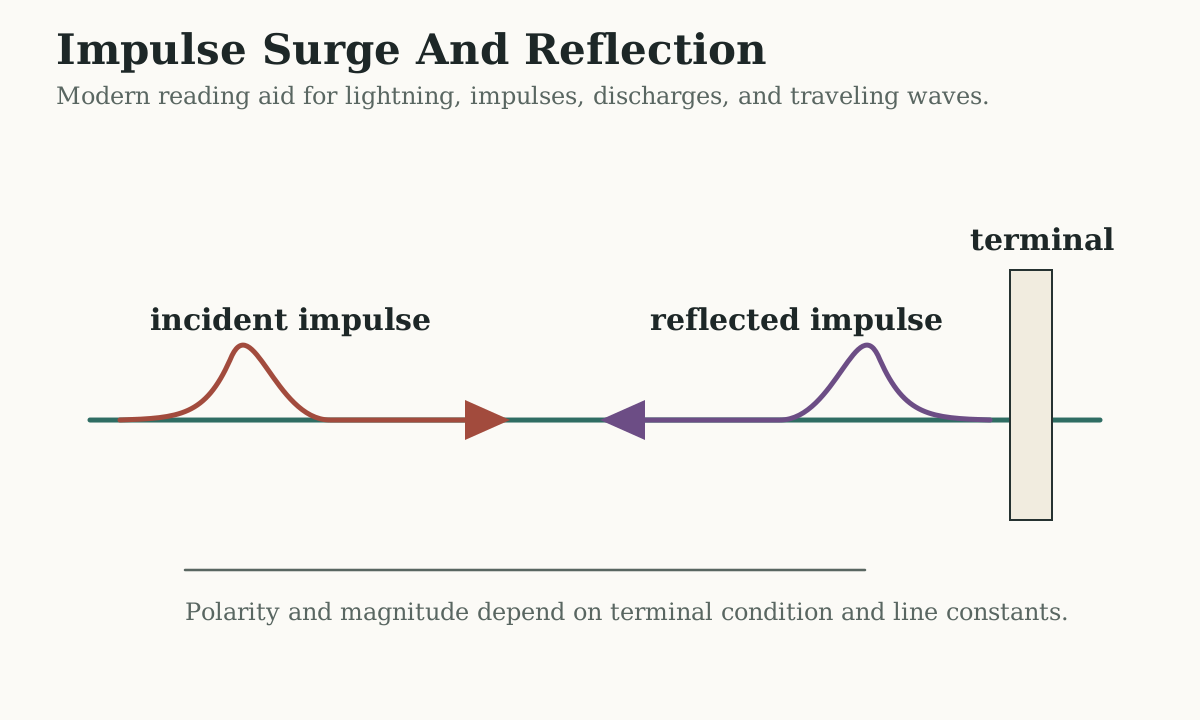
Section titled “Related Modern Guide Diagrams”Modern reading aid for lightning, impulses, discharges, and traveling waves.
lightning-surges, impulse-current, traveling-wave
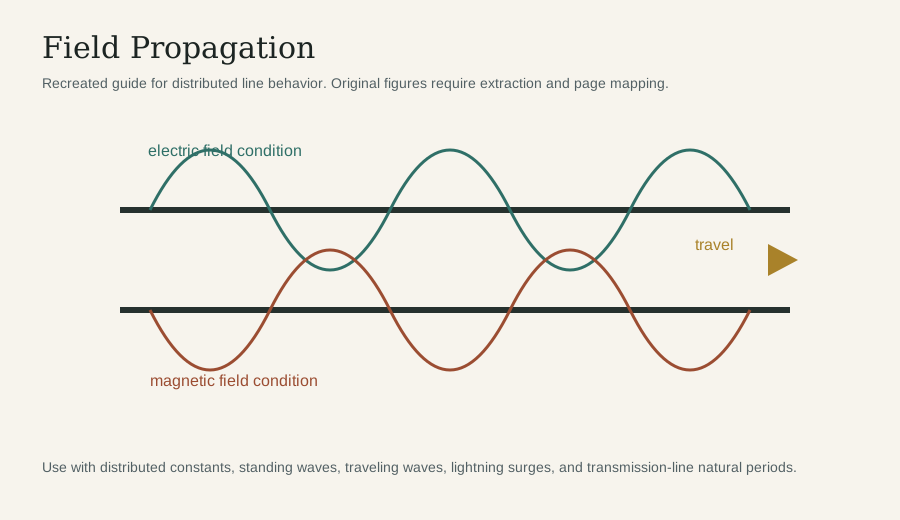
Modern reading aid for distributed constants, standing waves, traveling waves, and surge propagation.
electric-waves, distributed-constants, traveling-wave, lightning-surges
Highest-Priority Formula Leads
Section titled “Highest-Priority Formula Leads”| Candidate | Family | OCR/PDF text | Routes |
|---|---|---|---|
theory-calculation-transient-electric-phenomena-oscillations-eq-candidate-0272strong-formula-candidate | transients-oscillation | At the moment 0 = 0, let the e.m.f. e = E cos (0 - 00) be | source research review |
electric-discharges-waves-impulses-1914-eq-candidate-0240strong-formula-candidate | transients-oscillation | e = 2;oCe-”’ sin (0 =F co - 7) j | source research review |
electric-discharges-waves-impulses-1914-eq-candidate-0293strong-formula-candidate | transients-oscillation | i = e~ ”’ J ai cos </) cos co + 6i sin cf) cos co + Ci cos 0 sin co | source research review |
elementary-lectures-electric-discharges-waves-impulses-eq-candidate-0195strong-formula-candidate | transients-oscillation | i = io cos (0 - 7) = io cos 7 cos <j> + i0 sin 7 sin | source research review |
theory-calculation-transient-electric-phenomena-oscillations-eq-candidate-0276strong-formula-candidate | transients-oscillation | Since e = E cos (0 - 00) = impressed e.m.f., | source research review |
theory-calculation-transient-electric-phenomena-oscillations-eq-candidate-0296strong-formula-candidate | transients-oscillation | i = -z | cos (I? - 00- 0J- i~x° cos (00 + OJ j (9) | source research review |
elementary-lectures-electric-discharges-waves-impulses-eq-candidate-0220strong-formula-candidate | transients-oscillation | if = 140 cos 0.2 1 - 80 sin 0.2 1, | source research review |
theory-calculation-alternating-current-phenomena-1900-eq-candidate-0156strong-formula-candidate | apparatus-systems | E.M.F. of the generator OE°, where Z0 = r0 - jx0 = inter- | source research review |
Highest-Priority Figure Leads
Section titled “Highest-Priority Figure Leads”| Candidate | Caption lead | Section | Routes |
|---|---|---|---|
electric-discharges-waves-impulses-1914-fig-001Fig. 1 | oo,o o Fig. 1. exist, which are constant, or permanent, as long as the conditions | Lecture 1: Nature And Origin Of Transients | source research review |
electric-discharges-waves-impulses-1914-fig-002Fig. 2 | ]C Fig. 2. Commonly, transient and permanent phenomena are super- imposed upon each other. For instance, if in the circuit Fig. 1 | Lecture 1: Nature And Origin Of Transients | source research review |
electric-discharges-waves-impulses-1914-fig-003Fig. 3 | G O Fig. 3. the stored energy has to be supplied from the source of power; that is, for a short time power, in supplying the stored energy, flows not | Lecture 1: Nature And Origin Of Transients | source research review |
electric-discharges-waves-impulses-1914-fig-025Fig. 25 | frequency, and as the result an increase of voltage and a distor- tion of the quadrature phase occurs, as shown in the oscillogram Fig. 25. Various momentary short-circuit phenomena are illustrated by the oscillograms… | Lecture 4: Single-Energy Transients In Alternating Current Circuits | source research review |
electric-discharges-waves-impulses-1914-fig-029Fig. 29 | 4 5 Fig. 29. seconds | Lecture 5: Single-Energy Tra.Nsient Of Ironclad Circuit | source research review |
general-lectures-electrical-engineering-fig-027Fig. 27 | ^ Fig. 27 142 - GENERAL LECTURES | Lecture 11: Lightning Protection | source research review |
general-lectures-electrical-engineering-fig-028Fig. 28 | over a path of zero resistance, Z. On lower voltage, commonly only two resistances are used, one high and one moderately low, as shown by the diagram of a 2000 volt multi-gap arrester. Fig. 28. The resistance of the d… | Lecture 11: Lightning Protection | source research review |
theory-calculation-transient-electric-phenomena-oscillations-fig-099Fig. 99 | given for ^ = 0, where tt = t] for any other point of the line X the wave shape is the same, but all the ordinates reduced by the factor £~115* in the proportion as shown in the dotted curve in Fig. 99. Fig. 101 shows… | Chapter 4: Traveling Waves | source research review |