Illumination
Steinmetz Context
Section titled “Steinmetz Context”In this source, illumination is not just light output. It is radiation, visibility, photometry, distribution, room geometry, fatigue, shadows, brilliancy, and physiology.
Modern Equivalent
Section titled “Modern Equivalent”Lighting engineering, photometry, luminous flux, illuminance, luminance, visual comfort, and lighting design.
Why It Matters
Section titled “Why It Matters”It shows Steinmetz treating engineering as a relation between physical systems and human perception.
Reader Synthesis
Section titled “Reader Synthesis”What Steinmetz Is Doing Here
The processed corpus gives this concept a source trail across Steinmetz’s books and lectures. Read the source distribution first, because the meaning often changes between radiation, AC calculation, apparatus, and transients.
The current strongest source route is Radiation, Light and Illumination, with 2488 candidate hits across 33 sections.
Modern Translation
Translate the older wording into modern electrical-engineering language only after the source location is visible.
This page currently tracks 3266 candidate occurrences across 13 sources and 87 sections.
Mathematical And Visual Route
Use the linked equation atlas and source formula maps to decide whether this concept has a mathematical layer, a diagrammatic layer, or mainly a terminology layer.
Use the math/visual bridge lower on this page to jump into formula families, source visual maps, and candidate figure leads.
Interpretive Boundary
Interpretive readings are welcome in this archive only when they are labeled and separated from Steinmetz’s explicit wording.
Layer labels stay active: source claim, modern equivalent, mathematical reconstruction, historical note, and interpretive reading are not interchangeable.
Best Steinmetz Passages To Read First
Section titled “Best Steinmetz Passages To Read First”| Passage | Hits | Location | Open |
|---|---|---|---|
| Lecture 12: Illumination And Illuminating Engineering Radiation, Light and Illumination | 521 | lines 16485-17445 | read - research review |
| Lecture 17: Arc Lighting General Lectures on Electrical Engineering | 402 | lines 9920-12795 | read - research review |
| Lecture 11: Light Intensity And Illumination Radiation, Light and Illumination | 309 | lines 12574-16484 | read - research review |
| Lecture 10: Light Flux And Distribution Radiation, Light and Illumination | 276 | lines 9389-12573 | read - research review |
Research Position
Section titled “Research Position”- Tracked vocabulary: Illumination, Light, Photometry, Light flux density.
- Concordance: Illumination - Light - Photometry - Light flux density.
- Source discipline: the table above is for reading and navigation; exact quotation still requires scan verification.
- Reader route: read the passage first, then return here for modern translation, mathematical reconstruction, visual routes, and interpretation boundaries.
- Editorial rule: expand this page by promoting scan-checked passages, equations, and diagrams from the linked workbench pages, not by adding unsourced generalizations.
Source-Grounded Dossier
Section titled “Source-Grounded Dossier”Generated evidence layer: this dossier is built from the processed concept concordance. Counts and snippets are OCR/PDF-text aids, not final quotations. Verify against scans before making exact claims.
Candidate occurrences tracked for this page.
Sources with at least one hit.
Sections, lectures, chapters, or report divisions to review.
What The Current Corpus Shows
Section titled “What The Current Corpus Shows”Read this concept page through the linked source passages first. Use the dossier to locate Steinmetz’s wording, then add modern, mathematical, historical, and interpretive layers only with labels.
The strongest current source concentration is Radiation, Light and Illumination with 2488 candidate hits across 33 sections.
The dossier is meant to turn a concept page into a reading path: begin with Steinmetz’s source wording, then use the research links only when you need candidate counts, snippets, mathematical reconstruction, historical context, or interpretive layers.
Terms And Aliases Tracked
Section titled “Terms And Aliases Tracked”Illumination, candle power, candle-power, illuminant, illuminants, illuminating, illumination, Light, light, luminous, visible light, Photometry, photometer, photometers, photometric, photometry, Light flux density, light-flux-density
Concordance Records
Section titled “Concordance Records”Illumination - Light - Photometry - Light flux density
Source Distribution
Section titled “Source Distribution”Priority Passages To Read
Section titled “Priority Passages To Read”Lecture 12: Illumination And Illuminating Engineering - 521 candidate hits
Source: Radiation, Light and Illumination (1909)
Location: lines 16485-17445 - Tracked concepts: Illumination, Light, Light flux density, Photometry
LECTURE XII. ILLUMINATION AND ILLUMINATING ENGINEERING. 110. Artificial light is used for the purpose of seeing and distinguishing objects clearly and comfortably when the day- light fails. The problem of artificial lighting thus comprises con- sideration of the source of light o ...LECTURE XII. ILLUMINATION AND ILLUMINATING ENGINEERING. 110. Artificial light is used for the purpose of seeing and distinguishing objects clearly and comfortably when the day- light fails. The problem of artificial lighting thus comprises con- sideration of the source of light or the illuminant; ...Lecture 17: Arc Lighting - 402 candidate hits
Source: General Lectures on Electrical Engineering (1908)
Location: lines 9920-12795 - Tracked concepts: Illumination, Light, Photometry
... ved. So far only three materials have been found, which in luminous arcs give efficiences vastly superior to incandescence : mercury, calcium (lime), and titanium. All (three even in moderate sized units, give efficiencies of one-half watt or better per candle power. The mercury arc has the advantage of perfect steadiness, a long life - requiring no a...... r efficiency of the latter ; and the inconvenience of daily attendance required by an open arc, and the large consumption of carbons, makes a return to this type improbable. For this reason the flame carbon lamp has not proven suitable for general outdoor illumination, as street lighting, where the cost of carbons and trimming would usually far more t...Lecture 11: Light Intensity And Illumination - 309 candidate hits
Source: Radiation, Light and Illumination (1909)
Location: lines 12574-16484 - Tracked concepts: Illumination, Light
LECTURE XI. LIGHT INTENSITY AND ILLUMINATION. A. INTENSITY CURVES FOR UNIFORM ILLUMINATION. 102. The distribution of the light flux in space, and thus the illumination, depends on the location of the light sources, and on their distribution curves. The character of the required illumi- nation de ...LECTURE XI. LIGHT INTENSITY AND ILLUMINATION. A. INTENSITY CURVES FOR UNIFORM ILLUMINATION. 102. The distribution of the light flux in space, and thus the illumination, depends on the location of the light sources, and on their distribution curves. The character of the required illumi- nation depends on the purpose for which it is used: a gene ...Lecture 10: Light Flux And Distribution - 276 candidate hits
Source: Radiation, Light and Illumination (1909)
Location: lines 9389-12573 - Tracked concepts: Illumination, Light, Light flux density
LECTURE X. LIGHT FLUX AND DISTRIBUTION. 86. The light flux of an illuminant is its total radiation power, in physiological measure. It therefore is the useful output of the illuminant, and the efficiency of an illuminant thus is the ratio of the total light flux divided by the power input. In general, the distribution of the li ...LECTURE X. LIGHT FLUX AND DISTRIBUTION. 86. The light flux of an illuminant is its total radiation power, in physiological measure. It therefore is the useful output of the illuminant, and the efficiency of an illuminant thus is the ratio of the total light flux divided by the power input. In general, the distribution of the light flux throughout space is...Lecture 3: Physiological Effects Of Radiation - 262 candidate hits
Source: Radiation, Light and Illumination (1909)
Location: lines 2366-3638 - Tracked concepts: Illumination, Light, Photometry
... CTURE III. PHYSIOLOGICAL EFFECTS OF RADIATION. Visibility. 20. The most important physiological effect is the visibility of the narrow range of radiation, of less than one octave, between wave length 76 X 10~6 and 39 X 1Q-6. The range of intensity of illumination, over which the eye can see with practically equal comfort, is enormous: the average inte...... e visibility of the narrow range of radiation, of less than one octave, between wave length 76 X 10~6 and 39 X 1Q-6. The range of intensity of illumination, over which the eye can see with practically equal comfort, is enormous: the average intensity of illumination at noon of a sunny day is nearly one million times greater than the illumination given...Lecture 13: Physiological Problems Of Illuminating Engineering - 232 candidate hits
Source: Radiation, Light and Illumination (1909)
Location: lines 17446-17956 - Tracked concepts: Illumination, Light, Light flux density
LECTURE XIII. PHYSIOLOGICAL PROBLEMS OF ILLUMINATING ENGINEERING. 123. The design of an illumination requires the solution of physiological as well as physical problems. Physical considera- tions, for instance, are the distribution of light-flux intensity throughout the illuminated space, as related to si ...LECTURE XIII. PHYSIOLOGICAL PROBLEMS OF ILLUMINATING ENGINEERING. 123. The design of an illumination requires the solution of physiological as well as physical problems. Physical considera- tions, for instance, are the distribution of light-flux intensity throughout the illuminated space, as related to size, location and number of light sources, while th ...Reading Layers To Build Out
Section titled “Reading Layers To Build Out”| Layer | What to add next |
|---|---|
| Steinmetz wording | Pull exact source passages only after scan verification; keep OCR text labeled until then. |
| Modern engineering reading | Translate the source usage into present electrical-engineering or physics language without erasing the older vocabulary. |
| Mathematical layer | Link equations, variables, diagrams, and worked examples when the concept has formula candidates. |
| Historical layer | Identify whether the term is still used, renamed, absorbed into modern theory, or historically obsolete. |
| Ether-field interpretation | Keep interpretive readings separate from Steinmetz’s explicit claim and from modern physics. |
| Open questions | Record places where the concordance suggests a lead but the scan or edition has not yet been checked. |
Next Editorial Actions
Section titled “Next Editorial Actions”- Open the highest-priority source-text passages above and verify the wording against scans.
- Promote exact definitions, equations, diagrams, and hidden-gem passages into this page with source references.
- Add related concept links, equation pages, and diagram pages once the evidence is scan checked.
- Keep speculative or Wheeler-style readings in explicitly labeled interpretation blocks.
Math And Visual Evidence Map
Section titled “Math And Visual Evidence Map”Generated bridge: this section crosslinks the concept page with the formula atlas, figure atlas, source visual maps, and source formula maps. It is a routing layer, not final interpretation.
Formula candidates routed to this concept.
Figure candidates routed to this concept.
Modern guide diagrams related to this concept.
Formula Families To Review
Section titled “Formula Families To Review”Power, Energy, Work, And Efficiency - Waves, Lines, Radiation, And Frequency
Source Maps For This Concept
Section titled “Source Maps For This Concept”radiation-light-and-illumination visuals - radiation-light-and-illumination formulas - general-lectures-electrical-engineering visuals - general-lectures-electrical-engineering formulas - four-lectures-relativity-space visuals - four-lectures-relativity-space formulas - theory-calculation-transient-electric-phenomena-oscillations visuals - theory-calculation-transient-electric-phenomena-oscillations formulas - theory-calculation-electric-circuits visuals - theory-calculation-electric-circuits formulas - theoretical-elements-electrical-engineering visuals - theoretical-elements-electrical-engineering formulas
Related Modern Guide Diagrams
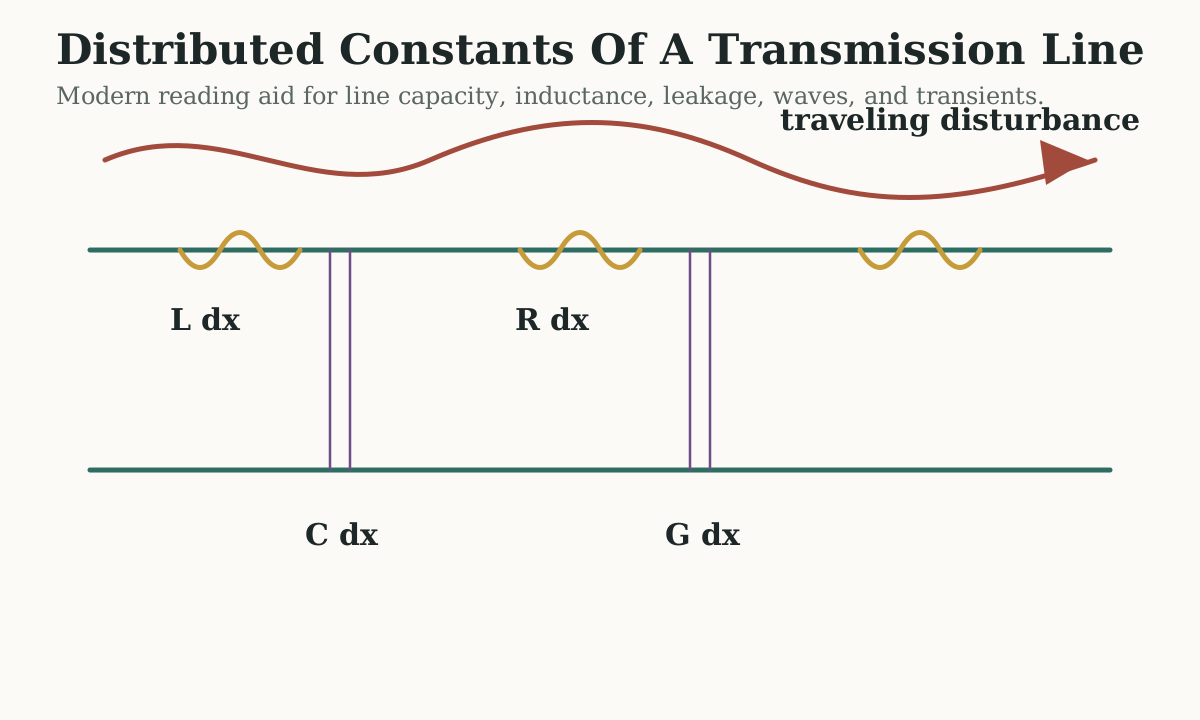
Section titled “Related Modern Guide Diagrams”Modern reading aid for line capacity, inductance, leakage, waves, and transients.
distributed-constants, capacity, inductance, waves
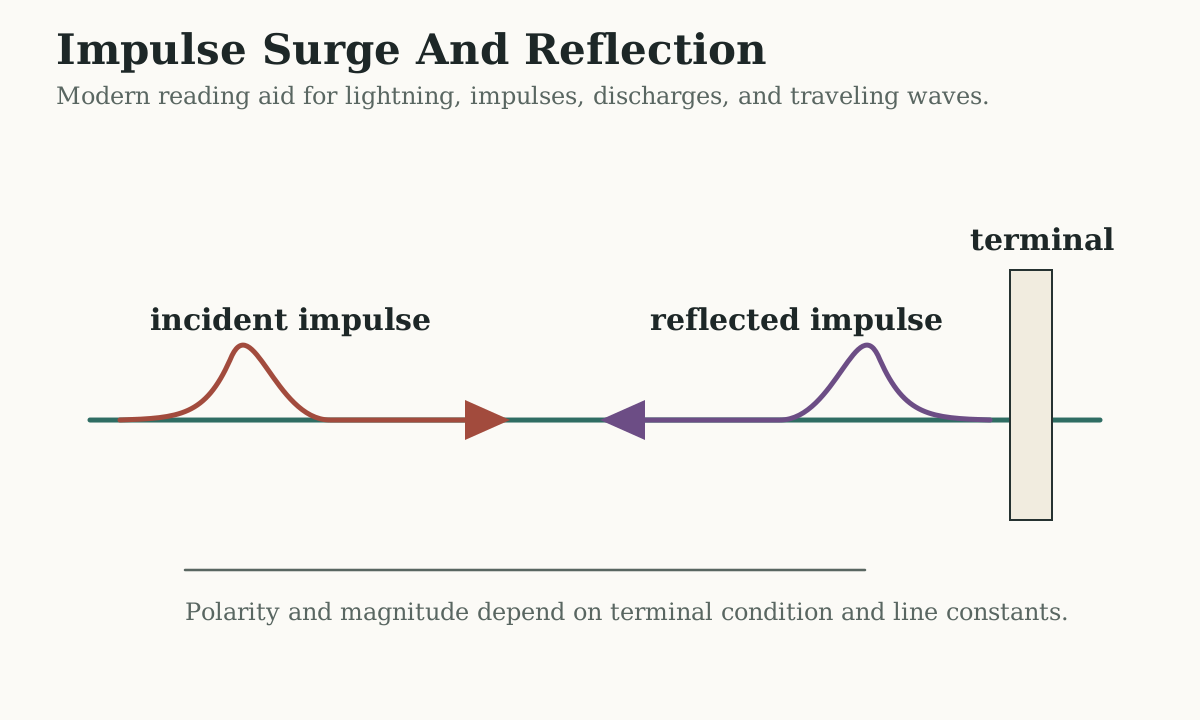
Modern reading aid for lightning, impulses, discharges, and traveling waves.
lightning-surges, impulse-current, traveling-wave
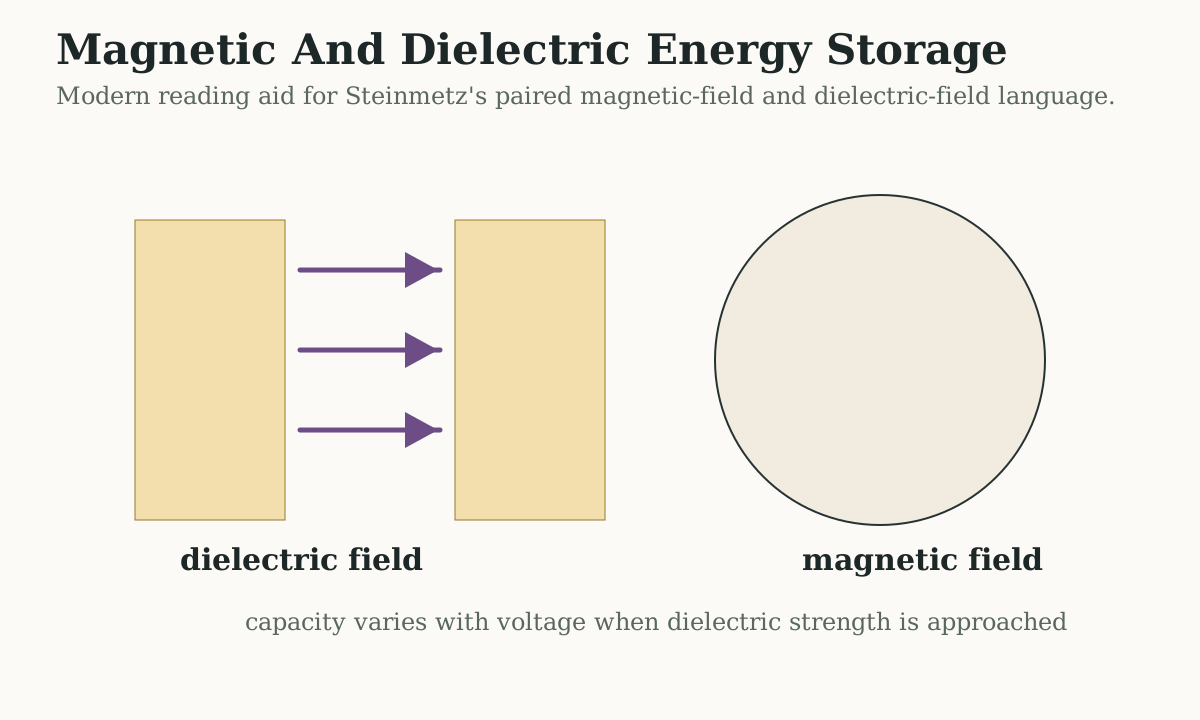
Modern reading aid for Steinmetz’s paired magnetic-field and dielectric-field language.
dielectric-field, magnetic-field, energy-storage
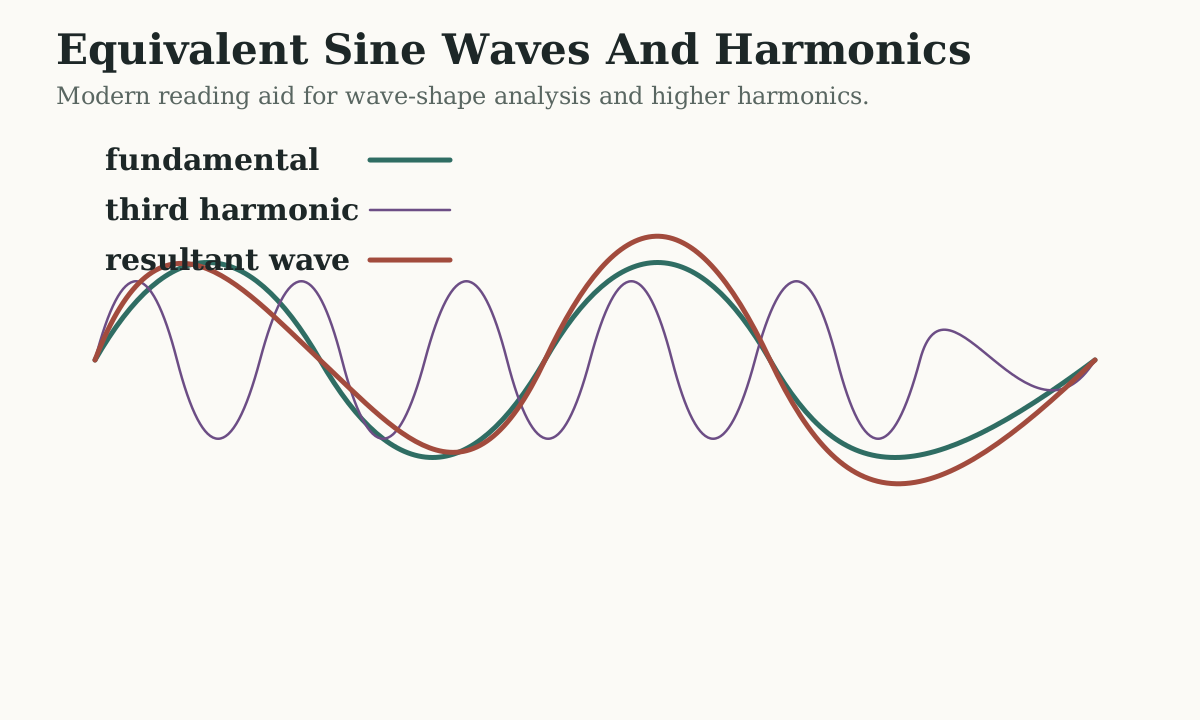
Modern reading aid for wave-shape analysis and higher harmonics.
harmonics, wave-shape, fourier-analysis
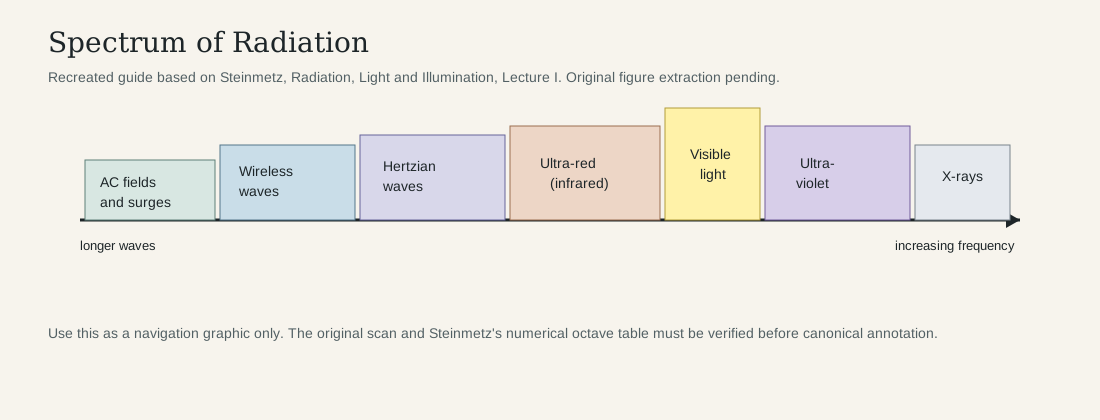
Modern navigation guide for Steinmetz’s electric-wave, visible-light, ultraviolet, and X-ray spectrum bridge.
radiation, electric-waves, frequency, spectrum, ether
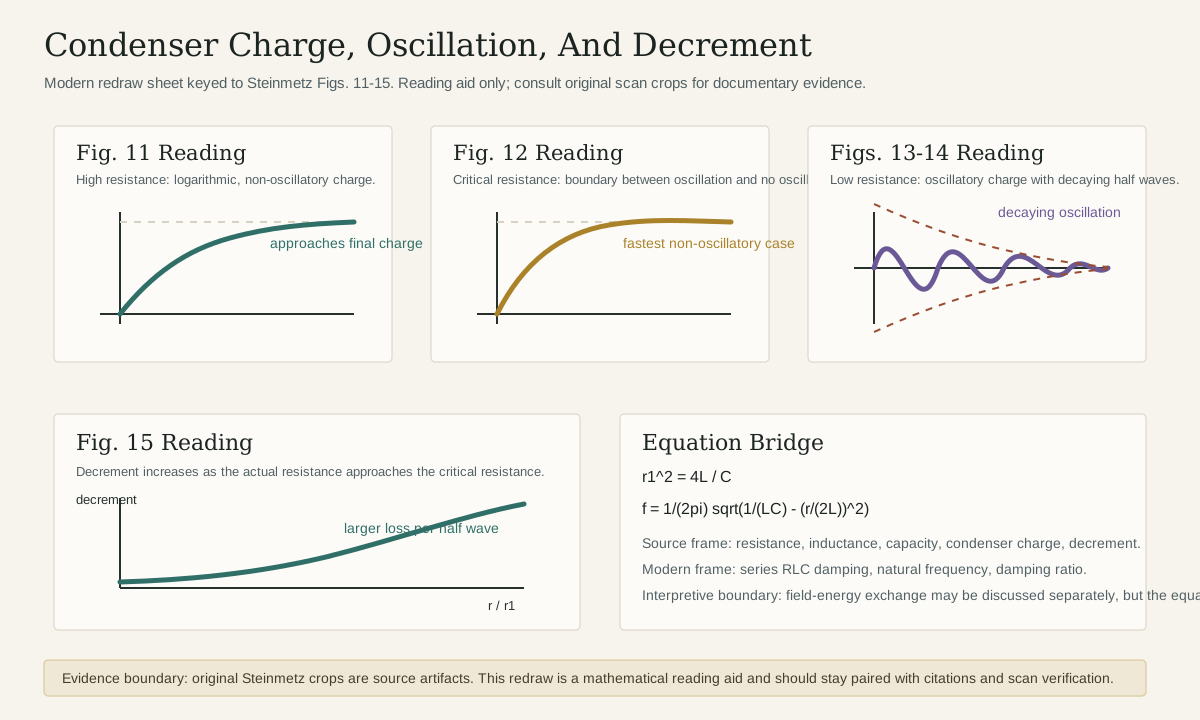
Modern redraw sheet for logarithmic charge, critical damping, oscillatory charge, and decrement.
transient-phenomena, oscillation-damping, capacity, condenser
Highest-Priority Formula Leads
Section titled “Highest-Priority Formula Leads”| Candidate | Family | OCR/PDF text | Routes |
|---|---|---|---|
general-lectures-electrical-engineering-eq-candidate-0026strong-formula-candidate | symbolic-ac | copper of No. 5, or j of ;j = ^: Cu. = ^ | source research review |
radiation-light-and-illumination-eq-candidate-0063strong-formula-candidate | symbolic-ac | FH = DH sin a, and DL = DH sin av (1) | source research review |
radiation-light-and-illumination-eq-candidate-0198strong-formula-candidate | symbolic-ac | cubic hyperbolas: e^i = kz2; or, el =- £j and since we find for | source research review |
radiation-light-and-illumination-eq-candidate-0235strong-formula-candidate | waves-radiation | pi = 6li = kli, (7) | source research review |
radiation-light-and-illumination-eq-candidate-0300strong-formula-candidate | symbolic-ac | fc1 = 2 TT / sin <t>dfa (3) | source research review |
theory-calculation-electric-circuits-eq-candidate-0135strong-formula-candidate | symbolic-ac | J? = 1, may give any value of flux density between B = -4.6 | source research review |
general-lectures-electrical-engineering-eq-candidate-0071strong-formula-candidate | waves-radiation | If m == number of phases, the higher harmonics : 2m - i | source research review |
radiation-light-and-illumination-eq-candidate-0281strong-formula-candidate | waves-radiation | L -T- S = x2 -T- 7/2, where x and y are the two distances of the | source research review |
Highest-Priority Figure Leads
Section titled “Highest-Priority Figure Leads”| Candidate | Caption lead | Section | Routes |
|---|---|---|---|
radiation-light-and-illumination-fig-001Fig. 1 | tion, the time at which the moon M should disappear from sight, FIG. 1. when seen from the earth E, by passing behind Jupiter, 7 (Fig. 1), could be exactly calculated. It was found, however, that some- | Lecture 1: Nature And Different Forms Of Radiation | source research review |
radiation-light-and-illumination-fig-002Fig. 2 | 5_MOE_S FIG. 2. direction the light reappears. If the disk is slowly revolved, alter- nate light and darkness will be observed, but when the speed in- | Lecture 1: Nature And Different Forms Of Radiation | source research review |
radiation-light-and-illumination-fig-003Fig. 3 | from the upper surface of the plain glass plate A. A beam of FIG. 3. reflected light a, thus is a combination of a beam b and a beam c. | Lecture 1: Nature And Different Forms Of Radiation | source research review |
radiation-light-and-illumination-fig-004Fig. 4 | glass plates. At those points dv dv etc. at which the distance FIG. 4. between the two glass plates is J wave length, or j, J, etc., the | Lecture 1: Nature And Different Forms Of Radiation | source research review |
radiation-light-and-illumination-fig-005Fig. 5 | etc. in the plane of the paper, and thus perpendicular to the ray FIG. 5. of light. In the former case (a longitudinal vibration, as sound) there obviously can be no difference between the directions at | Lecture 1: Nature And Different Forms Of Radiation | source research review |
radiation-light-and-illumination-fig-009Fig. 9 | it to you, by bringing the rods near to this Crookes’ radiometer, FIG. 9. which is an instrument showing the energy of radiation. It con- sists (Fig. 10) of four aluminum vanes, mounted in a moderately | Lecture 1: Nature And Different Forms Of Radiation | source research review |
radiation-light-and-illumination-fig-010Fig. 10 | (red, orange and yellow) with increase in temperature, the light FIG. 10. 12 | Lecture 1: Nature And Different Forms Of Radiation | source research review |
radiation-light-and-illumination-fig-011Fig. 11 | of the lower frequencies of visible radiation, red or orange. FIG. 11. In the tungsten lamp at high brilliancy and more still in the | Lecture 1: Nature And Different Forms Of Radiation | source research review |