Ether
The Short Version
Section titled “The Short Version”For Steinmetz, “ether” is not a simple yes-or-no keyword. It is a historical problem he moves through.
In Radiation, Light and Illumination (1909), Steinmetz presents the classical optical argument: if light is a wave motion, something must be waving. He calls that hypothetical carrier the ether, assigns it extreme properties, and says the energy of radiation resides there while in transit. This is the old wave-medium language, and it should be preserved accurately.
In Four Lectures on Relativity and Space (1923), Steinmetz revisits the same problem after relativity and field theory. There he explicitly treats the mechanical ether as contradictory and unnecessary. He does not abandon waves; he abandons the idea that electromagnetic waves require a material carrier. The replacement is the field of force, or more precisely the field of energy: energy storage and field action in space.
That is why this page matters. Steinmetz gives readers a rare bridge from luminiferous ether language to modern electromagnetic field language without losing the conceptual weight of space, field, energy, force, and propagation.
What Steinmetz Actually Does With Ether
Section titled “What Steinmetz Actually Does With Ether”The useful way to read Steinmetz is chronological and conceptual:
| Layer | Source route | What Steinmetz is doing | Reader warning |
|---|---|---|---|
| Optical ether argument | Radiation, Light and Illumination, Lecture I | Uses wave theory, interference, polarization, velocity, and vacuum propagation to explain why physicists had posited a special medium called ether. | This is historical source language, not the final word of Steinmetz’s later position. |
| Matter and energy language | Radiation, Light and Illumination, Lecture I | Says the ether can be called matter only if matter means the hypothetical carrier or seat of energy. | The claim is conditional: it depends on how “matter” is defined. |
| Relativity-era critique | Four Lectures on Relativity and Space, Lecture II | Argues that the mechanical ether leads to contradictory conclusions about ether drift, aberration, and absolute motion. | Do not quote the 1909 ether passage without also noticing the 1923 rejection. |
| Field replacement | Four Lectures on Relativity and Space, Lecture II | Replaces action at a distance and ether with the field of force/field of energy: a condition of energy storage in space exerting force on susceptible bodies. | This is the center of Steinmetz’s mature field language. |
Steinmetz’s 1909 Ether: Why The Hypothesis Appears
Section titled “Steinmetz’s 1909 Ether: Why The Hypothesis Appears”Steinmetz begins with evidence that light behaves like a wave. He discusses interference, phase opposition, wave length, frequency, and polarization. The key step is simple: if light is a wave motion, a 1909 reader would naturally ask what substance or medium is moving.
In that context, Steinmetz says the medium must have extraordinary properties:
- It must transmit radiation at extremely high speed.
- It must have extremely high elasticity and extremely low density.
- It must penetrate all substances.
- It cannot be removed by making a vacuum, because light passes through vacuum.
- It cannot be any known gas.
This is why he names the ether. In the processed OCR for Lecture I, Steinmetz says the required medium is “essentially different” and “has been called the ether.” The important point is not merely the word ether. The important point is the reasoning: wave motion plus high speed plus vacuum propagation produced a demand for a universal, almost paradoxical medium.
The Energy-Carrier Passage
Section titled “The Energy-Carrier Passage”Steinmetz then makes a more philosophically important move. He does not simply ask whether ether is a substance. He asks what counts as matter. If matter means the carrier or seat of energy, then ether can be called matter because radiation energy, while traveling from radiator to absorber, is assigned to the ether in that older framework.
That passage is one of the archive’s key “hidden gems” because it shows Steinmetz thinking through ontology by way of energy. The older ether language is already under pressure: the carrier is hypothetical, and the definition of matter is being tied to energy rather than to ordinary tangible substance.
Steinmetz’s 1923 Ether: Why The Hypothesis Fails
Section titled “Steinmetz’s 1923 Ether: Why The Hypothesis Fails”By the time Steinmetz writes Four Lectures on Relativity and Space, the page turns sharply. Lecture II is titled around the ether and the field of force, and it is one of the most important Steinmetz passages in the archive for readers interested in ether, field ontology, relativity, and forgotten electrical language.
His critique has several steps:
- Interference still proves that light is a wave-like periodic phenomenon.
- Polarization made the old ether look like a solid, because transverse waves seemed to require rigidity.
- The ether also had to be almost frictionless and extremely tenuous, because planets move through space without detectable resistance.
- Aberration and light-velocity reasoning pulled the ether in opposite directions: one line of argument suggested a stationary ether, another suggested an earth-carried ether.
- Relativity eliminates absolute rest and absolute motion, while an ether would supply exactly such an absolute reference.
Steinmetz’s mature conclusion is blunt in the OCR text: the ether hypothesis is “untenable”; light and wireless waves are not wave motions of the ether. This is not a modern editor reading anti-ether conclusions into him. It is the later Steinmetz explicitly saying the mechanical ether should be abandoned.
The Replacement: Field Of Force, Field Of Energy
Section titled “The Replacement: Field Of Force, Field Of Energy”Steinmetz does not replace ether with empty words. He replaces it with field language.
In Lecture II, he defines a field of force as a condition in space that exerts force on a body susceptible to that field. A magnetic field acts on magnetizable matter. A dielectric or electrostatic field acts on bodies susceptible to electrostatic forces. A gravitational field acts on mass. The point is not that “nothing is there”; the point is that the physical description is now field-centered rather than medium-centered.
He then strengthens the definition. Producing a field requires energy, and this energy is stored in space. Thus the field can be read as a condition of energy storage in space that can exert force on susceptible bodies.
This is the single most important bridge on the page:
- The old view asks: what matter carries the wave?
- Steinmetz’s mature view asks: what field condition and energy storage exist in space?
- Modern electrical engineering usually computes the field behavior without needing a material luminiferous ether.
Plain-English Meaning
Section titled “Plain-English Meaning”Imagine a reader in 1909. Every wave they know seems to be a movement of something: water waves move water, sound waves move air. Light also behaves like a wave. So the reader assumes there must be an invisible, all-pervading medium that waves. Steinmetz presents that reasoning clearly.
Now imagine Steinmetz in 1923. Electrical engineering has become fluent with alternating fields, voltages, currents, radio waves, and Maxwell-Hertz electromagnetic theory. Engineers do not need a substance sloshing around to compute waves. They can describe energy in fields, fields in space, and propagation at finite velocity. In this later setting, Steinmetz says the ether was an unnecessary mechanical picture imported from older wave analogies.
So the learning point is not “ether was silly” and not “ether was proven.” The learning point is richer: Steinmetz shows how physical explanation can move from substance analogy to field ontology.
Modern Engineering Translation
Section titled “Modern Engineering Translation”In modern language, the 1909 ether passage corresponds to the old luminiferous ether hypothesis: a proposed medium for electromagnetic radiation. Modern electromagnetic theory does not require that medium. Light and radio waves are described as electromagnetic fields propagating through space according to field equations and the electromagnetic constants of space.
The mature Steinmetz position is close to the modern engineering posture:
- Use fields, not action at a distance, as the physical language.
- Treat magnetic, dielectric, and electromagnetic fields as real calculable conditions in space.
- Understand wave propagation through field energy and finite propagation speed.
- Do not require a mechanical material carrier for light or wireless waves.
This is why the ether page belongs next to Electric Waves, Radiation, Inductance And Capacity, and Distributed Constants. Steinmetz’s replacement for ether is not vague philosophical emptiness; it is the electrical engineer’s field world.
Mathematical Route
Section titled “Mathematical Route”The ether discussion is not mainly an equation page, but it sits on several mathematical pillars:
| Mathematical idea | Why it matters for ether | Where to read |
|---|---|---|
| Velocity, frequency, and wave length | Steinmetz uses the enormous speed and tiny wave length of light to motivate the old ether medium problem. | Radiation, Lecture I |
| Interference and phase | Interference is what makes the wave theory stronger than a simple particle-bombardment theory in his exposition. | Radiation, Lecture I |
| Polarization | Polarization makes light a transverse wave, intensifying the old problem of what medium could support it. | Radiation, Lecture I |
| Field constants of space | In 1923, propagation is tied to electromagnetic field constants rather than rigidity and elasticity constants of matter. | Relativity, Lecture II |
| Energy storage in fields | The field becomes the place where energy is stored and through which force action is described. | Relativity, Lecture II |
Use the Waves, Lines, Radiation, And Frequency formula family for curated and candidate equations. Treat raw OCR equation candidates as review leads, not final mathematical transcriptions.
Visual Route
Section titled “Visual Route”The ether question is also visual. Steinmetz moves readers through:
- interfering light beams,
- transverse vibration directions,
- polarized waves,
- magnetic field lines,
- dielectric field directions,
- electromagnetic waves around conductors,
- and field energy radiating away from an antenna or light source.
Start with the modern guide diagrams:
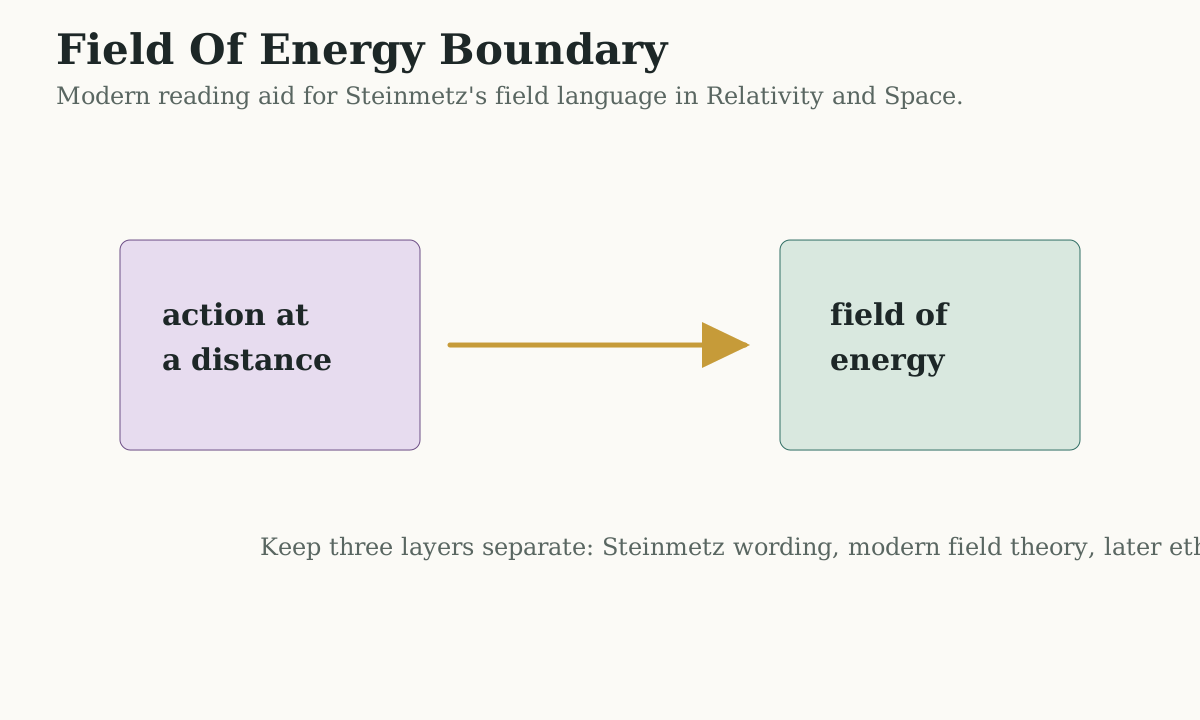
Best visual entry for the 1923 transition from ether to field of energy.
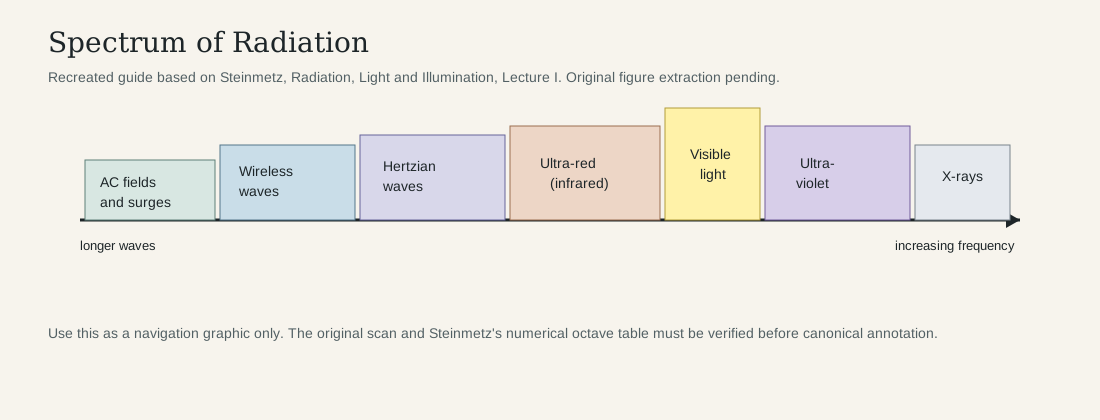
Best visual entry for the 1909 radiation setting in which ether language first appears.
Common Misreadings
Section titled “Common Misreadings”| Misreading | Better reading |
|---|---|
| Steinmetz mentioned ether, therefore he taught an ether ontology identical to later alternative theories. | He used ether in the older optical-wave setting, then later explicitly rejected the mechanical ether and replaced it with field-energy language. |
| Steinmetz rejected ether, therefore all ether-era language on the site is useless. | The older language remains historically and conceptually valuable because it shows what problem field theory had to solve. |
| Ether, field, dielectricity, and magnetism are interchangeable words. | Steinmetz separates them. Ether is the old hypothetical carrier; magnetic and dielectric fields are calculable field conditions; electromagnetic waves are alternating field phenomena. |
| Modern physics simply erases Steinmetz’s insight. | Modern engineering keeps much of the field language while discarding the mechanical luminiferous medium. |
| Wheeler-style or other ether-field readings can be attributed directly to Steinmetz. | They can be explored only as interpretation unless the exact Steinmetz passage supports the claim. |
Ether-Field Interpretive Boundary
Section titled “Ether-Field Interpretive Boundary”Ether-Field Interpretive Reading
Interpretive only: a Wheeler-style or broader ether-field reading may find value in Steinmetz’s emphasis on dielectric fields, magnetic fields, field energy, gradients, force, and energy storage in space. That is a legitimate comparison layer for this archive.
But the boundary is strict. Steinmetz’s later source text does not preserve the mechanical luminiferous ether as a required carrier of light. His mature replacement is field language: electromagnetic energy fields in space, not a transverse wave motion of a material ether. Any interpretation that uses his work to discuss dielectricity, magnetism, field pressure, field inertia, counterspace, or later ether models must say clearly: this is an interpretive reading, not Steinmetz’s explicit historical claim.
Best Reading Order
Section titled “Best Reading Order”- Read Radiation, Light and Illumination, Lecture I for the original optical-wave ether argument.
- Read Four Lectures on Relativity and Space, Lecture II for Steinmetz’s later critique.
- Jump inside Lecture II to field of force, field of energy, and energy storage in space.
- Compare with Electric Waves and Radiation to see how the wave vocabulary survives without the old ether carrier.
- Use the generated dossier and concordance below when you want source distribution, OCR snippets, and research leads.
Source Map At A Glance
Section titled “Source Map At A Glance”The current processed corpus tracks 66 candidate occurrences across 3 sources and 6 sections. Most hits cluster in Four Lectures on Relativity and Space, where Steinmetz discusses ether in relation to Faraday-Maxwell field language and relativity-era revision. The earlier Radiation, Light and Illumination passages preserve the optical wave-theory setting.
Research Questions
Section titled “Research Questions”- How should the archive distinguish Steinmetz’s 1909 explanatory use of ether from his 1923 rejection of the ether hypothesis?
- Does the 1923 field-of-energy language appear elsewhere in his engineering books under different terminology?
- How much of Steinmetz’s mature field language maps cleanly to modern electromagnetic field theory, and where does the old vocabulary preserve a useful physical intuition?
- Does Steinmetz ever explicitly connect the abandoned ether to dielectricity or magnetism, or are those later interpretive bridges?
- How should Tesla-era, Dollard-style, and Wheeler-style readings be compared without collapsing them into Steinmetz’s own words?
Reader Synthesis
Section titled “Reader Synthesis”What Steinmetz Is Doing Here
Steinmetz’s ether trail is not evenly distributed. The strongest current cluster is in the relativity lectures, where ether is discussed beside the replacement of mechanical ether language by field language; the radiation lectures preserve the older optical-wave setting.
The current strongest source route is Four Lectures on Relativity and Space, with 59 candidate hits across 3 sections.
Modern Translation
A modern reader should treat ether passages as historical source language and as evidence of how wave propagation was framed before field theory and relativity settled into present textbook form.
This page currently tracks 66 candidate occurrences across 3 sources and 6 sections.
Mathematical And Visual Route
The mathematical bridge is usually indirect: velocity, frequency, wavelength, field energy, and propagation arguments matter more than a single ether equation.
Use the math/visual bridge lower on this page to jump into formula families, source visual maps, and candidate figure leads.
Interpretive Boundary
Ether-field readings belong here only as labeled interpretation. Do not attribute Wheeler-style dielectric or counterspatial vocabulary to Steinmetz unless a passage explicitly supports it.
Layer labels stay active: source claim, modern equivalent, mathematical reconstruction, historical note, and interpretive reading are not interchangeable.
Best Steinmetz Passages To Read First
Section titled “Best Steinmetz Passages To Read First”| Passage | Hits | Location | Open |
|---|---|---|---|
| Lecture 2: Conclusions From The Relativity Theory Four Lectures on Relativity and Space | 52 | lines 736-2388 | read - research review |
| Lecture 4: The Characteristics Of Space A. The Geometry Of The Gravitational Field Four Lectures on Relativity and Space | 6 | lines 3595-6820 | read - research review |
| Lecture 1: Nature And Different Forms Of Radiation Radiation, Light and Illumination | 5 | lines 608-1548 | read - research review |
| Lecture 3: Gravitation And The Gravitational Fleld Four Lectures on Relativity and Space | 1 | lines 2389-3594 | read - research review |
Research Position
Section titled “Research Position”- Tracked vocabulary: Ether.
- Concordance: Ether.
- Source discipline: the table above is for reading and navigation; exact quotation still requires scan verification.
- Reader route: read the passage first, then return here for modern translation, mathematical reconstruction, visual routes, and interpretation boundaries.
- Editorial rule: expand this page by promoting scan-checked passages, equations, and diagrams from the linked workbench pages, not by adding unsourced generalizations.
Source Expansion Impact
Section titled “Source Expansion Impact”Ether remains a boundary topic, not a claim bucket.
The new sources may enrich field-language context, but Wheeler-style or broader ether-field readings must remain labeled interpretation unless Steinmetz explicitly says it.
| Source Target | Year | Status | Why It Matters Here |
|---|---|---|---|
| Mechanical Forces in Magnetic Fields | 1910 | Registered Authority Target | This is the highest-value pending source for force, stress, pressure, and tension vocabulary in magnetic fields. |
| Complex Quantities and Their Use in Electrical Engineering | 1894 | Registered Authority Target | This should become the flagship source for how Steinmetz made alternating-current calculation algebraic, geometric, and teachable. |
| The Future of Electricity | 1910 | Registered Authority Target | This short work should help readers understand Steinmetz’s civilizational view of electrification without confusing it with circuit theory. |
Source-Grounded Dossier
Section titled “Source-Grounded Dossier”Generated evidence layer: this dossier is built from the processed concept concordance. Counts and snippets are OCR/PDF-text aids, not final quotations. Verify against scans before making exact claims.
Candidate occurrences tracked for this page.
Sources with at least one hit.
Sections, lectures, chapters, or report divisions to review.
What The Current Corpus Shows
Section titled “What The Current Corpus Shows”Read this concept as a historical-language and field-theory boundary page. The current corpus places most ether hits in Steinmetz’s relativity lectures, where ether is treated alongside the rise of Faraday-Maxwell field language; the earlier radiation source uses it in the wave-theory-of-light setting. That distribution matters.
The strongest current source concentration is Four Lectures on Relativity and Space with 59 candidate hits across 3 sections.
The dossier is meant to turn a concept page into a reading path: begin with Steinmetz’s source wording, then use the research links only when you need candidate counts, snippets, mathematical reconstruction, historical context, or interpretive layers.
Terms And Aliases Tracked
Section titled “Terms And Aliases Tracked”Ether, aether, ether
Concordance Records
Section titled “Concordance Records”Source Distribution
Section titled “Source Distribution”Priority Passages To Read
Section titled “Priority Passages To Read”Lecture 2: Conclusions From The Relativity Theory - 52 candidate hits
Source: Four Lectures on Relativity and Space (1923)
Location: lines 736-2388 - Tracked concepts: Ether
... obser- vation. The law of conservation of matter thus had to be abandoned and mass became a manifestation of energy. The law of gravitation has been recast, and the force of gravitation has become an effect of inertial motion, like centrifugal force. The ether has been abandoned, and the field of force of Faraday and Maxwell has become the fundamental...... ion miles. Therefore the principal value of the relativity theory thus far consists in the better conception of nature and its laws which it affords. Some of the most interesting illustra- tions of this will be discussed in the following pages. B. THE ETHER AND THE FIELD OF FORCE Newton's corpuscular theory of light explained radiation as a bombardmen...Lecture 4: The Characteristics Of Space A. The Geometry Of The Gravitational Field - 6 candidate hits
Source: Four Lectures on Relativity and Space (1923)
Location: lines 3595-6820 - Tracked concepts: Ether
... ge, 47 field, 18 ElUptic geometry, 64, 72, 74 trigonometry, 77 Energy equivalent of mass, 44 field, 22, 46 kinetic, 47 and mass, 41 of wave, 22 123 124 INDEX Entity energy, 24 Equations of transformation to moving system, 25, 27 Ether, 12, 14 as solid, 14 drift, 14 fallacy of conception, 16 illogical, 18 unnecessary, 17 waves, 18 Euclid, 71 Euclidean...... NDEX Entity energy, 24 Equations of transformation to moving system, 25, 27 Ether, 12, 14 as solid, 14 drift, 14 fallacy of conception, 16 illogical, 18 unnecessary, 17 waves, 18 Euclid, 71 Euclidean geometry, 64, 72, 74 F Fallacy of ether conception, 16 Faraday, 12, 17 Field, centrifugal, 47 dielectric, 18 electromagnetic, 21 electrostatic, 18 gravit...Lecture 1: Nature And Different Forms Of Radiation - 5 candidate hits
Source: Radiation, Light and Illumination (1909)
Location: lines 608-1548 - Tracked concepts: Ether
... icity and extremely low density, and it must penetrate all substances since no vacuum can be produced for this medium, because light passes through any vacuum. Hence it cannot be any known gas, but must be essen- tially different, and has been called the "ether." Whether the ether is a form of matter or not depends upon the definition of matter. If ma...... w density, and it must penetrate all substances since no vacuum can be produced for this medium, because light passes through any vacuum. Hence it cannot be any known gas, but must be essen- tially different, and has been called the "ether." Whether the ether is a form of matter or not depends upon the definition of matter. If matter is defined as the...Lecture 3: Gravitation And The Gravitational Fleld - 1 candidate hits
Source: Four Lectures on Relativity and Space (1923)
Location: lines 2389-3594 - Tracked concepts: Ether
LECTURE III GRAVITATION AND THE GRAVITATIONAL FLELD A. THE IDENTITY OF GRAVITATIONAL, CENTRIFUGAL AND INERTIAL MASS As seen in the preceding lecture, the conception of the ether as the carrier of radiation had to be abandoned as incompatible with the theory of relativity; the conception of action at a distance is repugnant to our reasoning, and its place...Lecture 17: Arc Lighting - 1 candidate hits
Source: General Lectures on Electrical Engineering (1908)
Location: lines 9920-12795 - Tracked concepts: Ether
... ions. There are different forms of energy, all convertible into each other, as magnetic energy, electric energy, heat energy, mechanical momentum, radiating energy, etc. The latter, radi- ating energy, is a vibratory motion of a hypothetical medium, the ether, which vibration is transmitted or propagated at a velocity of about 188,000 miles per second...Lecture 2: Relation Of Bodies To Radiation - 1 candidate hits
Source: Radiation, Light and Illumination (1909)
Location: lines 1549-2365 - Tracked concepts: Ether
... less and, as will be seen, is different for different frequencies. 22 RADIATION, LIGHT, AND ILLUMINATION. Assume then, in Fig. 15, a beam of light B striking under an angle the boundary between two media, as air A and water W, the vibration of the ether particles in the beam of light is at right angles to the direction of propagation BC, and successiv...Reading Layers To Build Out
Section titled “Reading Layers To Build Out”| Layer | What to add next |
|---|---|
| Steinmetz wording | Pull exact source passages only after scan verification; keep OCR text labeled until then. |
| Modern engineering reading | Translate the source usage into present electrical-engineering or physics language without erasing the older vocabulary. |
| Mathematical layer | Link equations, variables, diagrams, and worked examples when the concept has formula candidates. |
| Historical layer | Identify whether the term is still used, renamed, absorbed into modern theory, or historically obsolete. |
| Ether-field interpretation | Keep interpretive readings separate from Steinmetz’s explicit claim and from modern physics. |
| Open questions | Record places where the concordance suggests a lead but the scan or edition has not yet been checked. |
Next Editorial Actions
Section titled “Next Editorial Actions”- Open the highest-priority source-text passages above and verify the wording against scans.
- Promote exact definitions, equations, diagrams, and hidden-gem passages into this page with source references.
- Add related concept links, equation pages, and diagram pages once the evidence is scan checked.
- Keep speculative or Wheeler-style readings in explicitly labeled interpretation blocks.
Math And Visual Evidence Map
Section titled “Math And Visual Evidence Map”Generated bridge: this section crosslinks the concept page with the formula atlas, figure atlas, source visual maps, and source formula maps. It is a routing layer, not final interpretation.
Formula candidates routed to this concept.
Figure candidates routed to this concept.
Modern guide diagrams related to this concept.
Formula Families To Review
Section titled “Formula Families To Review”Waves, Lines, Radiation, And Frequency
Source Maps For This Concept
Section titled “Source Maps For This Concept”four-lectures-relativity-space visuals - four-lectures-relativity-space formulas - radiation-light-and-illumination visuals - radiation-light-and-illumination formulas - general-lectures-electrical-engineering visuals - general-lectures-electrical-engineering formulas
Related Modern Guide Diagrams
Section titled “Related Modern Guide Diagrams”Modern reading aid for Steinmetz’s field language in Relativity and Space.
field-language, ether, relativity, energy-field
Modern navigation guide for Steinmetz’s electric-wave, visible-light, ultraviolet, and X-ray spectrum bridge.
radiation, electric-waves, frequency, spectrum, ether
Highest-Priority Formula Leads
Section titled “Highest-Priority Formula Leads”| Candidate | Family | OCR/PDF text | Routes |
|---|---|---|---|
four-lectures-relativity-space-eq-candidate-0126strong-formula-candidate | symbolic-ac | R = j/VK. (15) | source research review |
radiation-light-and-illumination-eq-candidate-0063strong-formula-candidate | symbolic-ac | FH = DH sin a, and DL = DH sin av (1) | source research review |
radiation-light-and-illumination-eq-candidate-0198strong-formula-candidate | symbolic-ac | cubic hyperbolas: e^i = kz2; or, el =- £j and since we find for | source research review |
radiation-light-and-illumination-eq-candidate-0235strong-formula-candidate | waves-radiation | pi = 6li = kli, (7) | source research review |
radiation-light-and-illumination-eq-candidate-0300strong-formula-candidate | symbolic-ac | fc1 = 2 TT / sin <t>dfa (3) | source research review |
general-lectures-electrical-engineering-eq-candidate-0071strong-formula-candidate | waves-radiation | If m == number of phases, the higher harmonics : 2m - i | source research review |
general-lectures-electrical-engineering-eq-candidate-0078strong-formula-candidate | waves-radiation | 2g3 QQQ = ^ seconds; the frequency 587 cycles, and if this | source research review |
radiation-light-and-illumination-eq-candidate-0281strong-formula-candidate | waves-radiation | L -T- S = x2 -T- 7/2, where x and y are the two distances of the | source research review |
Highest-Priority Figure Leads
Section titled “Highest-Priority Figure Leads”| Candidate | Caption lead | Section | Routes |
|---|---|---|---|
four-lectures-relativity-space-fig-020Fig. 20 | R = j/VK. (15) Fig. 20. E. THE STRAIGHT LINE AND THE ELLIPTIC 2-SPACE | Lecture 4: The Characteristics Of Space A. The Geometry Of The Gravitational Field | source research review |
four-lectures-relativity-space-fig-021Fig. 21 | line between them, as Li or L2 — shown dotted in Fig. 21 — Fig. 21. is longer. Suppose we have a straight line L in the plane Fig. 21 and a point P outside of L. Any line drawn in the | Lecture 4: The Characteristics Of Space A. The Geometry Of The Gravitational Field | source research review |
four-lectures-relativity-space-fig-025Fig. 25 | The mathematical n-space merely is the continuous mani- FiG. 25. fold of oo« elements which are given by the n ratios: x : y : | Lecture 4: The Characteristics Of Space A. The Geometry Of The Gravitational Field | source research review |
four-lectures-relativity-space-fig-029Fig. 29 | however, are no part of projective geometry, as they are Fig. 29. made by its relation to infinity and therefore are metric in character : The hyperbola has two infinitely distant points, | Lecture 4: The Characteristics Of Space A. The Geometry Of The Gravitational Field | source research review |
four-lectures-relativity-space-fig-030Fig. 30 | with regard to a conic, then the line connecting the points Fig. 30. pi and P2 is the polar of the point of intersection of Pi and | Lecture 4: The Characteristics Of Space A. The Geometry Of The Gravitational Field | source research review |
four-lectures-relativity-space-fig-031Fig. 31 | of these six lines by e = ah, cd;f = ac, hd; g = ad, he, and Fig. 31. draw the three additional lines ef, eg and fg, we get a total of nine lines and four points on each of these nine lines. | Lecture 4: The Characteristics Of Space A. The Geometry Of The Gravitational Field | source research review |
four-lectures-relativity-space-fig-032Fig. 32 | tant (that is, very far distant) we thus recognize by the Fig. 32. two lines of sight from our eyes to the object having the same direction. | Lecture 4: The Characteristics Of Space A. The Geometry Of The Gravitational Field | source research review |
four-lectures-relativity-space-fig-033Fig. 33 | parallels Li and Lo through a point P — that is, two lines Fig. 33. which intersect L at infinity — and these tvv^o parallels Li and L2 make an angle L1PL2 with each other. Thus L] | Lecture 4: The Characteristics Of Space A. The Geometry Of The Gravitational Field | source research review |