Inductance And Capacity
Conceptual Role
Section titled “Conceptual Role”Inductance and capacity are the two major circuit constants of field storage. In Steinmetz’s AC and transient language, they are not merely component labels. They are the reason reactance, phase shift, resonance, and transient oscillation exist.
Modern Equivalent
Section titled “Modern Equivalent”Inductance:
Capacity:
Transient oscillation:
Physical Meaning
Section titled “Physical Meaning”Inductance stores energy magnetically. Capacity stores energy electrostatically. A circuit with one storage form can approach a new condition gradually. A circuit with both can oscillate as energy moves from one storage form to the other.
Ether-Field Interpretive Reading
Interpretive only: this is one of the strongest bridges to field-centered interpretation because the mathematics already distinguishes magnetic and electrostatic storage. The archive must still separate Steinmetz’s engineering statements from later dielectric/magnetic ontology.
Related Pages
Section titled “Related Pages”Reader Synthesis
Section titled “Reader Synthesis”What Steinmetz Is Doing Here
The processed corpus gives this concept a source trail across Steinmetz’s books and lectures. Read the source distribution first, because the meaning often changes between radiation, AC calculation, apparatus, and transients.
The current strongest source route is Theory and Calculation of Transient Electric Phenomena and Oscillations, with 1164 candidate hits across 83 sections.
Modern Translation
Translate the older wording into modern electrical-engineering language only after the source location is visible.
This page currently tracks 5084 candidate occurrences across 15 sources and 267 sections.
Mathematical And Visual Route
Use the linked equation atlas and source formula maps to decide whether this concept has a mathematical layer, a diagrammatic layer, or mainly a terminology layer.
Use the math/visual bridge lower on this page to jump into formula families, source visual maps, and candidate figure leads.
Interpretive Boundary
Interpretive readings are welcome in this archive only when they are labeled and separated from Steinmetz’s explicit wording.
Layer labels stay active: source claim, modern equivalent, mathematical reconstruction, historical note, and interpretive reading are not interchangeable.
Best Steinmetz Passages To Read First
Section titled “Best Steinmetz Passages To Read First”| Passage | Hits | Location | Open |
|---|---|---|---|
| Chapter 14: Constant-Potential Constant-Current Trans Formation Theory and Calculation of Electric Circuits | 193 | lines 24023-27995 | read - research review |
| Chapter 6: Oscillating Currents, Theory and Calculation of Transient Electric Phenomena and Oscillations | 120 | lines 5312-6797 | read - research review |
| Lecture 10: Continual And Cumulative Oscillations Elementary Lectures on Electric Discharges, Waves and Impulses, and Other Transients | 105 | lines 6804-8485 | read - research review |
| Chapter 9: Inductive Discharges Theory and Calculation of Transient Electric Phenomena and Oscillations | 103 | lines 34897-40349 | read - research review |
Research Position
Section titled “Research Position”- Tracked vocabulary: Inductance, Electrostatic Capacity, Energy Storage in Fields.
- Concordance: Inductance - Electrostatic Capacity - Energy Storage in Fields.
- Source discipline: the table above is for reading and navigation; exact quotation still requires scan verification.
- Reader route: read the passage first, then return here for modern translation, mathematical reconstruction, visual routes, and interpretation boundaries.
- Editorial rule: expand this page by promoting scan-checked passages, equations, and diagrams from the linked workbench pages, not by adding unsourced generalizations.
Source Expansion Impact
Section titled “Source Expansion Impact”Inductance and capacity connect directly to cable, line, and discharge sources.
This is a good reader doorway into distributed rather than lumped electrical behavior.
| Source Target | Year | Status | Why It Matters Here |
|---|---|---|---|
| Cable Charge and Discharge | 1923 | Registered Authority Target | This is the direct source for cable transients and should strengthen the line/capacity side of the archive. |
| The Natural Period of a Transmission Line and the Frequency of Lightning Discharge Therefrom | 1898 | Planned Acquisition | This is the missing early bridge between line constants, natural oscillation, and lightning-frequency reasoning. |
| Condenser Discharges Through a General Gas Circuit | 1922 | Planned Acquisition | This should enrich discharge, damping, oscillation, and nonlinear gas-circuit behavior. |
Source-Grounded Dossier
Section titled “Source-Grounded Dossier”Generated evidence layer: this dossier is built from the processed concept concordance. Counts and snippets are OCR/PDF-text aids, not final quotations. Verify against scans before making exact claims.
Candidate occurrences tracked for this page.
Sources with at least one hit.
Sections, lectures, chapters, or report divisions to review.
What The Current Corpus Shows
Section titled “What The Current Corpus Shows”Read this concept as an energy-storage pair. The archive should keep magnetic-flux and dielectric-flux language visible before reducing everything to modern lumped L and C notation.
The strongest current source concentration is Theory and Calculation of Transient Electric Phenomena and Oscillations with 1164 candidate hits across 83 sections.
The dossier is meant to turn a concept page into a reading path: begin with Steinmetz’s source wording, then use the research links only when you need candidate counts, snippets, mathematical reconstruction, historical context, or interpretive layers.
Terms And Aliases Tracked
Section titled “Terms And Aliases Tracked”inductance, inductive, mutual inductance, self-inductance, capacitance, capacity, condenser, condensers, electrostatic capacity, energy of the field, energy stored, stored energy, stored in the field
Concordance Records
Section titled “Concordance Records”Inductance - Electrostatic Capacity - Energy Storage in Fields
Source Distribution
Section titled “Source Distribution”Priority Passages To Read
Section titled “Priority Passages To Read”Chapter 14: Constant-Potential Constant-Current Trans Formation - 193 candidate hits
Source: Theory and Calculation of Electric Circuits (1917)
Location: lines 24023-27995 - Tracked concepts: Electrostatic Capacity, Inductance
... escent lamps, the constant direct current is usually derived by rectification of constant alternating-current supply circuits. Such constant alternating currents are usually produced from constant- voltage supply circuits by means of constant or variable inductive reactances, and may be produced by the combination of inductive and condensive reactance...... rectification of constant alternating-current supply circuits. Such constant alternating currents are usually produced from constant- voltage supply circuits by means of constant or variable inductive reactances, and may be produced by the combination of inductive and condensive reactances; and the investigation of different methods of producing const...Chapter 6: Oscillating Currents, - 120 candidate hits
Source: Theory and Calculation of Transient Electric Phenomena and Oscillations (1909)
Location: lines 5312-6797 - Tracked concepts: Electrostatic Capacity, Energy Storage in Fields, Inductance
CHAPTER VI. OSCILLATING CURRENTS, 44. The charge and discharge of a condenser through an inductive circuit produces periodic currents of a frequency depending upon the circuit constants. The range of frequencies which can be produced by electro- dynamic machinery is rather limited: synchronous machines or ordinary alternators can give economically and ...... ly is this energy dissipated, that is, the faster the oscillation dies out. With a resistance of the circuit sufficiently low to give a fairly well sustained oscillation, the frequency is, with sufficient approximation, 45. The constants, capacity, C, inductance, L, and resistance, r, have no relation to the size or bulk of the apparatus. For instance...Lecture 10: Continual And Cumulative Oscillations - 105 candidate hits
Source: Elementary Lectures on Electric Discharges, Waves and Impulses, and Other Transients (1914)
Location: lines 6804-8485 - Tracked concepts: Electrostatic Capacity, Energy Storage in Fields, Inductance
... grams, Figs. 62 to 65, were taken on an artificial transmission line.* Oscillations of the type 64 and 65 are industrially used, as ''sing- ing arc, " in wireless telegraphy, and are produced by shunting a suitable arc by a circuit containing capacity and inductance in series with each other. Fig. 62. - Semi -continuous Recurrent Oscillation of Arcing...... in Figs. 59 and 60, while in high-potential trans- former windings, due to their much lesser damping, continuous oscillations seem to be more common, as in Fig. 46. Our knowl- edge of these phenomena is however still extremely incomplete. LECTUEE XI, INDUCTANCE AND CAPACITY OF ROUND PARALLEL CONDUCTORS. A. Inductance and capacity. 46. As inductance an...Chapter 9: Inductive Discharges - 103 candidate hits
Source: Theory and Calculation of Transient Electric Phenomena and Oscillations (1909)
Location: lines 34897-40349 - Tracked concepts: Electrostatic Capacity, Energy Storage in Fields, Inductance
CHAPTER IX. INDUCTIVE DISCHARGES. 64. The discharge of an inductance into a transmission line may be considered as an illustration of the phenomena in a complex circuit comprising sections of very different constants; that is, a combination of a circuit section of high induct ...CHAPTER IX. INDUCTIVE DISCHARGES. 64. The discharge of an inductance into a transmission line may be considered as an illustration of the phenomena in a complex circuit comprising sections of very different constants; that is, a combination of a circuit section of high inductance and small resistance and negligible capacit ...Chapter 13: Distributed Capacity, Inductance, Resistance, And Leakage - 97 candidate hits
Source: Theory and Calculation of Alternating Current Phenomena (1900)
Location: lines 9741-11604 - Tracked concepts: Electrostatic Capacity, Inductance
CHAPTER XIII. DISTRIBUTED CAPACITY, INDUCTANCE, RESISTANCE, AND LEAKAGE. 107. As far as capacity has been considered in the foregoing chapters, the assumption has been made that the condenser or other source of negative reactance is shunted across the circuit at a definite point. In many cases, how- ...... ensers infi nitely near together, as diagrammatically shown in Fig. 83. iiiimiiiiumiiiT TTTTTTTTTT.TTTTTTTTTT i Fig. 83. Distributed Capacity. In this case the intensity as well as phase of the current, and consequently of the counter E.M.F. of inductance and resistance, vary from point to point ; and it is no longer possible to treat the circuit in t...Lecture 10: Inductance And Capacity Of Round Parallel Conductors - 96 candidate hits
Source: Elementary Lectures on Electric Discharges, Waves and Impulses, and Other Transients (1911)
Location: lines 6089-7274 - Tracked concepts: Electrostatic Capacity, Inductance
LECTURE X. INDUCTANCE AND CAPACITY OF ROUND PARALLEL CONDUCTORS. A. Inductance and capacity. 43. As inductance and capacity are the two circuit constants which represent the energy storage, and which therefore are of fundamental importance in the study of transients, their ...LECTURE X. INDUCTANCE AND CAPACITY OF ROUND PARALLEL CONDUCTORS. A. Inductance and capacity. 43. As inductance and capacity are the two circuit constants which represent the energy storage, and which therefore are of fundamental importance in the study of transients, their calcula- tion is discussed in the following. The inductan ...Reading Layers To Build Out
Section titled “Reading Layers To Build Out”| Layer | What to add next |
|---|---|
| Steinmetz wording | Pull exact source passages only after scan verification; keep OCR text labeled until then. |
| Modern engineering reading | Translate the source usage into present electrical-engineering or physics language without erasing the older vocabulary. |
| Mathematical layer | Link equations, variables, diagrams, and worked examples when the concept has formula candidates. |
| Historical layer | Identify whether the term is still used, renamed, absorbed into modern theory, or historically obsolete. |
| Ether-field interpretation | Keep interpretive readings separate from Steinmetz’s explicit claim and from modern physics. |
| Open questions | Record places where the concordance suggests a lead but the scan or edition has not yet been checked. |
Next Editorial Actions
Section titled “Next Editorial Actions”- Open the highest-priority source-text passages above and verify the wording against scans.
- Promote exact definitions, equations, diagrams, and hidden-gem passages into this page with source references.
- Add related concept links, equation pages, and diagram pages once the evidence is scan checked.
- Keep speculative or Wheeler-style readings in explicitly labeled interpretation blocks.
Math And Visual Evidence Map
Section titled “Math And Visual Evidence Map”Generated bridge: this section crosslinks the concept page with the formula atlas, figure atlas, source visual maps, and source formula maps. It is a routing layer, not final interpretation.
Formula candidates routed to this concept.
Figure candidates routed to this concept.
Modern guide diagrams related to this concept.
Formula Families To Review
Section titled “Formula Families To Review”Inductance, Capacity, And Stored Energy - Transients, Oscillation, And Damping
Source Maps For This Concept
Section titled “Source Maps For This Concept”theory-calculation-transient-electric-phenomena-oscillations visuals - theory-calculation-transient-electric-phenomena-oscillations formulas - theory-calculation-alternating-current-phenomena-1900 visuals - theory-calculation-alternating-current-phenomena-1900 formulas - theory-calculation-alternating-current-phenomena visuals - theory-calculation-alternating-current-phenomena formulas - theory-calculation-electric-apparatus visuals - theory-calculation-electric-apparatus formulas - theory-calculation-electric-circuits visuals - theory-calculation-electric-circuits formulas - theory-calculation-alternating-current-phenomena-1897 visuals - theory-calculation-alternating-current-phenomena-1897 formulas
Related Modern Guide Diagrams
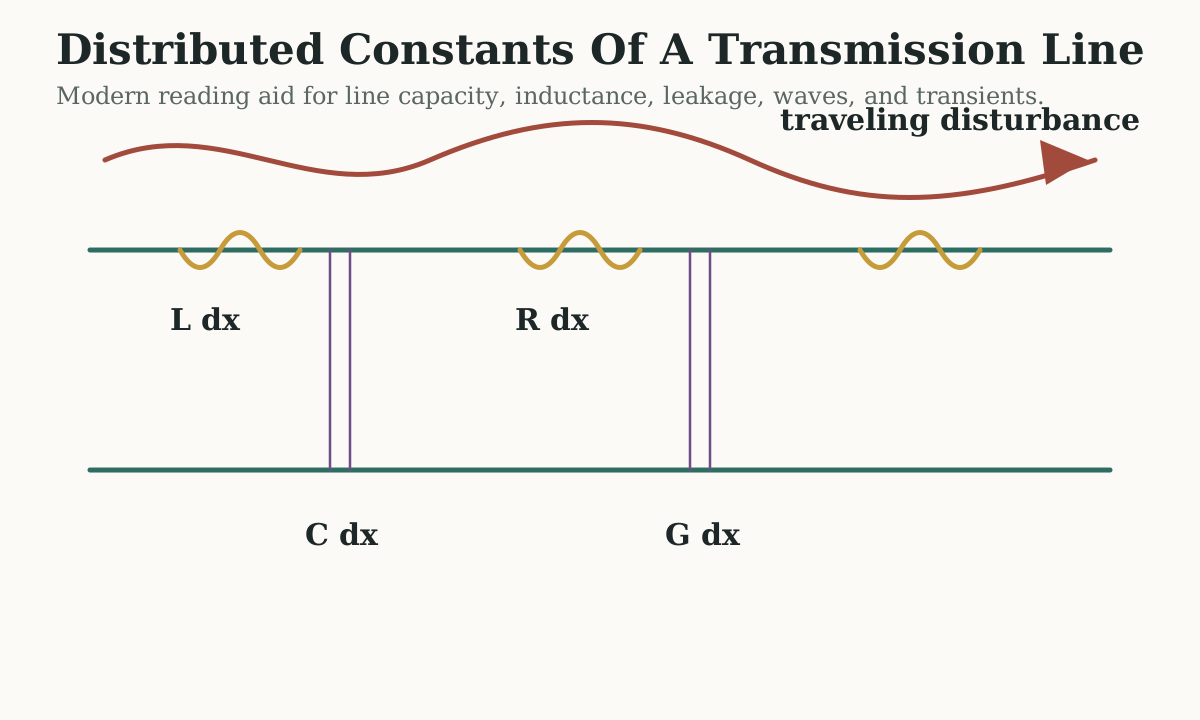
Section titled “Related Modern Guide Diagrams”Modern reading aid for line capacity, inductance, leakage, waves, and transients.
distributed-constants, capacity, inductance, waves
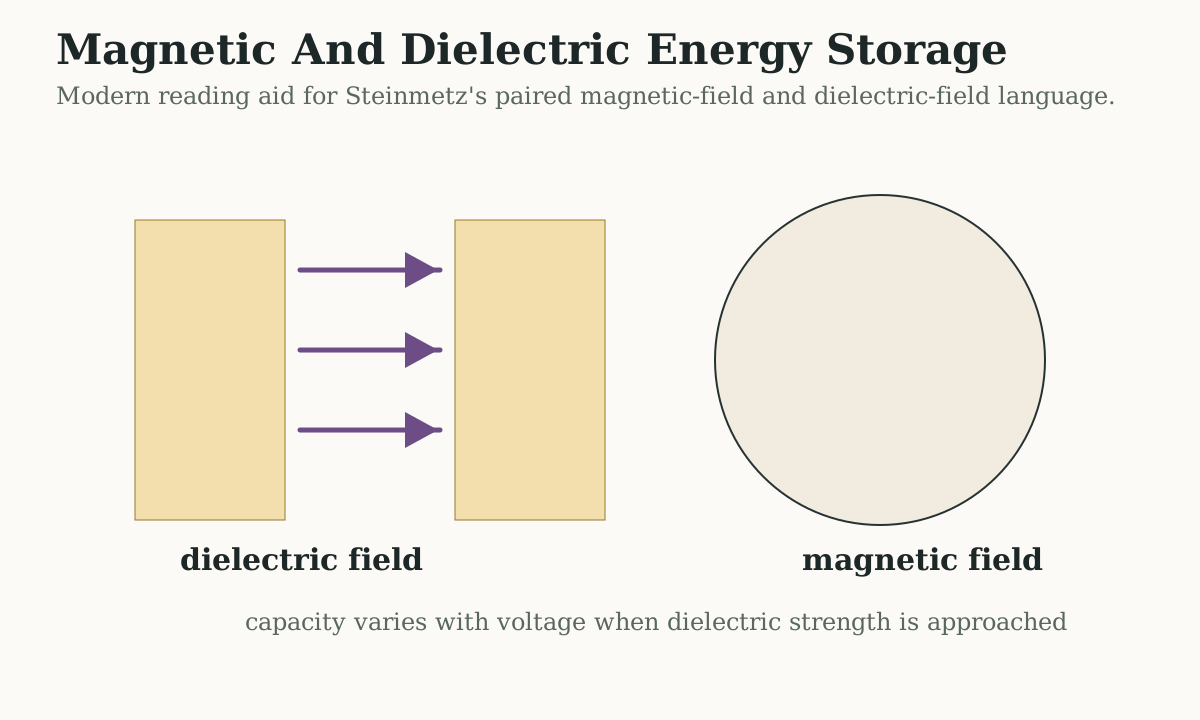
Modern reading aid for Steinmetz’s paired magnetic-field and dielectric-field language.
dielectric-field, magnetic-field, energy-storage
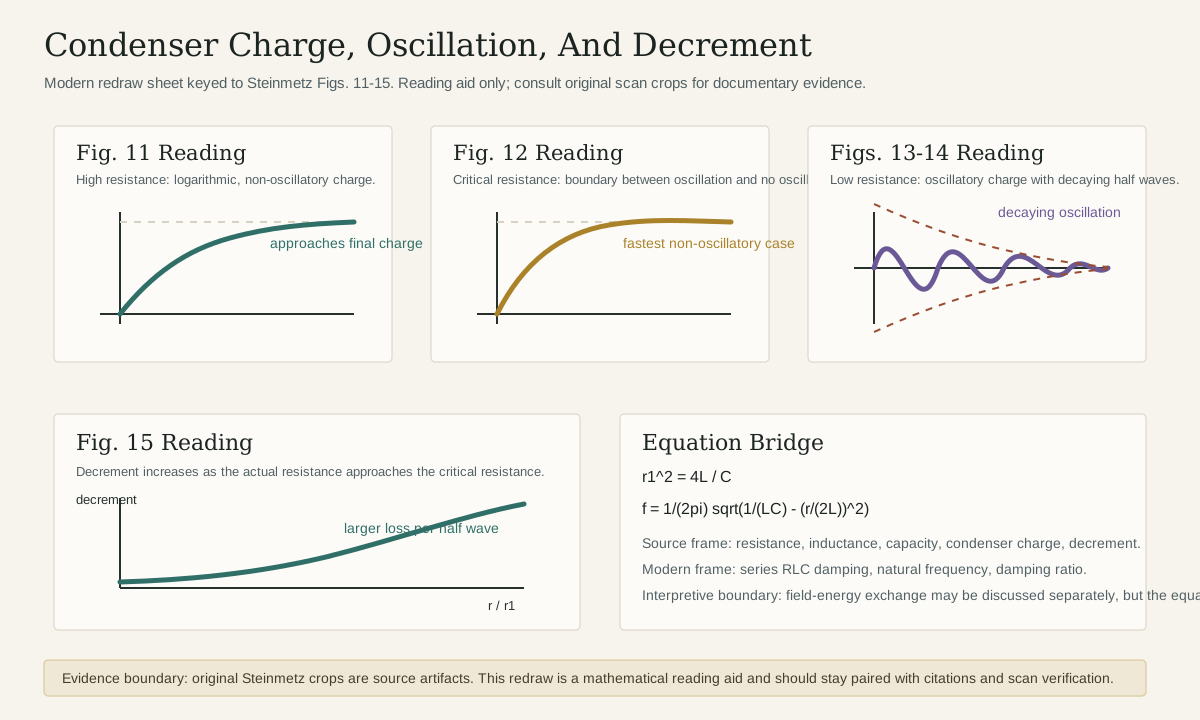
Modern redraw sheet for logarithmic charge, critical damping, oscillatory charge, and decrement.
transient-phenomena, oscillation-damping, capacity, condenser
Highest-Priority Formula Leads
Section titled “Highest-Priority Formula Leads”| Candidate | Family | OCR/PDF text | Routes |
|---|---|---|---|
theory-calculation-transient-electric-phenomena-oscillations-eq-candidate-0272strong-formula-candidate | transients-oscillation | At the moment 0 = 0, let the e.m.f. e = E cos (0 - 00) be | source research review |
electric-discharges-waves-impulses-1914-eq-candidate-0240strong-formula-candidate | transients-oscillation | e = 2;oCe-”’ sin (0 =F co - 7) j | source research review |
electric-discharges-waves-impulses-1914-eq-candidate-0293strong-formula-candidate | transients-oscillation | i = e~ ”’ J ai cos </) cos co + 6i sin cf) cos co + Ci cos 0 sin co | source research review |
elementary-lectures-electric-discharges-waves-impulses-eq-candidate-0195strong-formula-candidate | transients-oscillation | i = io cos (0 - 7) = io cos 7 cos <j> + i0 sin 7 sin | source research review |
theory-calculation-alternating-current-phenomena-1900-eq-candidate-0240strong-formula-candidate | symbolic-ac | is r - j (x -f x0} = r = .6, x + x0 = 0, and tan S>0 = 0 ; | source research review |
theory-calculation-transient-electric-phenomena-oscillations-eq-candidate-0276strong-formula-candidate | transients-oscillation | Since e = E cos (0 - 00) = impressed e.m.f., | source research review |
theory-calculation-transient-electric-phenomena-oscillations-eq-candidate-0296strong-formula-candidate | transients-oscillation | i = -z | cos (I? - 00- 0J- i~x° cos (00 + OJ j (9) | source research review |
theory-calculation-alternating-current-phenomena-1900-eq-candidate-0281strong-formula-candidate | inductance-capacity | Then, if E0 = impressed E.M.F.,- | source research review |
Highest-Priority Figure Leads
Section titled “Highest-Priority Figure Leads”| Candidate | Caption lead | Section | Routes |
|---|---|---|---|
theory-calculation-alternating-current-phenomena-1900-fig-018Fig. 18 | E0 = V(^ cos w + Ir)2 -f- (E sin w + Ix)z. Fig. 18. If, however, the current in the receiving circuit is leading, as -is the case when feeding condensers or syn- | Chapter 4: Graphic Representation | source research review |
theory-calculation-alternating-current-phenomena-1900-fig-020Fig. 20 | same E.M.F. and current ; or conversely, at a given primary Fig. 20. impressed E.M.F., E0, the secondary E.M.F., E^ will be smaller with an inductive, and larger with a condenser | Chapter 4: Graphic Representation | source research review |
theory-calculation-alternating-current-phenomena-1900-fig-038Fig. 38 | Er Er0 Fig. 38. and the current is, /= | Chapter 8: Circuits Containing Resistance, Inductance, And Capacity | source research review |
theory-calculation-alternating-current-phenomena-1900-fig-039Fig. 39 | E Fig. 39. Z-jx0 r—j(x + x0}‘ | Chapter 8: Circuits Containing Resistance, Inductance, And Capacity | source research review |
theory-calculation-alternating-current-phenomena-1900-fig-040Fig. 40 | of reactance in series in a non-inductive circuit is, for small Fig. 40. values of reactance, independent of the sign, but propor- | Chapter 8: Circuits Containing Resistance, Inductance, And Capacity | source research review |
theory-calculation-alternating-current-phenomena-1900-fig-041Fig. 41 | -t-CONDENSANCE Fig. 41. E0 = 100 volts, and the following conditions of receiver circuit •— z= 1 Qj r = 1>0> x= 0 (Curve j) | Chapter 8: Circuits Containing Resistance, Inductance, And Capacity | source research review |
theory-calculation-alternating-current-phenomena-1900-fig-042Fig. 42 | series reactance continues up to x0 = il.6, or, x0 = — %x, Fig. 42. where E = 100 volts again ; and for x0 > 1.6 the voltage drops again. | Chapter 8: Circuits Containing Resistance, Inductance, And Capacity | source research review |
theory-calculation-alternating-current-phenomena-1900-fig-043Fig. 43 | \ Fig. 43. Since a synchronous motor in the condition of efficient working acts as a condensance, we get the remarkable result | Chapter 8: Circuits Containing Resistance, Inductance, And Capacity | source research review |