Skip to content

Commonwealth Edison Generating System Trouble

Original Source Access

Investigation of Some Trouble in the Generating System of the Commonwealth Edison Co.

The local raw PDF is preserved for custody. The current text layer is extracted from the PDF and must be checked against page images before exact quotation or canonical equation promotion.

sources/commonwealth-edison-generating-system-trouble/raw/commonwealth-edison-generating-system-trouble-local.pdf

This source looks different from the major textbooks: it is practical engineering investigation. Steinmetz is not teaching from a clean classroom circuit. He is diagnosing a real, large generating system after operating trouble in 1919, with station sections, tie cables, short circuits, dropped synchronous machines, relay questions, reactors, and voltage collapse after faults.

That makes the report one of the archive’s strongest examples of Steinmetz’s engineering method: start with system symptoms, separate ordinary fault clearing from abnormal recovery failure, identify the role of reactance and synchronizing power, and then connect the recommendation to a mathematical appendix.

The archive now has raw-file custody, PDF checksum, embedded PDF text extraction, a page map, source-specific section splits, and candidate catalogs. This is still not a corrected transcription. Every exact wording claim and every appendix equation remains scan-verification work.

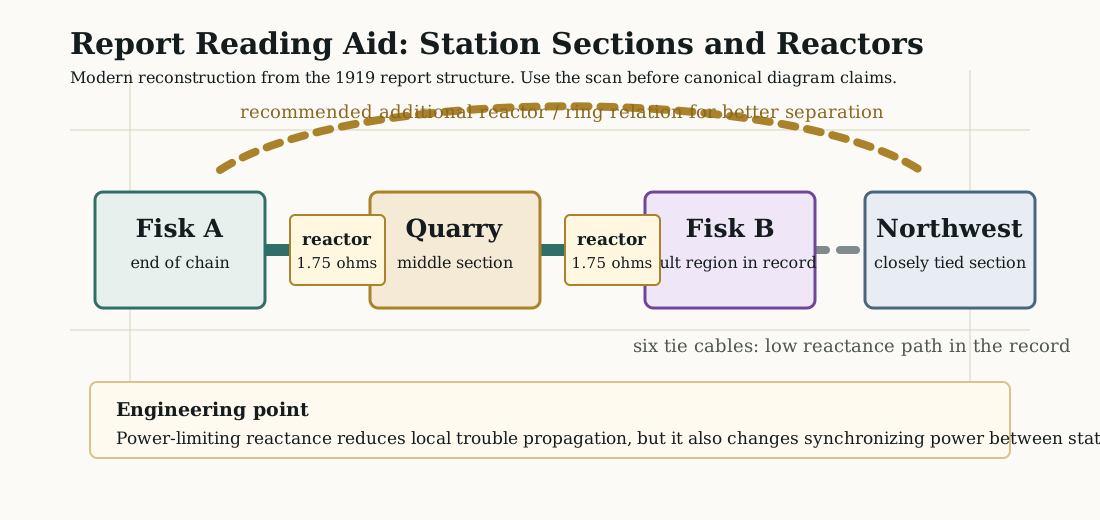
Modern reading aid for Commonwealth Edison station sections and power-limiting reactors
Station-section reading aid

A modern reconstruction of the report’s station chain and reactor logic. It is a guide to the source, not a substitute for the scan.

ArtifactCurrent CountUse
PDF pages68Page map for source custody and future scan review.
Report sections5Cover letter, recommendations, discussion, record, and mathematical appendix.
Equation candidates220Appendix formulas for phase displacement, frequency slip, synchronizing current, power, energy transfer, and critical slip.
Concept candidates12Power-limiting reactor, synchronism, synchronizing power, differential relay, tie cable, system model, hunting pulsation, and related terms.
Glossary candidates12Older practical power-system language tied to modern protection and stability vocabulary.
Figure candidates1Appendix Figure 1 reference for synchronous-operation curves.
  • Cover letter to Samuel Insull: Steinmetz explains the limits of the report, recommends reactor and substation studies, and proposes a reduced operating model of the system for disturbance experiments.
  • Recommendations: protection devices, relays, current transformers, breaker mechanisms, feeder reactances, differential relay possibilities, and station-section reactors.
  • Discussion of recommendations: the crucial distinction between the short circuit itself and the failure of the system to recover normal voltage after the fault cleared.
  • Record of four troubles: dated event records from May, September, and October 1919, including synchronous machines dropping out and station sections failing to pull back into step.
  • Appendix on synchronous operation: mathematical treatment of alternators or station sections connected out of phase or out of frequency, with candidate equations for synchronizing behavior.

Open the power-limiting reactor and synchronism analysis

Modern Electrical Engineering Interpretation

Modern readers can place this report at the intersection of fault-current limitation, relay coordination, transient stability, out-of-step operation, governor response, low-voltage recovery, and system segmentation. The report is especially valuable because Steinmetz treats protection and stability together rather than as unrelated specialties.

Ether-Field Interpretive Boundary

This source is not an ether source. Its main value is practical power-system diagnosis. Field-centered readers may still find a useful interpretive bridge in the way reactance, stored machine energy, phase relation, and synchronizing power govern the system response, but that reading must remain separate from what the report explicitly states.

  • Processed text: processed/commonwealth-edison-generating-system-trouble/cleaned_text/pdf-extracted-text.txt
  • Page map: processed/commonwealth-edison-generating-system-trouble/page_map.json
  • Section records: processed/commonwealth-edison-generating-system-trouble/chapters.json
  • Equation candidates: processed/commonwealth-edison-generating-system-trouble/equations.json
  • Concepts and glossary: processed/commonwealth-edison-generating-system-trouble/concepts.json, processed/commonwealth-edison-generating-system-trouble/glossary.json

Generated source dashboard: this section joins the source overview to the book coverage atlas, source text reader, chapter workbench, visual maps, and formula maps. Counts are candidate research aids until scan verification promotes them.

5

processed sections

17,784

candidate words

220

formula candidates

1

figure candidates

0

promoted crops

What This Source Currently Gives The Archive

Section titled “What This Source Currently Gives The Archive”

Investigation of Some Trouble in the Generating System of the Commonwealth Edison Co. currently contributes 5 processed sections and 17,784 candidate OCR/PDF-text words to the archive. Its strongest tracked evidence clusters are Impedance / reactance, Radiation / light, Ether references.

This is a routing judgment based on processed metadata, not a final historical claim. The strongest next move for any exact quotation, equation, or diagram is still to open the source scan and check the page image.
ThemeCandidate HitsEvidence Route
Impedance / reactance106Open theme evidence
Radiation / light62Open theme evidence
Ether references50Open theme evidence
Transients / damping27Open theme evidence
Field language23Open theme evidence
Dielectricity / capacity16Open theme evidence
Magnetism13Open theme evidence
Alternating current1Open theme evidence

Mathematical Appendix 5: Appendix: Synchronous Operation

PDF pages 27-68, lines 2165-5013 - 8,812 words

Signals

Impedance / reactance, Radiation / light, Transients / damping

Synchronism, Synchronizing power, Synchronous machines, Power limiting reactor
Candidate material

8 equations - 1 figures - 1 quotes

Report Section 3: Discussion of Recommendations

PDF pages 12-16, lines 721-1138 - 1,622 words

Signals

Radiation / light, Ether references, Field language

Synchronism, Short circuit, Synchronizing power, Synchronous machines
Candidate material

0 equations - 0 figures - 3 quotes

Report Section 2: Recommendations

PDF pages 7-12, lines 145-720 - 2,384 words

Signals

Ether references, Impedance / reactance, Radiation / light

Short circuit, Synchronism, Tie cable, Circuit breaker
Candidate material

0 equations - 0 figures - 0 quotes

Report Record 4: Record of Four Troubles

PDF pages 16-27, lines 1139-2164 - 4,341 words

Signals

Ether references, Impedance / reactance, Radiation / light

Synchronism, Synchronous machines, Short circuit, Synchronizing power
Candidate material

0 equations - 0 figures - 0 quotes

Front Matter 1: Cover Letter to Samuel Insull

PDF pages 1-7, lines 1-144 - 625 words

Signals

Ether references, Impedance / reactance

Tie cable, Power limiting reactor, Protective reactance
Candidate material

0 equations - 0 figures - 1 quotes

TermCandidate HitsUse
synchronizing power35Review in workbench before promoting to glossary.
power limiting reactor17Review in workbench before promoting to glossary.
tie cable13Review in workbench before promoting to glossary.
synchronous apparatus4Review in workbench before promoting to glossary.
power limiting reactance4Review in workbench before promoting to glossary.
critical slip4Review in workbench before promoting to glossary.
feeder reactance2Review in workbench before promoting to glossary.
protective reactance1Review in workbench before promoting to glossary.

Source custody

Verify title page, edition, page images, and OCR line boundaries before final quotation.

Mathematics

Use the formula map to locate equations, then correct OCR symbols and preserve Steinmetz notation before modern translation.

Interpretation boundary

Modern engineering and ether-field readings belong after source anchoring, with labels kept visible.