Power-Limiting Reactors
Steinmetz Usage
Section titled “Steinmetz Usage”In the Commonwealth Edison report, Steinmetz uses power-limiting reactors as system-architecture devices. Their purpose is to limit how much trouble in one station section can draw in or disturb another station section.
This is practical reactance. It is not only the X term of an impedance triangle. A reactor changes the path through which fault current, synchronizing current, and station-to-station power exchange can occur during disturbance.
Modern Equivalent
Section titled “Modern Equivalent”Modern engineering would call this a series reactor or fault-current-limiting reactor, usually discussed in protection coordination, short-circuit studies, bus sectionalizing, and transient-stability planning.
The key modern point is the same tradeoff Steinmetz sees: added reactance reduces fault-current concentration and disturbance propagation, but it also affects voltage drop, power transfer, and synchronizing power.
Mathematical Explanation
Section titled “Mathematical Explanation”For a simple interconnection, the current driven by a voltage difference is limited by impedance:
and for a mostly reactive path:
Increasing X reduces the current for a given voltage difference. In a synchronous-machine system, however, the same interconnection impedance also participates in the restoring exchange that tends to keep machines in step.
Why It Matters
Section titled “Why It Matters”Power-limiting reactors show why Steinmetz’s older electrical language should not be flattened into component definitions. Reactance here is part of disturbance containment, station separation, machine stability, and operating procedure.
Ether-Field Interpretive Reading
Interpretive only: a field-centered reading may describe the reactor as adding magnetic field inertia or opposition to sudden current concentration. That vocabulary can be useful as a reading aid, but the source itself frames the device as a power-system engineering remedy, not as an ether-theory proof.
Related Pages
Section titled “Related Pages”- Commonwealth Edison Power-Limiting Reactors and Synchronism
- Reactance
- Synchronizing Power
- Transient Phenomena
Reader Synthesis
Section titled “Reader Synthesis”What Steinmetz Is Doing Here
The processed corpus gives this concept a source trail across Steinmetz’s books and lectures. Read the source distribution first, because the meaning often changes between radiation, AC calculation, apparatus, and transients.
The current strongest source route is Investigation of Some Trouble in the Generating System of the Commonwealth Edison Co., with 21 candidate hits across 4 sections.
Modern Translation
Translate the older wording into modern electrical-engineering language only after the source location is visible.
This page currently tracks 70 candidate occurrences across 7 sources and 15 sections.
Mathematical And Visual Route
Use the linked equation atlas and source formula maps to decide whether this concept has a mathematical layer, a diagrammatic layer, or mainly a terminology layer.
Use the math/visual bridge lower on this page to jump into formula families, source visual maps, and candidate figure leads.
Interpretive Boundary
Interpretive readings are welcome in this archive only when they are labeled and separated from Steinmetz’s explicit wording.
Layer labels stay active: source claim, modern equivalent, mathematical reconstruction, historical note, and interpretive reading are not interchangeable.
Best Steinmetz Passages To Read First
Section titled “Best Steinmetz Passages To Read First”| Passage | Hits | Location | Open |
|---|---|---|---|
| Chapter 6: Oscillating Currents, Theory and Calculation of Transient Electric Phenomena and Oscillations | 12 | lines 5312-6797 | read - research review |
| Apparatus Section 9: Alternating-current Transformer: Reactors Theoretical Elements of Electrical Engineering | 10 | lines 18813-18948 | read - research review |
| Chapter 16: Load Balance Of Polyphase Systems Theory and Calculation of Electric Circuits | 10 | lines 29302-30428 | read - research review |
| Mathematical Appendix 5: Appendix: Synchronous Operation Investigation of Some Trouble in the Generating System of the Commonwealth Edison Co. | 9 | PDF pages 27-68, lines 2165-5013 | read - research review |
Research Position
Section titled “Research Position”- Tracked vocabulary: Power-Limiting Reactor, Protective reactance.
- Concordance: Power-Limiting Reactor - Protective reactance.
- Source discipline: the table above is for reading and navigation; exact quotation still requires scan verification.
- Reader route: read the passage first, then return here for modern translation, mathematical reconstruction, visual routes, and interpretation boundaries.
- Editorial rule: expand this page by promoting scan-checked passages, equations, and diagrams from the linked workbench pages, not by adding unsourced generalizations.
Source-Grounded Dossier
Section titled “Source-Grounded Dossier”Generated evidence layer: this dossier is built from the processed concept concordance. Counts and snippets are OCR/PDF-text aids, not final quotations. Verify against scans before making exact claims.
Candidate occurrences tracked for this page.
Sources with at least one hit.
Sections, lectures, chapters, or report divisions to review.
What The Current Corpus Shows
Section titled “What The Current Corpus Shows”Read this concept as a practical power-system stability and protection page. The theory matters because Steinmetz is dealing with station behavior, synchronism, short-circuit current, and recovery.
The strongest current source concentration is Investigation of Some Trouble in the Generating System of the Commonwealth Edison Co. with 21 candidate hits across 4 sections.
The dossier is meant to turn a concept page into a reading path: begin with Steinmetz’s source wording, then use the research links only when you need candidate counts, snippets, mathematical reconstruction, historical context, or interpretive layers.
Terms And Aliases Tracked
Section titled “Terms And Aliases Tracked”Power limiting reactor, current limiting reactor, power limiting reactor, power-limiting reactor, power-limiting-reactor, reactor, Protective reactance, protective-reactance
Concordance Records
Section titled “Concordance Records”Power-Limiting Reactor - Protective reactance
Source Distribution
Section titled “Source Distribution”Priority Passages To Read
Section titled “Priority Passages To Read”Chapter 6: Oscillating Currents, - 12 candidate hits
Source: Theory and Calculation of Transient Electric Phenomena and Oscillations (1909)
Location: lines 5312-6797 - Tracked concepts: Power-Limiting Reactor
... t means that reactors, condensers, and resistors are rated in kilowatts or kilo volt-amperes, just as other electrical appa- ratus, and this rating characterizes their size within the limits of design, while a statement like "a condenser of 10 mf. " or "a reactor of 100 mh." no more characterizes the size than a Statement like "an alternator of 100 am...... ce equals the condensive reactance. The same current is in both at the same terminal voltage. That means that the volt-amperes consumed by the inductance equal the volt-amperes consumed by the capacity. The kilovolt-amperes of a condenser as well as of a reactor are proportional to the frequency. With increasing frequency, at constant voltage impresse...Apparatus Section 9: Alternating-current Transformer: Reactors - 10 candidate hits
Source: Theoretical Elements of Electrical Engineering (1915)
Location: lines 18813-18948 - Tracked concepts: Power-Limiting Reactor
IX. Reactors (Reactive Coils, Reactances) 129. The reactor consists of one electric circuit interlinked with a magnetic circuit, and its purpose is, not to transform power, but to produce wattless or reactive power, that is, lagging current, or what amounts to the same, leading vo ...... purpose is, not to transform power, but to produce wattless or reactive power, that is, lagging current, or what amounts to the same, leading voltage. While therefore theoretically we cannot speak of an ''efficiency" of a reactor, since there is no power output, nevertheless in the in- dustry the expression " efficiency of a reactive coil" is gener- a...Chapter 16: Load Balance Of Polyphase Systems - 10 candidate hits
Source: Theory and Calculation of Electric Circuits (1917)
Location: lines 29302-30428 - Tracked concepts: Power-Limiting Reactor
... sformation. Thus mechanical momentum acts as energy-storing device in the use as phase bal- ancer, of the induction or the synchronous machine. Electrically, energy is stored by inductance and by capacity. The question then arises, whether by the use of a reactor, or a condenser, con- nected to a suitable phase of the system, an unequally loaded polyp...... single-phase alternator reduces the pulsation of the field flux, but also increases the momentary short-circuit stresses. Thus, it is of interest to study the question of balancing unbal- anced polyphase circuits by stationary energy-storing devices, as reactor or condenser. 164. Let a voltage, e = E cos <l> (1) be impressed upon a non-inductive load,...Mathematical Appendix 5: Appendix: Synchronous Operation - 9 candidate hits
Source: Investigation of Some Trouble in the Generating System of the Commonwealth Edison Co. (1919)
Location: PDF pages 27-68, lines 2165-5013 - Tracked concepts: Power-Limiting Reactor
... ism with each other. If then the load distribution between the alternators differs from the distribution of their driving power, electric power is transferred over the impedance z, current flows and a phase displacement 2co occurs between the two sides of the reactor z. In this case, the phase angle w is constant, and not periodically fluctuating as i...... d to keep in synchronism with each other. Coming now to the consideration of the relation between Fisk Street B and Quarry Street Station, during the trouble of September 18th, 1919: (6.) Four 12,000KW alternators in Fisk Street B, out of synch- ronism over a power limiting reactor with three 14,000 KW alter- nators in Quarry Street, the latter in syn...Report Record 4: Record of Four Troubles - 6 candidate hits
Source: Investigation of Some Trouble in the Generating System of the Commonwealth Edison Co. (1919)
Location: PDF pages 16-27, lines 1139-2164 - Tracked concepts: Power-Limiting Reactor
... rs in Fisk B and in Northwest Station did not pull into step with each other, but remained out of synchronism; the voltage at the busbars of these two stations remained practically zero, and an excessive current fed into Fisk B from Quarry Street, heating the power limiting reactor B. f ) After 7 minutes, the tie line between Fisk Street B and Quarry...... voltage at the busbars of these two stations remained practically zero, and an excessive current fed into Fisk B from Quarry Street, heating the power limiting reactor B. f ) After 7 minutes, the tie line between Fisk Street B and Quarry Street, that is, the power limiting reactor B, was opened, and Quarry Street and Fisk A, came back to normal. About...Chapter 15: Constant-Voltage Series Operation - 6 candidate hits
Source: Theory and Calculation of Electric Circuits (1917)
Location: lines 27996-29301 - Tracked concepts: Power-Limiting Reactor
... rcuit. n = number of consuming devices (lamps) in series. p = fraction of burned-out lamps. g a= conductance of lamp. (15) 302 ELECTRIC CIRCUITS and let 6 1 = shunted susceptance with the lamp in circuit, that is, exciting susceptance of reactor or auto- transformer, and y = \/g^ + bi^ = admittance of complete consuming device. 62 = shunted susceptanc...... e of reactor or auto- transformer, and y = \/g^ + bi^ = admittance of complete consuming device. 62 = shunted susceptance with the lamp burned out and let c = - = exciting current as fraction of load ^ current: c < 1. a = ^- = saturation factor of reactor or - auto transformer: o > 1. (16) (17) it is, then: voltage of lamp and reactor: voltage of reac...Reading Layers To Build Out
Section titled “Reading Layers To Build Out”| Layer | What to add next |
|---|---|
| Steinmetz wording | Pull exact source passages only after scan verification; keep OCR text labeled until then. |
| Modern engineering reading | Translate the source usage into present electrical-engineering or physics language without erasing the older vocabulary. |
| Mathematical layer | Link equations, variables, diagrams, and worked examples when the concept has formula candidates. |
| Historical layer | Identify whether the term is still used, renamed, absorbed into modern theory, or historically obsolete. |
| Ether-field interpretation | Keep interpretive readings separate from Steinmetz’s explicit claim and from modern physics. |
| Open questions | Record places where the concordance suggests a lead but the scan or edition has not yet been checked. |
Next Editorial Actions
Section titled “Next Editorial Actions”- Open the highest-priority source-text passages above and verify the wording against scans.
- Promote exact definitions, equations, diagrams, and hidden-gem passages into this page with source references.
- Add related concept links, equation pages, and diagram pages once the evidence is scan checked.
- Keep speculative or Wheeler-style readings in explicitly labeled interpretation blocks.
Math And Visual Evidence Map
Section titled “Math And Visual Evidence Map”Generated bridge: this section crosslinks the concept page with the formula atlas, figure atlas, source visual maps, and source formula maps. It is a routing layer, not final interpretation.
Formula candidates routed to this concept.
Figure candidates routed to this concept.
Modern guide diagrams related to this concept.
Formula Families To Review
Section titled “Formula Families To Review”Apparatus, Machines, And Power Systems - Impedance, Reactance, And Admittance - Power, Energy, Work, And Efficiency
Source Maps For This Concept
Section titled “Source Maps For This Concept”commonwealth-edison-generating-system-trouble visuals - commonwealth-edison-generating-system-trouble formulas - theory-calculation-electric-circuits visuals - theory-calculation-electric-circuits formulas - theory-calculation-transient-electric-phenomena-oscillations visuals - theory-calculation-transient-electric-phenomena-oscillations formulas - theoretical-elements-electrical-engineering visuals - theoretical-elements-electrical-engineering formulas - engineering-mathematics visuals - engineering-mathematics formulas - theory-calculation-alternating-current-phenomena visuals - theory-calculation-alternating-current-phenomena formulas
Related Modern Guide Diagrams
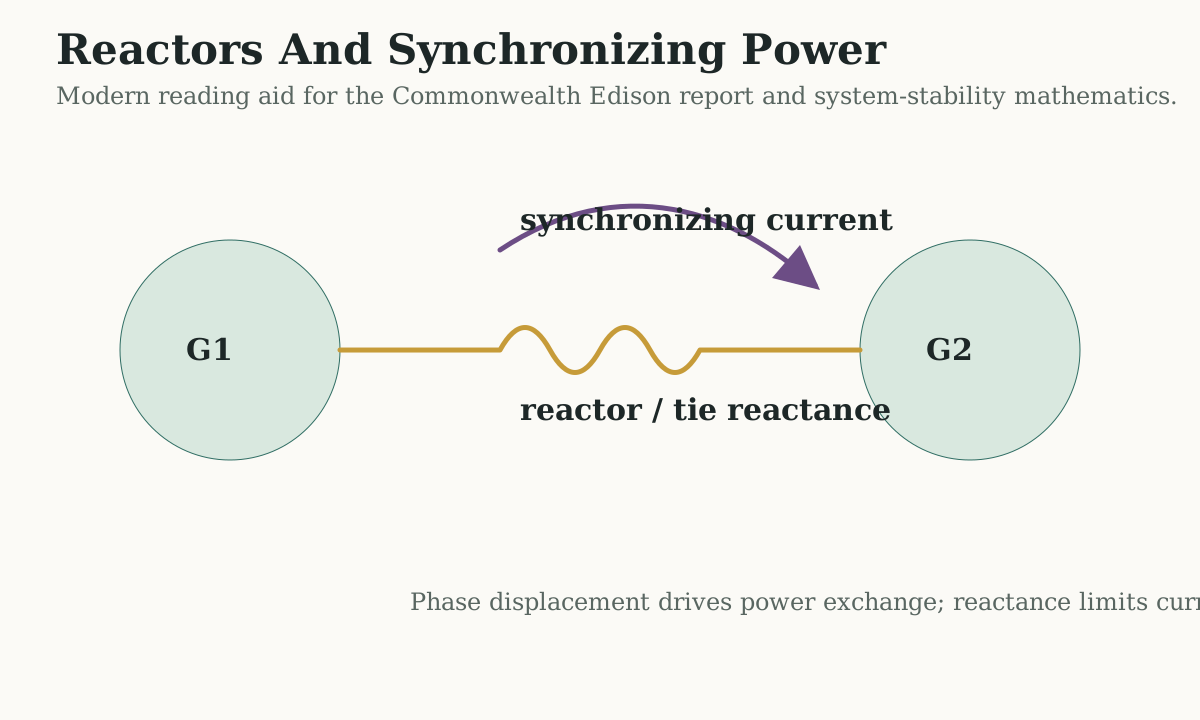
Section titled “Related Modern Guide Diagrams”Modern reading aid for the Commonwealth Edison report and system-stability mathematics.
synchronizing-power, power-limiting-reactors, reactance
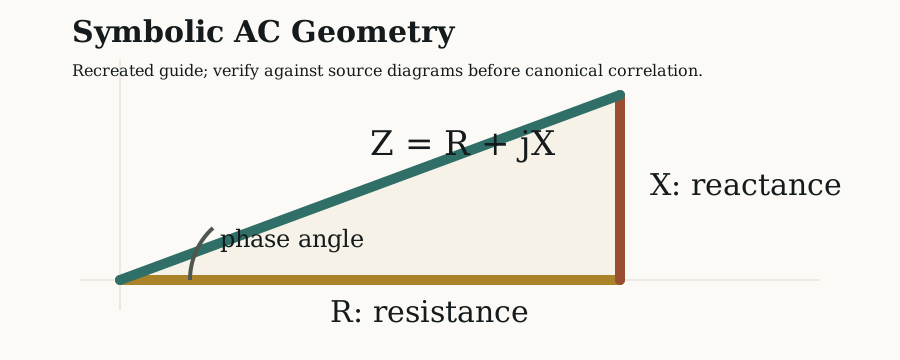
Modern guide for resistance, reactance, impedance, phase angle, and symbolic quantities.
impedance, reactance, power-factor, symbolic-method
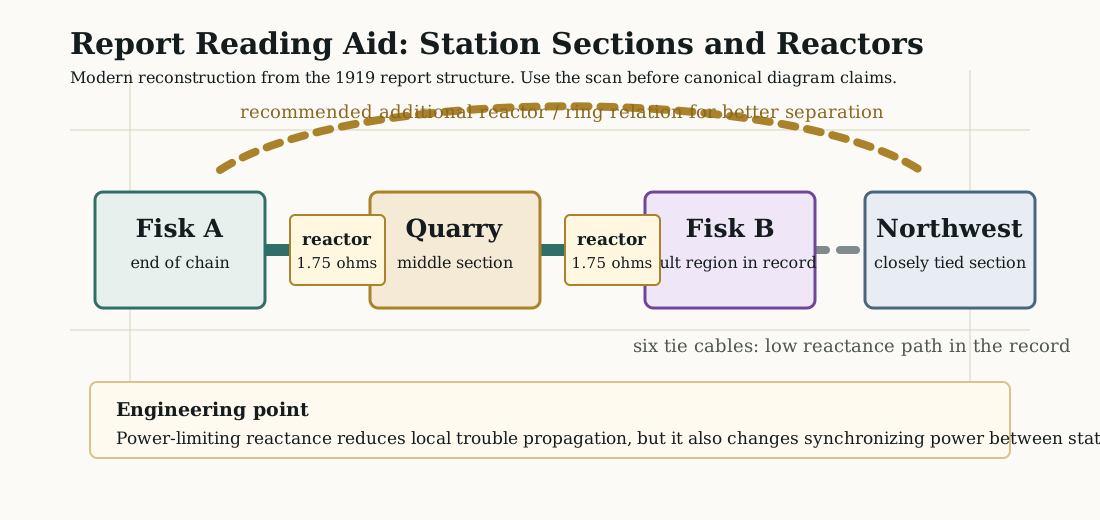
Modern reading aid for station sections, power-limiting reactors, tie cables, and synchronism.
power-limiting-reactors, synchronizing-power, reactance, power-systems
Highest-Priority Formula Leads
Section titled “Highest-Priority Formula Leads”| Candidate | Family | OCR/PDF text | Routes |
|---|---|---|---|
theory-calculation-alternating-current-phenomena-eq-candidate-0294strong-formula-candidate | symbolic-ac | is r - j {x + Xo) = r = 0.6, x -{- Xo = 0, and tan do = 0; that | source research review |
commonwealth-edison-generating-system-trouble-eq-candidate-0007strong-formula-candidate | apparatus-systems | ei = E cos (0 | source research review |
commonwealth-edison-generating-system-trouble-eq-candidate-0024strong-formula-candidate | apparatus-systems | p’Y=-!|cos(2a>-a) | source research review |
commonwealth-edison-generating-system-trouble-eq-candidate-0027strong-formula-candidate | apparatus-systems | P=- sin a sin 2co | source research review |
commonwealth-edison-generating-system-trouble-eq-impedance-angle-0004strong-formula-candidate | apparatus-systems | z = sqrt(r^2 + x^2); tan a = x / r, OCR candidate | source research review |
commonwealth-edison-generating-system-trouble-eq-interchange-current-0003strong-formula-candidate | apparatus-systems | i = (2E / z) sin(…) sin(…), OCR candidate | source research review |
commonwealth-edison-generating-system-trouble-eq-resultant-voltage-0002strong-formula-candidate | apparatus-systems | e = e1 - e2 = 2E sin(…) sin(…), OCR candidate | source research review |
commonwealth-edison-generating-system-trouble-eq-sync-emfs-0001strong-formula-candidate | apparatus-systems | e1 = E cos(…); e2 = E cos(…), OCR candidate | source research review |
Highest-Priority Figure Leads
Section titled “Highest-Priority Figure Leads”| Candidate | Caption lead | Section | Routes |
|---|---|---|---|
theory-calculation-alternating-current-phenomena-fig-051Fig. 51 | Eo E Fig. 51. M | Chapter 9: Circuits Containing Resistance, Inductive Reactance, And Condensive Reactance | source research review |
theoretical-elements-electrical-engineering-fig-161Fig. 161 | the coils, it follows that in Fig. 162 the leakage flux interlinked with each turn of each winding, and thus the reactance of the transformer, is materially less than one-quarter of what it is in Fig. 161. The regulat… | Apparatus Section 4: Alternating-current Transformer: Regulation | source research review |
theory-calculation-electric-circuits-fig-107Fig. 107 | ^i-1.9 00 - 60°; ^0=7.6. Fig. 107. and the magnetic distribution in the transformer, during the moments marked as a, 6, c, d, e, /, g, in Fig. 107, is shown in | Chapter 12: Reactance Of Induction Apparatus | source research review |
theory-calculation-electric-circuits-fig-105Fig. 105 | and the magnetic distribution in the transformer, during the moments marked as a, 6, c, d, e, /, g, in Fig. 107, is shown in Fig. 105. In Fig. 105a, the primary flux is larger than the secondary, and all leakage fluxe… | Chapter 12: Reactance Of Induction Apparatus | source research review |
theory-calculation-electric-circuits-fig-109Fig. 109 | the primary coil equals its resistance drop, eo = roi, then the Fig. 109. voltage across the secondary coil, s, gives the total reactance, x^, for s as primary, | Chapter 12: Reactance Of Induction Apparatus | source research review |
theory-calculation-electric-circuits-fig-115Fig. 115 | / Fig. 115. give the best regulation; series inductive reactance with an in- ductive, and series condensive reactance with leading current in | Chapter 14: Constant-Potential Constant-Current Trans Formation | source research review |
theory-calculation-electric-circuits-fig-123Fig. 123 | 8INQLE-PHA8E Fig. 123. Different arrangements can also be used of the constant-current control, for instance, the inductive and condensive reactances in | Chapter 14: Constant-Potential Constant-Current Trans Formation | source research review |
theory-calculation-electric-circuits-fig-127Fig. 127 | That is, the regulation is improved, by the line and leakage reactance, from g = 4 per cent, to 5 = 1.5 per cent, as seen in Fig. 127. 163. In paragraph 161 and the preceding, the shunted react- ances, 61 and 62, have… | Chapter 15: Constant-Voltage Series Operation | source research review |