Conductance
Steinmetz Usage
Section titled “Steinmetz Usage”Conductance is the active component of admittance. It belongs to the part of current in phase with voltage and therefore to real power consumption.
In the dielectric-loss chapter, Steinmetz also uses conductance for leakage and effective dielectric losses.
Modern Equivalent
Section titled “Modern Equivalent”For a simple resistor:
But in a general AC circuit:
so conductance is the real component of the reciprocal of the whole impedance.
Why It Matters
Section titled “Why It Matters”Conductance is not just a flipped resistance. In Steinmetz’s AC language it is the mathematical home of real-power effects when using the admittance view, especially parallel circuits and dielectric paths.
Interpretive Boundary
Source fact: conductance is tied to power or energy components. Interpretive reading: field-centered researchers may see conductance as the measurable channel by which field processes become real power loss. That broader reading should remain labeled.
Related Pages
Section titled “Related Pages”Reader Synthesis
Section titled “Reader Synthesis”What Steinmetz Is Doing Here
The processed corpus gives this concept a source trail across Steinmetz’s books and lectures. Read the source distribution first, because the meaning often changes between radiation, AC calculation, apparatus, and transients.
The current strongest source route is Theory and Calculation of Alternating Current Phenomena, with 86 candidate hits across 10 sections.
Modern Translation
Translate the older wording into modern electrical-engineering language only after the source location is visible.
This page currently tracks 321 candidate occurrences across 11 sources and 60 sections.
Mathematical And Visual Route
Use the linked equation atlas and source formula maps to decide whether this concept has a mathematical layer, a diagrammatic layer, or mainly a terminology layer.
Use the math/visual bridge lower on this page to jump into formula families, source visual maps, and candidate figure leads.
Interpretive Boundary
Interpretive readings are welcome in this archive only when they are labeled and separated from Steinmetz’s explicit wording.
Layer labels stay active: source claim, modern equivalent, mathematical reconstruction, historical note, and interpretive reading are not interchangeable.
Best Steinmetz Passages To Read First
Section titled “Best Steinmetz Passages To Read First”| Passage | Hits | Location | Open |
|---|---|---|---|
| Chapter 8: Admittance, Conductance, Susceptance Theory and Calculation of Alternating Current Phenomena | 26 | lines 4088-4673 | read - research review |
| Chapter 7: Admittance, Conductance, Susceftance Theory and Calculation of Alternating Current Phenomena | 23 | lines 3546-3871 | read - research review |
| Chapter 7: Admittance, Conductance, Susceptance Theory and Calculation of Alternating Current Phenomena | 23 | lines 3132-3576 | read - research review |
| Chapter 10: Effective Resistance And Reactance Theory and Calculation of Alternating Current Phenomena | 19 | lines 6957-8383 | read - research review |
Research Position
Section titled “Research Position”- Tracked vocabulary: Conductance.
- Concordance: Conductance.
- Source discipline: the table above is for reading and navigation; exact quotation still requires scan verification.
- Reader route: read the passage first, then return here for modern translation, mathematical reconstruction, visual routes, and interpretation boundaries.
- Editorial rule: expand this page by promoting scan-checked passages, equations, and diagrams from the linked workbench pages, not by adding unsourced generalizations.
Source-Grounded Dossier
Section titled “Source-Grounded Dossier”Generated evidence layer: this dossier is built from the processed concept concordance. Counts and snippets are OCR/PDF-text aids, not final quotations. Verify against scans before making exact claims.
Candidate occurrences tracked for this page.
Sources with at least one hit.
Sections, lectures, chapters, or report divisions to review.
What The Current Corpus Shows
Section titled “What The Current Corpus Shows”Read this concept page through the linked source passages first. Use the dossier to locate Steinmetz’s wording, then add modern, mathematical, historical, and interpretive layers only with labels.
The strongest current source concentration is Theory and Calculation of Alternating Current Phenomena with 86 candidate hits across 10 sections.
The dossier is meant to turn a concept page into a reading path: begin with Steinmetz’s source wording, then use the research links only when you need candidate counts, snippets, mathematical reconstruction, historical context, or interpretive layers.
Terms And Aliases Tracked
Section titled “Terms And Aliases Tracked”conductance, conductances
Concordance Records
Section titled “Concordance Records”Source Distribution
Section titled “Source Distribution”Priority Passages To Read
Section titled “Priority Passages To Read”Chapter 8: Admittance, Conductance, Susceptance - 26 candidate hits
Source: Theory and Calculation of Alternating Current Phenomena (1916)
Location: lines 4088-4673 - Tracked concepts: Conductance
CHAPTER VIII ADMITTANCE, CONDUCTANCE, SUSCEPTANCE 48. If in a continuous-current circuit, a number of resistances, Ti, r2, ?'3, . . ., are connected in series, their joint resistance, R, is the sum of the individual resistances, K = ri + r2 + ra + . . . If, however, a number of resistances ...... ir joint resistance, R, cannot be expressed in a simple form, but is represented by the expression 1 R = Ti n rz Hence, in the latter case it is preferable to introduce, instead of the term resistance, its reciprocal, or inverse value, the term conductance, g = ~- If, then, a number of conductances, 9iy Qij ds, • ' ' are connected in parallel, their j...Chapter 7: Admittance, Conductance, Susceftance - 23 candidate hits
Source: Theory and Calculation of Alternating Current Phenomena (1897)
Location: lines 3546-3871 - Tracked concepts: Conductance
CHAPTER VII. ADMITTANCE, CONDUCTANCE, SUSCEFTANCE. 38. If in a continuous-current circuit, a number of resistances, rj, rj, rg, . . . are connected in series, their joint resistance, Ry is the sum of the individual resistances ^ = ^1 + ^2 + 'a + • • • If, however, a number of resistance ...... , their joint resistance, R^ cannot be expressed in a simple form, but is represented by the expression : - rx n r^ Hence, in the latter case it is preferable to introduce, in- stead of the term resistance^ its reciprocal, or inverse value, the term conductance^ g =\ J r. If, then, a number of con- ductances, gxy g%i g^y . . . are connected in paralle...Chapter 7: Admittance, Conductance, Susceptance - 23 candidate hits
Source: Theory and Calculation of Alternating Current Phenomena (1900)
Location: lines 3132-3576 - Tracked concepts: Conductance
CHAPTER VII. ADMITTANCE, CONDUCTANCE, SUSCEPTANCE. 38. If in a continuous-current circuit, a number of resistances, ?\, r%, r3, . . . are connected in series, their joint resistance, R, is the sum of the individual resistances If, however, a number of resistances are connected in multiple ...... ce, R, cannot be expressed in a simple form, but is represented by the expression : - = J_ _l_ JL + J_ + /*! /*2 ^3 Hence, in the latter case it is preferable to introduce, in- stead of the term resistance, its reciprocal, or inverse value, the term conductance, g = 1 / r. If, then, a number of con- ductances, g^, g^, gz, . . . are connected in parall...Chapter 10: Effective Resistance And Reactance - 19 candidate hits
Source: Theory and Calculation of Alternating Current Phenomena (1900)
Location: lines 6957-8383 - Tracked concepts: Conductance
... of E.M.F. Total current It is called the effective resistance of the circuit, since it represents the effect, or power, expended by the circuit. The energy coefficient of current, a._ Energy component of current Total E.M.F. is called the effective conductance of the circuit. EFFECTIVE RESISTANCE AND REACTANCE. 105 In the same way, the value, _ Wattle...... he true ohmic resistance in such way as to represent a larger expenditure of energy. In dealing with alternating-current circuits, it is necessary, therefore, to substitute everywhere the values "effective re- sistance," "effective reactance," "effective conductance," and " effective susceptance," to make the calculation appli- cable to general altern...Chapter 10: Resistance And Reactance Of Transmission - 17 candidate hits
Source: Theory and Calculation of Alternating Current Phenomena (1916)
Location: lines 6993-9766 - Tracked concepts: Conductance
... ge due to a line of given resistance and reactance depends upon the phase difference in the receiver circuit, and can be varied and controlled by varying this phase difference; that is, by varying the admittance, Y = g - jh, of the receiver circuit. The conductance, g, of the receiver circuit depends upon the consumption of power - that is, upon the l...... shunt- ing the circuit with a reactance, and will be increased by a shunted inductive reactance, and decreased by a shunted con- densive reactance. Hence, for the purpose of investigation, the receiver circuit can be assumed to consist of two branches, a conductance, g, - the non-inductive part of the circuit - shunted by a susceptance, h, which can b...Chapter 9: Kbsistanci: And Kbactance Of Transmission Iine8 - 17 candidate hits
Source: Theory and Calculation of Alternating Current Phenomena (1897)
Location: lines 6371-8268 - Tracked concepts: Conductance
... due to a line of given re- sistance and inductance depends upon the phase difference in the receiver circuit, and can be varied and controlled by varying this phase difference; that is, by varying the admittance, Y = g + Jb, of the receiver circuit. The conductance, g, of the receiver circuit depends upon the consumption of power, - that is, upon the...... a reactance, and will be increased by a shunted inductance, and decreased by a shunted con- densance. Hence, for the purpose of investigation, the 84 AL TERN A TIXG-CURRENT PHENOMENA, [§ 68 receiver circuit can be assumed to consist of two branches, a conductance, g^ - the non-inductive part of the circuit, - shunted by a susceptance, by which can be...Reading Layers To Build Out
Section titled “Reading Layers To Build Out”| Layer | What to add next |
|---|---|
| Steinmetz wording | Pull exact source passages only after scan verification; keep OCR text labeled until then. |
| Modern engineering reading | Translate the source usage into present electrical-engineering or physics language without erasing the older vocabulary. |
| Mathematical layer | Link equations, variables, diagrams, and worked examples when the concept has formula candidates. |
| Historical layer | Identify whether the term is still used, renamed, absorbed into modern theory, or historically obsolete. |
| Ether-field interpretation | Keep interpretive readings separate from Steinmetz’s explicit claim and from modern physics. |
| Open questions | Record places where the concordance suggests a lead but the scan or edition has not yet been checked. |
Next Editorial Actions
Section titled “Next Editorial Actions”- Open the highest-priority source-text passages above and verify the wording against scans.
- Promote exact definitions, equations, diagrams, and hidden-gem passages into this page with source references.
- Add related concept links, equation pages, and diagram pages once the evidence is scan checked.
- Keep speculative or Wheeler-style readings in explicitly labeled interpretation blocks.
Math And Visual Evidence Map
Section titled “Math And Visual Evidence Map”Generated bridge: this section crosslinks the concept page with the formula atlas, figure atlas, source visual maps, and source formula maps. It is a routing layer, not final interpretation.
Formula candidates routed to this concept.
Figure candidates routed to this concept.
Modern guide diagrams related to this concept.
Formula Families To Review
Section titled “Formula Families To Review”Impedance, Reactance, And Admittance
Source Maps For This Concept
Section titled “Source Maps For This Concept”theory-calculation-alternating-current-phenomena visuals - theory-calculation-alternating-current-phenomena formulas - theory-calculation-alternating-current-phenomena-1900 visuals - theory-calculation-alternating-current-phenomena-1900 formulas - theory-calculation-alternating-current-phenomena-1897 visuals - theory-calculation-alternating-current-phenomena-1897 formulas - theory-calculation-transient-electric-phenomena-oscillations visuals - theory-calculation-transient-electric-phenomena-oscillations formulas - theory-calculation-electric-circuits visuals - theory-calculation-electric-circuits formulas - elementary-lectures-electric-discharges-waves-impulses visuals - elementary-lectures-electric-discharges-waves-impulses formulas
Related Modern Guide Diagrams
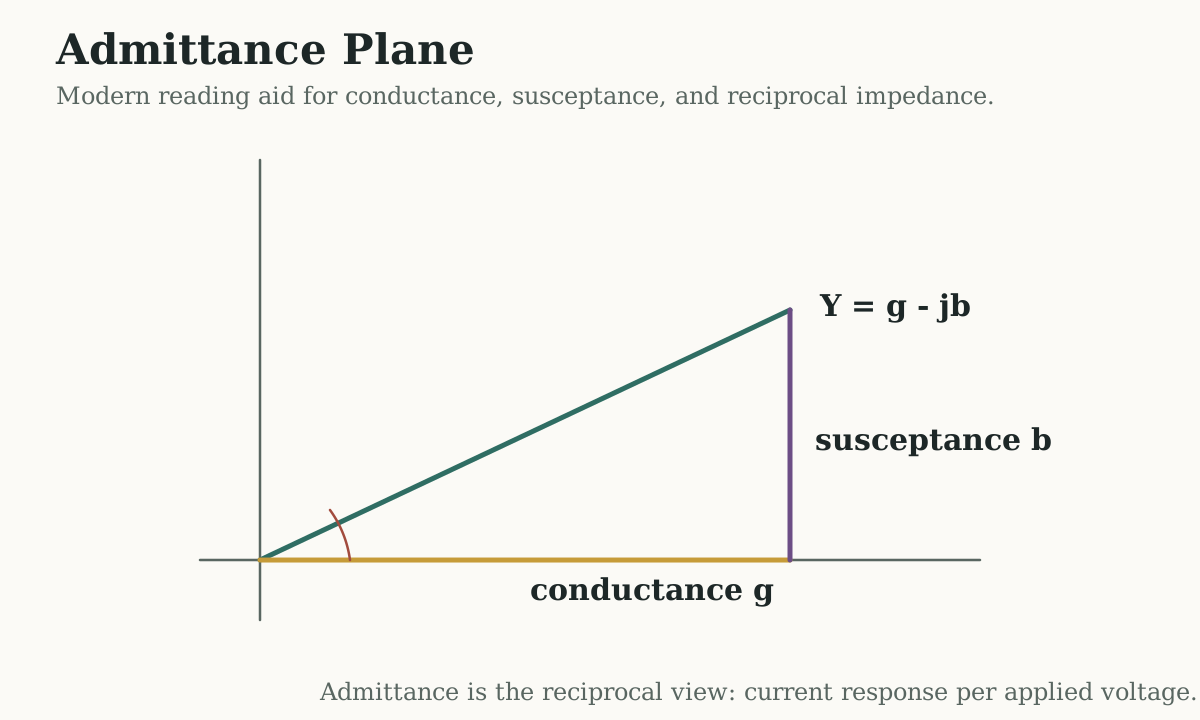
Section titled “Related Modern Guide Diagrams”Modern reading aid for conductance, susceptance, and reciprocal impedance.
admittance, conductance, susceptance, symbolic-method
Highest-Priority Formula Leads
Section titled “Highest-Priority Formula Leads”| Candidate | Family | OCR/PDF text | Routes |
|---|---|---|---|
theory-calculation-electric-apparatus-eq-candidate-0229strong-formula-candidate | symbolic-ac | Primary exciting admittance: Ya = 0.02 - 0.6 j. | source research review |
theory-calculation-alternating-current-phenomena-1900-eq-candidate-0164strong-formula-candidate | impedance-admittance | the term conductance, g = 1 / r. If, then, a number of con- | source research review |
theory-calculation-alternating-current-phenomena-1900-eq-candidate-0170strong-formula-candidate | impedance-admittance | 1.) If r = QO , or x = oo , since in this case no current | source research review |
theory-calculation-alternating-current-phenomena-1900-eq-candidate-0173strong-formula-candidate | impedance-admittance | 2.) If r = 0, since in this case the current which passes | source research review |
theory-calculation-alternating-current-phenomena-1900-eq-candidate-0174strong-formula-candidate | impedance-admittance | 1.) If x = oo , or r = oo . | source research review |
theory-calculation-alternating-current-phenomena-1900-eq-candidate-0181strong-formula-candidate | impedance-admittance | a maximum for r = x, where g - 1 / 2 r is equal to the | source research review |
theory-calculation-alternating-current-phenomena-eq-candidate-0224strong-formula-candidate | impedance-admittance | 1. If r = oo^ or a: = co ^ since in this case there is no current, | source research review |
theory-calculation-alternating-current-phenomena-eq-candidate-0274strong-formula-candidate | impedance-admittance | (d) If X = 0, that is, if the receiver circuit is non-inductive, | source research review |
Highest-Priority Figure Leads
Section titled “Highest-Priority Figure Leads”| Candidate | Caption lead | Section | Routes |
|---|---|---|---|
theory-calculation-alternating-current-phenomena-fig-049Fig. 49 | 7 1.8 Fig. 49. The sign in the complex expression of admittance is always opposite to that of impedance; this is obvious, since if the cur- | Chapter 8: Admittance, Conductance, Susceptance | source research review |
theory-calculation-alternating-current-phenomena-1900-fig-108Fig. 108 | 211 Fig. 108. admittance Y0) the exciting current, the other branches of the impedances ZJ + Z7, ZJ1 + Zn, … 2f + Zx, the latter | Chapter 14: The Alternating-Current Transformer | source research review |
theory-calculation-alternating-current-phenomena-fig-117Fig. 117 | of admittance Yq. Thus, double transformation will be represented by diagram. Fig. 117. With this the discussion of the alternate-current transformer ends, by becoming identical with that of a divided circuit con- | Chapter 17: The Alternating-Current Transformer | source research review |
theory-calculation-alternating-current-phenomena-fig-144Fig. 144 | nal admittance of the second machine. Fig. 144. Then, er + e’r = al^• | Chapter 23: Synchronizing Alternators | source research review |