Symbolic Operator j
Original Form To Preserve
Section titled “Original Form To Preserve”Steinmetz Meaning
Section titled “Steinmetz Meaning”Steinmetz does not introduce j as abstract algebra alone. It appears as the operator that carries a sine-wave quantity into quadrature. Multiplication by j is the symbolic form of a quarter-period displacement.
In other words, j is a bridge between a diagram and an equation. The vector drawing shows a perpendicular component; the algebraic operator lets that perpendicular relation participate in calculation.
Modern Equivalent
Section titled “Modern Equivalent”Modern electrical engineering keeps j for the imaginary unit because i is usually current:
What is easy to lose is the physical meaning: in AC phasors, j is a 90 degree rotation.
Step-By-Step Translation
Section titled “Step-By-Step Translation”Start with a rectangular complex quantity:
Multiplying by j gives:
Because j^2 = -1:
The pair (a, b) has rotated into (-b, a). This is the algebraic form of the quarter-period rotation shown in Steinmetz’s symbolic-method figure.
Source Figure
Section titled “Source Figure”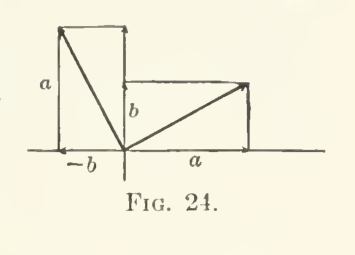
Conceptual Reading
The imaginary unit is a compact way to keep two facts together: magnitude and phase. Without it, AC calculation either becomes diagram-heavy or loses the physical phase relation.
Interpretive Boundary
The j operator should not be turned into an ontology claim by itself. It is a mathematical operator that represents quadrature. Field-based interpretation may discuss what the quadrature relation means physically in magnetic and dielectric storage, but Steinmetz’s explicit claim here is mathematical and geometric.
Research Routes
Section titled “Research Routes”j and its engineering notation role.Open AC symbolic visualsUse the visual route for phasors, rectangular components, quarter-period rotation, and impedance geometry.Open symbolic AC formulasReview the source-routed formula family for complex quantities and symbolic calculation.Related Pages
Section titled “Related Pages”Verification Needs
Section titled “Verification Needs”- Transcribe the surrounding definition from the scan, not only the displayed equations.
- Compare Fig. 24’s caption and diagram labels against the promoted crop manifest.
- Check whether earlier AC editions explain
jwith the same wording or a different pedagogical order.