Harmonics And Wave Shape
Steinmetz Usage
Section titled “Steinmetz Usage”Steinmetz does not treat every alternating-current wave as a perfect sine wave. The seeded AC source includes higher harmonics, wave-shape distortion, effective values, transformer behavior, and hysteretic loss under distorted waves.
This matters because a distorted wave can have the same nominal frequency but different peak value, RMS value, heating effect, transformer flux behavior, and core loss.
Modern Equivalent
Section titled “Modern Equivalent”Modern readers would connect this to Fourier series, harmonic distortion, RMS measurement, crest factor, transformer core loss, machine heating, and power-quality analysis.
Interactive Translation
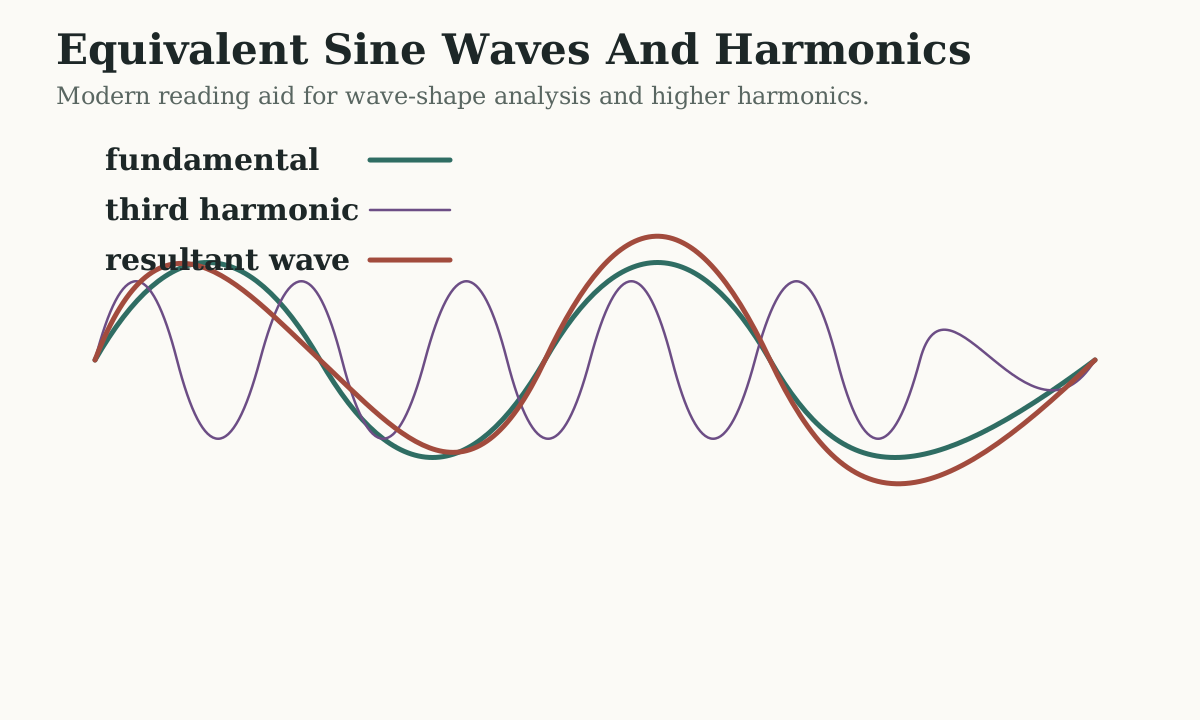
Section titled “Interactive Translation”The AC Waveform and Harmonics tool lets readers vary third and fifth harmonic content and watch the resultant wave, RMS value, peak value, crest factor, and approximate distortion.
Why It Matters
Section titled “Why It Matters”Wave shape is a hidden bridge between mathematics and apparatus. In a simplified sine-wave course, harmonics may feel like an afterthought. In Steinmetz’s practical engineering world, wave shape can change losses, stresses, and machine behavior.
Modern Electrical Engineering Interpretation
This is the route from ideal AC theory into power quality, transformer derating, harmonic heating, and nonlinear magnetic behavior. The archive should use Steinmetz’s wave-shape passages to keep that practical layer visible.
Interpretive Reading
Interpretive only: field-centered readers may treat waveform structure as evidence that electrical action is temporal and modal rather than merely scalar. The source-grounded claim is that Steinmetz analyzes practical alternating waves by their shape and harmonic components.
Still To Verify
Section titled “Still To Verify”- Exact chapter and page anchors for Steinmetz’s higher-harmonics discussion.
- Which figures should be extracted for distorted waves and machine/transformer effects.
- How Steinmetz relates nonsinusoidal waves to hysteresis and transformer loss in each edition.
Reader Synthesis
Section titled “Reader Synthesis”What Steinmetz Is Doing Here
The processed corpus gives this concept a source trail across Steinmetz’s books and lectures. Read the source distribution first, because the meaning often changes between radiation, AC calculation, apparatus, and transients.
The current strongest source route is Theory and Calculation of Electric Apparatus, with 758 candidate hits across 41 sections.
Modern Translation
Translate the older wording into modern electrical-engineering language only after the source location is visible.
This page currently tracks 4634 candidate occurrences across 15 sources and 317 sections.
Mathematical And Visual Route
Use the linked equation atlas and source formula maps to decide whether this concept has a mathematical layer, a diagrammatic layer, or mainly a terminology layer.
Use the math/visual bridge lower on this page to jump into formula families, source visual maps, and candidate figure leads.
Interpretive Boundary
Interpretive readings are welcome in this archive only when they are labeled and separated from Steinmetz’s explicit wording.
Layer labels stay active: source claim, modern equivalent, mathematical reconstruction, historical note, and interpretive reading are not interchangeable.
Best Steinmetz Passages To Read First
Section titled “Best Steinmetz Passages To Read First”| Passage | Hits | Location | Open |
|---|---|---|---|
| Chapter 12: Frequency Converter Or General Alternating Current Transformer Theory and Calculation of Electric Apparatus | 244 | lines 14897-17124 | read - research review |
| Lecture 17: Arc Lighting General Lectures on Electrical Engineering | 118 | lines 9920-12795 | read - research review |
| Lecture 1: Nature And Different Forms Of Radiation Radiation, Light and Illumination | 101 | lines 608-1548 | read - research review |
| Chapter 16: Induction Motor Theory and Calculation of Alternating Current Phenomena | 84 | lines 13649-16361 | read - research review |
Research Position
Section titled “Research Position”- Tracked vocabulary: Frequency, Alternating Current, Wave Length.
- Concordance: Frequency - Alternating Current - Wave Length.
- Source discipline: the table above is for reading and navigation; exact quotation still requires scan verification.
- Reader route: read the passage first, then return here for modern translation, mathematical reconstruction, visual routes, and interpretation boundaries.
- Editorial rule: expand this page by promoting scan-checked passages, equations, and diagrams from the linked workbench pages, not by adding unsourced generalizations.
Source-Grounded Dossier
Section titled “Source-Grounded Dossier”Generated evidence layer: this dossier is built from the processed concept concordance. Counts and snippets are OCR/PDF-text aids, not final quotations. Verify against scans before making exact claims.
Candidate occurrences tracked for this page.
Sources with at least one hit.
Sections, lectures, chapters, or report divisions to review.
What The Current Corpus Shows
Section titled “What The Current Corpus Shows”Read this concept page through the linked source passages first. Use the dossier to locate Steinmetz’s wording, then add modern, mathematical, historical, and interpretive layers only with labels.
The strongest current source concentration is Theory and Calculation of Electric Apparatus with 758 candidate hits across 41 sections.
The dossier is meant to turn a concept page into a reading path: begin with Steinmetz’s source wording, then use the research links only when you need candidate counts, snippets, mathematical reconstruction, historical context, or interpretive layers.
Terms And Aliases Tracked
Section titled “Terms And Aliases Tracked”Frequency, cycles per second, frequencies, frequency, periodicity, a.c., alternating current, alternating currents, alternating-current, Wave length, wave length, wave lengths, wave-length, wave-lengths, wavelength
Concordance Records
Section titled “Concordance Records”Frequency - Alternating Current - Wave Length
Source Distribution
Section titled “Source Distribution”Priority Passages To Read
Section titled “Priority Passages To Read”Chapter 12: Frequency Converter Or General Alternating Current Transformer - 244 candidate hits
Source: Theory and Calculation of Electric Apparatus (1917)
Location: lines 14897-17124 - Tracked concepts: Alternating Current, Frequency
CHAPTER XII FREQUENCY CONVERTER OR GENERAL ALTERNATING- CURRENT TRANSFORMER 103. In general, an alternating-current transformer conafete of a magnetic circuit, interlinked with two electric circuits or sets of electric circuits, the primary circuit, in which power, sup- plie ...... sist* of a magnetic circuit interlinked with two sets of electric circuits, the primary and the secondary, which are mounted rotatably with regards to each other. It transforms between primary electrical and secondary electrical power, and also between FREQUENCY CONVERTER 177 electrical and mechanical power. As the frequency of the re- volving seconda...Lecture 17: Arc Lighting - 118 candidate hits
Source: General Lectures on Electrical Engineering (1908)
Location: lines 9920-12795 - Tracked concepts: Alternating Current, Frequency, Wave Length
... body to a 230 GENERAL LECTURES high temperature. Then the heat energy is converted into radi- ation and issues from the heated body, as for instance an incan- descent lamp filament, as a mass of radiations of different wave lengths, that is, different frequencies. All kinds of frequencies appear : from very low frequencies, that is only a few millions...... ECTURES high temperature. Then the heat energy is converted into radi- ation and issues from the heated body, as for instance an incan- descent lamp filament, as a mass of radiations of different wave lengths, that is, different frequencies. All kinds of frequencies appear : from very low frequencies, that is only a few millions of millions of cycles...Lecture 1: Nature And Different Forms Of Radiation - 101 candidate hits
Source: Radiation, Light and Illumination (1909)
Location: lines 608-1548 - Tracked concepts: Alternating Current, Frequency, Wave Length
... from each other by a fractional wave length is called iridescence. Iridescent colors, for instance, are those of mother-of-pearl, of opal, of many butterflies, etc. Light, therefore, is a wave motion. NATURE AND DIFFERENT FORMS OF RADIATION. 1 The frequency of radiation follows from the velocity of light, and the wave length. The average wave length o...... of radiation follows from the velocity of light, and the wave length. The average wave length of visible radiation, or light, is about lw = 60 microcentimeters,* that is, 60 X 10~8 cm. (or about ^<y^<5-<y in.) and since the speed is S = 3 X 1010 cm. the frequency a is / = r- = 500 X 1012, or 500 millions of millions of cycles per LW second, that is, i...Chapter 16: Induction Motor - 84 candidate hits
Source: Theory and Calculation of Alternating Current Phenomena (1900)
Location: lines 13649-16361 - Tracked concepts: Alternating Current, Frequency
... circuits in inductive relation to primary circuits and vice versa, in spite of their relative motion. The result of the relative motion between primary and secondary is, that the E.M.Fs. induced in the secondary or the motor armature are not of the same frequency as the E.M.Fs. impressed upon the primary, but of a frequency which is the difference bet...... ersa, in spite of their relative motion. The result of the relative motion between primary and secondary is, that the E.M.Fs. induced in the secondary or the motor armature are not of the same frequency as the E.M.Fs. impressed upon the primary, but of a frequency which is the difference between the impressed frequency 238 ALTERNATING-CURRENT PHENOMEN...Chapter 4: Induction Motor With Secondary Excitation - 81 candidate hits
Source: Theory and Calculation of Electric Apparatus (1917)
Location: lines 5555-8554 - Tracked concepts: Alternating Current, Frequency
... which receives electric power and converts it into mechanical power, and the primary or stator of the induc- tion machine thus corresponds to the armature of the synchro- nous or commutating machine. In the secondary or rotor of the induction machine, low-frequency currents - of the frequency of slip - are induced by the primary, but the magnetic fiel...... r and converts it into mechanical power, and the primary or stator of the induc- tion machine thus corresponds to the armature of the synchro- nous or commutating machine. In the secondary or rotor of the induction machine, low-frequency currents - of the frequency of slip - are induced by the primary, but the magnetic field flux is produced by the ex...Chapter 15: The General Alternating-Current Transformer Or Frequency Converter - 68 candidate hits
Source: Theory and Calculation of Alternating Current Phenomena (1900)
Location: lines 12683-13648 - Tracked concepts: Alternating Current, Frequency
CHAPTER XV. THE GENERAL ALTERNATING-CURRENT TRANSFORMER OR FREQUENCY CONVERTER. 141. The simplest alternating-current apparatus is the alternating-current transformer. It consists of a magnetic- circuit, interlinked with two electric circuits or sets of electric circuits. The one, the primary circuit, is excited by an im ...... rrent and large self-induction; that is, comparatively large primary exciting susceptance and large reactance. The general alternating-current transformer transforms between electrical and mechanical power, and changes not only E.M.Fs. and currents, but frequencies also, and may therefore be called a "frequency converter." Obviously, it also may chang...Reading Layers To Build Out
Section titled “Reading Layers To Build Out”| Layer | What to add next |
|---|---|
| Steinmetz wording | Pull exact source passages only after scan verification; keep OCR text labeled until then. |
| Modern engineering reading | Translate the source usage into present electrical-engineering or physics language without erasing the older vocabulary. |
| Mathematical layer | Link equations, variables, diagrams, and worked examples when the concept has formula candidates. |
| Historical layer | Identify whether the term is still used, renamed, absorbed into modern theory, or historically obsolete. |
| Ether-field interpretation | Keep interpretive readings separate from Steinmetz’s explicit claim and from modern physics. |
| Open questions | Record places where the concordance suggests a lead but the scan or edition has not yet been checked. |
Next Editorial Actions
Section titled “Next Editorial Actions”- Open the highest-priority source-text passages above and verify the wording against scans.
- Promote exact definitions, equations, diagrams, and hidden-gem passages into this page with source references.
- Add related concept links, equation pages, and diagram pages once the evidence is scan checked.
- Keep speculative or Wheeler-style readings in explicitly labeled interpretation blocks.
Math And Visual Evidence Map
Section titled “Math And Visual Evidence Map”Generated bridge: this section crosslinks the concept page with the formula atlas, figure atlas, source visual maps, and source formula maps. It is a routing layer, not final interpretation.
Formula candidates routed to this concept.
Figure candidates routed to this concept.
Modern guide diagrams related to this concept.
Formula Families To Review
Section titled “Formula Families To Review”Engineering Mathematics Foundations - Symbolic AC And Complex Quantities - Waves, Lines, Radiation, And Frequency
Source Maps For This Concept
Section titled “Source Maps For This Concept”theory-calculation-electric-apparatus visuals - theory-calculation-electric-apparatus formulas - theory-calculation-transient-electric-phenomena-oscillations visuals - theory-calculation-transient-electric-phenomena-oscillations formulas - theory-calculation-alternating-current-phenomena-1900 visuals - theory-calculation-alternating-current-phenomena-1900 formulas - theory-calculation-alternating-current-phenomena visuals - theory-calculation-alternating-current-phenomena formulas - theoretical-elements-electrical-engineering visuals - theoretical-elements-electrical-engineering formulas - general-lectures-electrical-engineering visuals - general-lectures-electrical-engineering formulas
Related Modern Guide Diagrams
Section titled “Related Modern Guide Diagrams”Modern reading aid for wave-shape analysis and higher harmonics.
harmonics, wave-shape, fourier-analysis
Highest-Priority Formula Leads
Section titled “Highest-Priority Formula Leads”| Candidate | Family | OCR/PDF text | Routes |
|---|---|---|---|
engineering-mathematics-eq-candidate-0273strong-formula-candidate | engineering-math | Let A = a(cos a+j sin a) be divided by J5 = 6(cos ,5+y sin /5), | source research review |
engineering-mathematics-eq-candidate-0286strong-formula-candidate | engineering-math | If, A=ai +ja2 = a (cos a+j sin a), then | source research review |
engineering-mathematics-eq-candidate-0150strong-formula-candidate | engineering-math | and ai + ja2 = a (cos 6 + j sin d) ; | source research review |
theoretical-elements-electrical-engineering-eq-candidate-0102strong-formula-candidate | symbolic-ac | e = 2 7r/n$ sin r the instantaneous generated e.m.f. | source research review |
theory-calculation-alternating-current-phenomena-1900-eq-candidate-0240strong-formula-candidate | symbolic-ac | is r - j (x -f x0} = r = .6, x + x0 = 0, and tan S>0 = 0 ; | source research review |
theory-calculation-alternating-current-phenomena-eq-candidate-0167strong-formula-candidate | symbolic-ac | B = 6’ + jh” = 6(cos 13 + j sin /3) | source research review |
theory-calculation-alternating-current-phenomena-eq-candidate-0294strong-formula-candidate | symbolic-ac | is r - j {x + Xo) = r = 0.6, x -{- Xo = 0, and tan do = 0; that | source research review |
theory-calculation-electric-apparatus-eq-candidate-0028strong-formula-candidate | symbolic-ac | = - J = (tan a - j) (7) | source research review |
Highest-Priority Figure Leads
Section titled “Highest-Priority Figure Leads”| Candidate | Caption lead | Section | Routes |
|---|---|---|---|
theory-calculation-alternating-current-phenomena-fig-006Fig. 6 | maximum variation of the sine is equal to the variation of the Fig. 6. Fig. 7. | Chapter 2: Instantaneous Values And Integral Values | source research review |
theory-calculation-alternating-current-phenomena-1900-fig-011Fig. 11 | nates by a vector, which by its length, OC, denotes the in- Fig. 11. tensity, and by its amplitude, AOC, the phase, of the sine | Chapter 4: Graphic Representation | source research review |
theory-calculation-alternating-current-phenomena-1900-fig-022Fig. 22 | the graphical representation. Fig. 22. 25. We have seen that the alternating sine wave is represented in intensity, as well as phase, by a vector, Of, | Chapter 5: Symbolic Method | source research review |
theory-calculation-alternating-current-phenomena-fig-087Fig. 87 | / = FREQUENCY Fig. 87. 400 | Chapter 12: Effective Resistance And Reactance | source research review |
theory-calculation-electric-apparatus-fig-058Fig. 58 | which represents the current distribution per phase through the air gap of the induction machine, shown by the diagrams F of Fig. 58. The corresponding flux distribution, $, in Fig. 58, expressed by a trignometric ser… | Chapter 7: Higher Harmonics In Induction Motors | source research review |
theory-calculation-alternating-current-phenomena-1900-fig-113Fig. 113 | ) Fig. 113. Substituting these values in tne above equation gives | Chapter 15: The General Alternating-Current Transformer Or Frequency Converter | source research review |
theory-calculation-transient-electric-phenomena-oscillations-fig-099Fig. 99 | given for ^ = 0, where tt = t] for any other point of the line X the wave shape is the same, but all the ordinates reduced by the factor £~115* in the proportion as shown in the dotted curve in Fig. 99. Fig. 101 shows… | Chapter 4: Traveling Waves | source research review |
theory-calculation-alternating-current-phenomena-fig-179Fig. 179 | 1 Fig. 179. flux and the current, therefore, cannot both be sine waves; if the magnetic flux and therefore the generated e.m.f. are sine waves, | Chapter 25: Distortion Of Wave-Shape And Its Causes | source research review |